Best overall

- Deposit
- Varies (25% is common)
- Local moves
- Limited
- Long-distance moves
- Yes
- BBB rating
- A+
How ConsumerAffairs uses cookies
This website utilizes technologies such as cookies to enable essential site functionality, as well as for analytics, personalization, and targeted advertising. To learn more, view the following link:





Texas is one of the hardest states to move within — not just because of its size, but because summer temperatures can destroy electronics and warp furniture inside a non-climate-controlled truck. International Van Lines tops our list of the best moving companies in Texas for its strong local reviews and premium packing options that protect your belongings from the heat.
Even an in-state move can turn into a multiday haul across hundreds of miles. Knowing what to look for in a mover — especially one that offers climate-controlled transport — can make the difference between your belongings arriving intact or not.
International Van Lines has specialized heat protection protocols and solid local feedback, making it a dependable choice for Texas relocations where extreme temperatures are a real risk.
Jump to insightTexas moves average around $3,495 when you factor in both local and long-haul quotes, but costs can swing significantly depending on distance and services.
Jump to insightPrioritize movers that explicitly offer climate-controlled storage or transport. Without it your valuables can crack, melt or warp under the intense Texas sun.
Jump to insightTo help you find the best options, we compared moving companies available in Texas. Then we analyzed ratings and reviews on ConsumerAffairs from Texas customers.
To make our picks, we also considered pricing, the quote and deposit processes, and the availability of packing services and storage options. Read our full methodology below for all the details. Our picks may be Authorized Partners that compensate us — this does not affect our recommendations or evaluations.
| Company | Customer rating | Our pick for | Carrier vs. broker | Local moves | Long-distance moves | BBB rating | |
|---|---|---|---|---|---|---|---|
 International Van Lines | Get a Quote | 4.6
1,498 reviews
1,498 reviews
| Best overall | Broker and carrier hybrid |  | | A+ |
 PODS | Learn More | 4.5
5,828 reviews
5,828 reviews
| Value | Container company | | | A+ |
 Roadway Moving | Learn More | 4.9
391 reviews
391 reviews
| Customer service | Carrier | | | A+ |
 Condor Moving Systems | Learn More | 1.6
101 reviews
101 reviews
| Moving crews | Carrier | | | A+ |
Learn more about our top picks for the best moving companies, based on verified reviews on ConsumerAffairs from Texas customers.


The ConsumerAffairs Research Team evaluated moving companies available in Texas using a structured scoring model. We start with reputable movers, then rank them based on how they actually perform across the state. This way, moving companies with strong national reputations and great features are still judged primarily on their actual performance in your state.
We gather customer feedback from across the entire state to rank companies fairly based on what people across Texas say about the company. The more reviews a company has within Texas, the more confident we are in its ranking.
We also want to make sure we are recommending active, proven movers in your area. If a state has a strong presence of well-reviewed movers (meaning multiple companies have plenty of recent, local reviews), we apply a scoring penalty to companies that lack sufficient local feedback. This ensures that companies with strong local track records rank higher than those that rely solely on a national reputation.
We look at how the company performs nationally based on customer satisfaction and responsiveness. We analyze national and local customer reviews for:
We evaluate what the company provides, including pricing, service options and the digital experience. We research the features and services each company offers, including:
Companies earned a 0 to 10 score for every metric:
This standardized system lets us compare statewide satisfaction data, national track records and additional features on the same scale.
Award categories apply different weightings depending on what the designation highlights. For example, the "Best value" superlative weights pricing factors more heavily, while "Best moving crews" gives more weight to reviews that mention the quality and professionalism of the movers.
The company with the highest weighted score in each category earned the corresponding “Our pick for” designation. If a company ranked first in multiple categories, we awarded the designation to the next-highest scoring company in that category to highlight a broader group of top performers.

Jump into our guides and start learning
Texas moves are no joke — the state's sheer scale can turn a local relocation into a multiday haul, and triple-digit heat can silently destroy electronics and fine art left in an unventilated trailer. Climate-controlled transport isn't a luxury here; it's a necessity for protecting what matters.
Choosing the right mover in Texas starts with knowing exactly what you need. Then vet at least three licensed companies by comparing written estimates and checking independent reviews for warning signs like hidden fees or a pattern of damage claims.
Picking a mover accounts for your biggest relocation-related expense, so taking the time to research thoroughly is worth it. Here's how to evaluate movers and find the right fit for your Texas move:
Start by assessing what type of moving company you need to hire. Are you staying within Texas or crossing state lines? Do you need a full-service crew to handle packing and loading, or is basic transportation all you're after?
Getting clear on your move type helps narrow down which companies can actually serve you — and which ones can give you a reliable quote. Full-service movers cost more but take care of packing, loading, transport and unloading. Labor-only or self-service options are cheaper but put more of the work on you.
Start by asking people you trust for recommendations. Check online reviews on ConsumerAffairs and other independent platforms to get a real picture of what customers experience. The most common complaints we see about movers include:
Damage to belongings during transit: Customers report broken furniture, scratched surfaces and damaged personal items, often paired with slow or contentious claims processes. Some companies dispute damage or offer compensation that doesn't come close to covering the loss.
That frustration shows up in stories like Chastity from Fort Worth, who says the crew "broke multiple items, ruined my new couch," and that when she tried to make it right through insurance, "they offered $200." When she refused to accept this, she reported that the company simply closed the claim.
Missed delivery windows and communication failures: Deliveries get delayed without warning, with arrival windows shifting repeatedly. Customers can't get straight answers from their moving company about where their belongings are or when they'll arrive.
Matt in Midland shared that he was "getting different days told to me for the last week and a half for our delivery date" and that, "If it wasn’t for me calling there would be zero communication." He summed it up bluntly: "there has been zero communication with us on when our furniture will be delivered."
Reach out to at least three moving companies and ask for detailed written estimates. An in-home walkthrough typically produces a more accurate quote than an online form, since the crew can see your actual belongings and assess access points. When you compare quotes, look beyond the bottom line and confirm what's actually included.
Be skeptical of bids that come in dramatically lower than the others. That gap often signals missing services or a company that plans to tack on charges later. A solid quote should break out labor, truck fees, materials and any potential add-ons.
Once you've got a baseline quote, ask specifically about anything beyond the standard move. Packing and unpacking, specialty item handling for things like pianos or antiques, storage options and fees for tricky access situations (think third-floor walkups or tight parking) all add to your total.
Getting a full cost picture upfront is the best way to make a moving budget and avoid an unpleasant surprise on moving day.
Any reputable moving company should be properly licensed and insured. For moves crossing state lines, the company must have a valid USDOT number registered with the U.S. Department of Transportation — you can check this directly on the FMCSA website.
Before you sign anything, make sure you understand what their insurance actually covers and how their claims process works if something gets damaged.
Moving costs in Texas can range from a few hundred to several thousand dollars, depending on how far you're going, how much you're moving and what services you add on.
Ask specifically about climate-controlled transport, as heat can destroy sensitive electronics fast.
Key factors that affect what you'll pay include:
Base rates for local crews in Texas run roughly $120 to $160 per hour. Keep in mind that the state's size means even moves that stay within Texas can stretch into multiday hauls, which adds to both labor and fuel costs.
The average cost of a move from Texas is $3,495, based on quotes we collected for both local and interstate moves. Long-distance rates can climb considerably higher. The figures below reflect a three-bedroom home with no additional services.
| Distance | Average cost* |
|---|---|
| Local (50 to 100 miles) | $1,540 |
| Interstate (600 miles) | $5,451 |
| Long-distance (1,800 miles) | $7,813 |
Tipping isn't mandatory, but it's widely considered standard practice. A typical moving tip falls somewhere between $20 and $50 per mover for a local job. For long-distance moves, a larger amount or a percentage of the total bill is more appropriate. Cold drinks and snacks on a hot Texas moving day are also a genuinely appreciated gesture.
» COMPARE: Best movers in the U.S.
Lock in your deposit early — spring and summer spots fill up fast in Texas.
All legitimate moving companies operating in the U.S. must be licensed and insured. For any move that crosses state lines, the company is required to be registered with the U.S. Department of Transportation and hold a valid USDOT number, which you can verify on the FMCSA website.
Texas moves are regulated by the Texas Department of Motor Vehicles (TxDMV). One important difference from federal rules: Texas gives you only 90 days from the delivery date to file a damage claim, which is shorter than the federal standard. Once you submit a claim, the mover must acknowledge it within 20 days and either pay or formally deny it within 90 days of receipt.
Moving within or to Texas?
We've got some resources for you:
» MORE DETAILS: Moving checklist
Payton in Austin expected the usual moving-day chaos, but the crew arrived early and kept everything calm. “Our movers arrived ahead of schedule … wrapping up all of the furniture and handling it with care.” With the team walking him through each step, hiring pros felt like money well spent.
Key takeaway: Professional movers save time and reduce moving-day stress
Ronald in Sugar Land figured hiring movers would save his back, even if a few things went sideways. “Colonial's communication at times was poor ... We went way over our estimate about 2,000 pounds. But they were able to work with me on that.” In the end, the heavy lifting got handled, and the price still felt fair.
Key takeaway: A few hiccups can happen, but professional movers can still save the day
Michael in Cypress expected a veteran-friendly mover, not a broker and a bill that exploded. “I was being charged $2,000 for 'expedited service' which I did not require or ask for … In the end, I would pay approximately $22,000, double the original estimate.” Add-on fees piled up, and even a “shuttle” charge appeared, then refunds never came.
Key takeaway: Brokers and add-ons can double costs fast
Online moving estimates are not very accurate. They’re a useful starting point, but they're based on limited information. An in-home walkthrough will give you a far more accurate number. Always get a detailed written quote before you commit to anything.
Yes, moving insurance is often worth it, especially for high-value items. Standard valuation coverage is included with most moves, but it's extremely limited — typically around $0.60 per pound. A broken $1,000 TV might only get you $50 under that formula. Ask your mover about full-value protection or consider a third-party policy for anything irreplaceable.
Yes, high-rise condos in downtown Austin and Dallas typically require elevator reservations in advance, and large moving trucks often need special parking permits to operate in those areas. Make sure to ask your mover about these logistics upfront so there are no surprise fees on moving day.
Texas moves are roughly in line with the national average. The highly competitive market across major metro areas like Dallas, Houston and Austin keeps hourly rates reasonable, even given the logistical challenges that come with the state's size and climate.
You don’t have to be into the rodeo — or even the Dallas Cowboys — to want to move to Texas. With a strong job market and a solid mix of urban, suburban and rural neighborhoods, Texas has a place for everyone. But which one is right for you? If you’re starting your wish list from scratch, it may be worth considering the big-picture data points. To determine the best places to live in Texas in 2026, our research team analyzed the state's 50 largest cities based on affordability, safety, economic strength, health care and education, and quality of life.
The Dallas-Fort Worth-Arlington metro area is home to four of our top five cities to move to in Texas.
Jump to insightAllen ranks as the best city to move to in Texas due to low crime rates and high quality of life, including easy access to green spaces.
Jump to insightTexas’ leading high school completion rate is found in Frisco, where 97.7% of students make it to graduation.
Jump to insightHouston ranks as the worst city to move to in Texas because of high crime rates and a lack of affordability, followed by Beaumont and San Antonio.
Jump to insightTexas is one of the top states people are moving to in 2026 — and there’s room for newcomers. Houston, Dallas, San Antonio and Austin are among the cities building the most homes in the United States. But when you’re looking at a state made up of over 260,000 square miles, 254 counties and more than 1,200 cities, how do you narrow down the search for a new neighborhood? Keep reading to find out the five best places to move to in Texas.
All work and no play? Not in Allen. With an award-winning Parks and Recreation department and a jam-packed community calendar, Allen is a bustling suburb that holds its own in the Dallas-Fort Worth-Arlington metro area. Among the 50 largest cities in Texas, Allen has the highest percentage of people living within a 10-minute walk of a green space, at 87%.
Allen gets recognition outside of the Lone Star State, too. It ranked third on our list of best places to live in the South.
Frisco calls itself “the City That Plays” — an apt reference to its thriving sports culture, which includes the world headquarters of both the Dallas Cowboys and PGA of America. It has the seventh-strongest economic ranking in the state, including just 3.4% of the population living below the poverty level. And Frisco’s health care and education ranking (fifth) is the best of any city in the top five overall.
Just 20 miles north of Dallas, Plano is an ideal suburb for movers looking for green space, safe streets and fun activities — like “fowling,” a unique mix of football and bowling. Who knew? For residents who like their adventures on the dinner table, Plano is also home to one of the largest food halls in the United States, where diners can sample duck fried chicken, authentic Mexico City tacos and wine all under one roof.
Worried moving to the South will mean you miss out on East Coast autumnal vibes? Look no further than McKinney, which has declared itself the “Inflatable Turkey Capital of Texas.” (You can find an interactive online map so you don’t miss a single bird.)
Of course, there’s more to McKinney than holiday celebrations (though the city goes all out for Christmas, too!). This Dallas suburb is home to a recreation district, plenty of outdoor activities and a historic downtown.
Leander’s origin dates back to the 1880s, when a rail line was constructed to connect Austin to Abilene. Today, this Austin suburb has a population of about 86,000 residents and ranks first in safety and second in economic strength. Nowhere among Texas’ largest cities is violent crime less common, and over the past five years, no metro area has experienced faster job growth.
Whether you’re a Texan at heart or trying on a 10-gallon hat for the first time, there are a lot of factors that go into choosing where you should live. Everyone has different priorities, whether it’s green space, the economy, public safety or something else — so check out our full dataset below to get the big picture on Texas living.
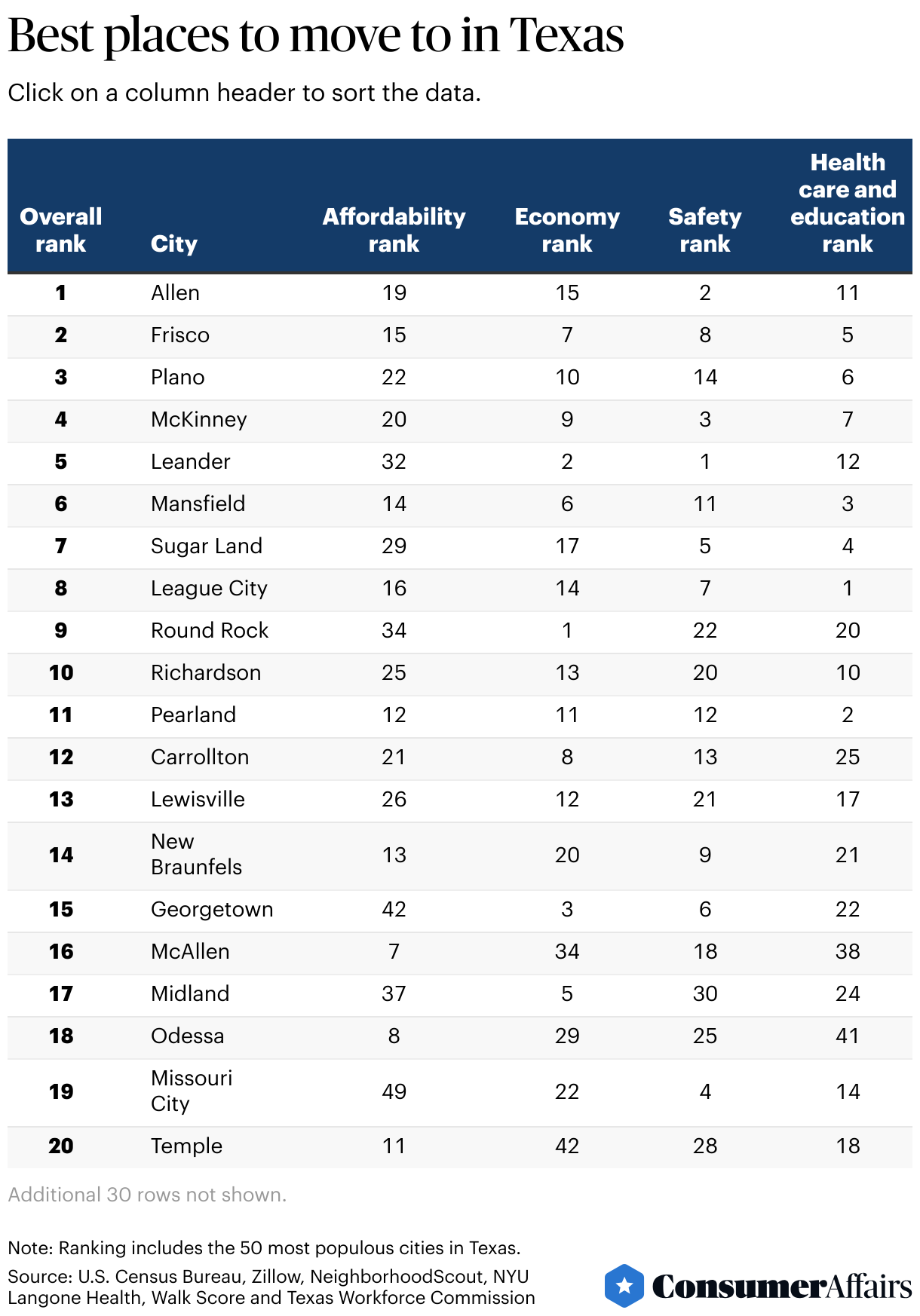
The ConsumerAffairs Research Team evaluated the 50 most populous cities in the state across five weighted categories to identify the best cities to move to in Texas. In each category, the city that performed the best received the highest possible score, while others received relative scores. We added the category scores together to get an overall score, which is out of 100 points.
For questions about the data or if you'd like to set up an interview, please contact dedens@consumeraffairs.com.
We love it when people share our findings! If you do, please link back to our original article to credit our research.
ConsumerAffairs writers primarily rely on government data, industry experts and original research from other reputable publications to inform their work. Specific sources for this article include:
Thanks for subscribing.
You have successfully subscribed to our newsletter! Enjoy reading our tips and recommendations.
| Company | Customer rating | About | Learn More |
|---|---|---|---|
|
International Van Lines
| 4.6
1,498 reviews
| Licensed moving company that offers local, long-distance and international moves. Services available by van, freight, air and ocean. Works in the entire U.S. and more than 180 countries. Free moving quotes available. | Get a Quote |
|
PODS
| 4.5
5,828 reviews
| Provides residential and commercial moving and storage solutions. Offers various container sizes. Local moves tend to cost about $500. Most long-distance moves cost between $1,000 and $3,000. Month-to-month pod rental. | Read Reviews |
|
Roadway Moving
| 4.9
391 reviews
| Full-service moving carrier. Offers local, interstate and international moving services. 99.3% on-time moves. Packing services and storage available. Provides free quotes. Licensed and insured. Track your move with mobile app. | Read Reviews |
 Condor Moving Systems
| 1.6
101 reviews
| Offers local and long-distance moves for residences and businesses. Based in Texas. Fully licensed and insured. Packing and storage services. Free quotes and coupons. Certified by moving associations. | Read Reviews |
 Perfectly Fast Moving
| 4.5
342 reviews
| Specializes in local and long-distance moves. Commercial and residential moving services. Offers packing, unpacking and storage services. Customizable pricing based on moving needs. Online quote request available. | Read Reviews |
 Northern Moving Systems
| 4.6
200 reviews
| Offers commercial and residential moving services. Price match guarantee on all moves. Available nationally. Storage and packing options available upon request. | Read Reviews |
 Colonial Van Lines
| 4.3
3,095 reviews
| Tailored moving services. Professional, experienced movers. Commitment to customer satisfaction, transparent pricing and a track record of reliable service. Moves out of state. Backed by years of expertise. | Get a Quote |
 AmeriSafe Van Lines
| 4.4
1,344 reviews
| Licensed carrier and broker providing full-service moving. Available nationwide. Local, long-distance and interstate moving services for residential and commercial customers. Packing and storage options. Free online quotes. | Get a Quote |
 iMoving.com
| 4.4
164 reviews
| Offers local, long-distance, international and commercial moving services. Local moves cost $150 to $900. Most interstate moves cost $1,000 to $4,000. Storage services, auto transport and specialty packing services available. | Get a Quote |
 Moving APT
| 4.3
314 reviews
| Broker that specializes in interstate moves for residential and commercial customers. Handles moves of all sizes. Packing services available. Free quotes include tolls, taxes, fuel and all other fees. | Get a Quote |
 American Van Lines
| 4.0
2,812 reviews
| Offers long-distance, military, commercial and corporate moving services. No extra charges for last-minute moves. Requires a significant deposit to reserve a move. Cross-country moves typically cost from $3,000 to $6,000. | Get a Quote |
 Interstate Moving & Relocation Group
| 4.1
573 reviews
| Licensed moving broker. Offers long-distance and military moves, auto transport and packing services. Free quotes. Works with authorized carriers. Available across the U.S. Online payments. | Get a Quote |
 Perennial Van Lines
| 4.0
112 reviews
| A brokerage company that arranges transportation for your move. Offers auto transport, packing and storage services. Not available in all states. Serves some states only partially. Free quote online or by phone. | Read Reviews |
 New Start Relocation
| 3.9
1,216 reviews
| Offers local, long-distance and office moving services from its location in Boynton Beach, Florida. Hires carriers for moves and provides a team of moving professionals. | Read Reviews |
 X Van Lines
| 3.7
153 reviews
| Offers four types of moving services. Short- and long-term storage options available. Available in all 50 states and Puerto Rico. Quotes range from $2,000 to $15,000 as of publishing. | Read Reviews |
 U-Pack
| 3.5
32 reviews
| Provides movable storage boxes you pack and unload yourself. Handles moves of at least 150 miles. Offers free quotes and flexible storage options. Does not offer services for local moves. Typical moves cost from $2,000 to $9,000. | Read Reviews |
 Safebound Moving & Storage
| 3.2
315 reviews
| Specializes in long-distance moves. Charges around $2,500 for a cross-country move. Full packing and unpacking services. Short- and long-term storage options available. Provides a dedicated moving coordinator. Military discounts. | Read Reviews |
 Top Tier Moving Group
| 3.0
105 reviews
| Offers local, long-distance, military and cross-border moves. Family owned and operated. Serves all 50 U.S. states. Provides packing, storage and furniture assembly. Quotes by phone only. | Read Reviews |
 Paramount Van Lines
| 3.2
62 reviews
| Offers local and long-distance moves nationwide. Packing and unpacking available. FMCSA-registered movers. Limited pricing information. | Read Reviews |
 Allied Van Lines
| 2.9
852 reviews
| Over 95 years in service. Cross-country and long-distance moves. Offers a variety of packing, moving and storage services. Vehicle shipping. Covers all 50 states and international moves. | Read Reviews |
 United Regions Van Lines
| 3.0
826 reviews
| Offers long-distance moving and corporate relocation services. Packing services and storage available. Serves the continental U.S. Charges between $2,500 and $5,000 for a two-bedroom move from Philadelphia to Kansas City. | Read Reviews |
 North American Van Lines
| 2.5
532 reviews
| Full-service mover offering local, long-distance, international and corporate moves. Also offers packing, storage and auto transport services. Available nationwide. Virtual in-home survey may be required for binding quotes. | Read Reviews |
 24/7 Logistic Services
| 2.3
292 reviews
| Specializes in moves for corporations, military personnel and seniors. Charges from $2,000 to $5,000 for long-distance moves. Provides door-to-door relocation options. Offers furniture assembly and protection. | Read Reviews |
 Van Lines Inc.
| 2.2
194 reviews
| National mover licensed in all 50 states. Provides a single point of contact for support on all moves. Offers multiple services, including white-glove delivery, antique moving and motorcycle moving. Rents storage units. | Read Reviews |
 Penske Truck Rental
| 1.8
361 reviews
| Rents 12- to 26-feet-long moving trucks. Sells packing materials. Free unlimited mileage on one-way trips. Discounts for AAA members and other programs. Minimum rental periods apply. A move from Houston to Dallas costs about $202. | Read Reviews |
 Mayflower
| 2.0
249 reviews
| Full-service moving company in business since 1927. Can handle local, long-distance and international moves. Additional services like auto transport and storage available. Provides full-valuation protection. Available nationwide. | Get a Quote |
 JK Moving Services
| 1.8
59 reviews
| Transports locally, long-distance and internationally. Offers residential and commercial moving. Also offers storage and archive services. Uses sustainable practices. Offers 24-hour customer support and mobile app. | Read Reviews |
 U-Haul
| 1.5
1,357 reviews
| Offers container shipping, storage, moving tools, packing supplies and hitches. Rental options include pickups and 26-foot trucks. Serves the U.S. and Canada. Hourly and per-mile fees. Local moves cost as little as $19.95 a day. | Read Reviews |
 Mayzlin Relocation
| 1.4
233 reviews
| Moving company based in North Carolina. Offers local, long-distance, commercial and military moving services. Packing and storage options are available. Provides a free quote with no hidden costs. | Read Reviews |
 Budget Truck Rental
| 1.1
980 reviews
| Rents out moving trucks and accessories for residential and commercial moves. Offers packing, loading and unloading assistance. Sells packing supplies. Available nationwide. Provides discounts for students, vets and older adults. | Read Reviews |
 Bellhop
| 1.2
296 reviews
| Matches clients with moving service providers. Local and long-distance moving in 28 states. Provides tailored packages. Offers hourly labor for loading and unloading. Sells packing supply kits. Offers a tracking app. | Read Reviews |

From moving and renovations to homeownership and maintaining a car, the right company matters. Explore local guides and resources.
Find Local Companies