2025 Inflation and Cost of Living

Article Image

Falling chocolate prices led grocery prices lower in June

  • The ConsumerAffairs Datasembly Shopping Cart Index fell nearly 3% year-over-year in June, largely due to a 62% drop in cookie prices, which benefited from falling sugar and chocolate costs.

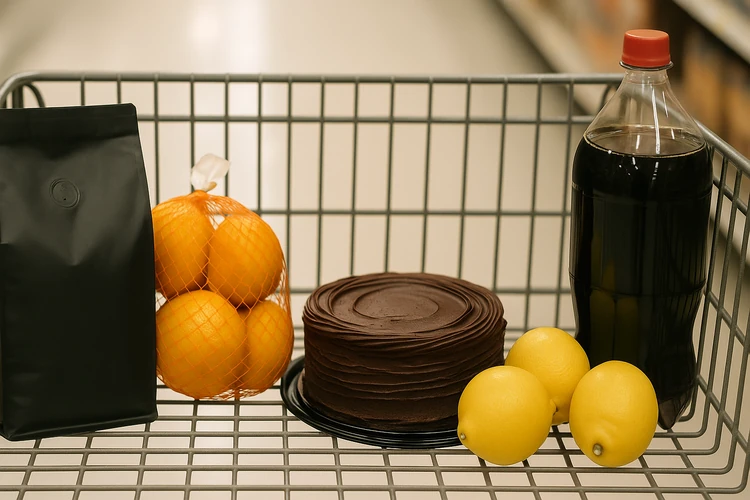
  • Despite the broader decline, prices for staples like whole bean coffee (+14.5%) and organic eggs (+13.5%) continued to rise, along with smaller increases for soda, chips, and milk.

  • While several items saw significant price cuts—including salted butter, spring water, tuna, and bread—others remained flat or edged higher, highlighting persistent inflation across parts of the grocery aisle.


After three years of inflation, grocery prices remain high, but a large decline in the price of chocolate pushed the ConsumerAffairs Datasembly Shopping Cart Index lower in June.

The Index is made up of 24 commonly purchased grocery items. Datasembly tracks price changes in real time.

In June, the total cost of the 24 items was $147.50, down from $152 in June 2024. That’s an annual decline of nearly 3%. But one item in the cart was responsible for much of the decline.

In July 2024, a 14.3 oz. package of cookies cost $9.91. Last month, that package of cookies sold for $3.78, a year-over-year decine of nearly 62%. Both sugar and chocolate prices have significantly moderated over the last 12 months. The cost has declined by 41 cents since May.

But prices for several other items have remained stubbornly high:

Top 5 items with the largest price increases

Product

June 2024

June 2025

Change ($)

Change (%)

Whole Bean Coffee 12oz

$11.83

$13.55

+$1.72

+14.54%

Organic Eggs 1 dozen

$5.54

$6.29

+$0.75

+13.54%

Cola Bottle 2 liters

$2.89

$3.11

+$0.22

+7.61%

Classic Potato Chips 8 oz bag

$3.83

$4.02

+$0.19

+4.96%

Whole Milk Half Gallon

$2.58

$2.66

+$0.08

+3.10%

In addition to cookies, prices have declined for salted butter, spring water, canned tuna and honey wheat bread.

June Shopping Cart Index

Product

May 2024

May 2025

June 2024

June 2025

Penne Pasta 16 oz

1.93

1.96

1.95

1.95

Select-a-size Paper towels

20.99

20.99

20.99

20.99

Solid White Albacore Tuna in water 5oz

2.28

2.22

2.27

2.21

Condensed Chicken Noodle Soup 10.75 oz

1.43

1.42

1.43

1.43

Cola Bottle 2 liters

2.89

3.11

2.89

3.11

Whole Milk Half Gallon

2.52

2.63

2.58

2.66

Whole Bean Coffee 12oz

11.83

12.74

11.83

13.55

Organic eggs 1 dozen

5.37

6.79

5.54

6.29

Waffles 10 count, 12.3 oz

3.29

3.24

3.28

3.24

Frosted donuts 8 count

5.42

5.36

5.36

5.3

Tomato ketchup 20 oz

3.85

3.89

3.84

3.89

Mayonnaise 30 oz

6.27

6.27

6.29

6.28

Honey Nut Cereal 18.8oz Family size

5.57

5.65

5.57

5.56

American Cheese singles 24 ct

5.5

5.4

5.5

5.45

Salted Butter 1 lb

5.94

5.4

6.12

5.42

Classic Potato Chips 8 oz bag

3.91

4.02

3.83

4.02

Honey Wheat Bread 20 oz

3.79

3.69

3.78

3.69

Cookies 14.3oz

9.98

4.19

9.91

3.78

Bacon 16 oz

7.72

8.02

8.02

7.92

Liquid dish detergent 46 oz

-

-

-

-

Spring Water 16.9 oz, 32 ct

7.57

7.26

7.55

7.24

1000 sheet toilet paper 12 ct

12.28

12.48

12.28

12.36

Peanut Butter 16.3 oz

3.3

3.27

3.29

3.25

White rice 32 oz

5.08

4.87

4.86

4.86

Laundry detergent 96 oz

13.05

13.04

13.04

13.05

TOTAL

151.76

147.91

152

147.5

Article Image

Inflation ticked higher in April, but less than expected

  • Inflation edges up slightly in April: The Consumer Price Index rose 0.2% after a decline in March, with shelter and energy prices driving the increase.

  • Overall food prices declined 0.1%, with grocery costs falling but restaurant prices continuing to rise.

  • The CPI rose 2.3% year-over-year, the smallest annual gain since February 2021.


Inflation showed modest movement in April as consumer prices increased slightly following a rare monthly dip, according to the latest data from the U.S. Bureau of Labor Statistics. The Consumer Price Index for All Urban Consumers rose 0.2% in April on a seasonally adjusted basis, reversing a 0.1% decline in March. 

Economists expected to see a higher rate of inflation in April because of tariffs. But over the past 12 months, inflation rose 2.3%, marking the slowest annual increase in more than four years.

Housing costs continued to be a major source of inflation, with the shelter index climbing 0.3% in April. This single component accounted for more than half of the month’s overall CPI increase. Rising costs in electricity and natural gas—up 0.8% and 3.7%, respectively—also contributed, although gasoline prices dipped 0.1% on a seasonally adjusted basis.

While energy prices rose 0.7% in April, the energy index remains down 3.7% compared to the same time last year. Gasoline prices have fallen 11.8% year-over-year, while natural gas has spiked 15.7%.

What does it mean for interest rates?

“We are one step closer to a rate cut by the Federal Reserve as consumer price inflation continues to calm down. The latest inflation rate of 2.3% is the slowest rise in about four years, but still above the target inflation rate of 2%," said Lawrence Yun, chief economist at the National Association of Realtors, in an email to ConsumerAffairs.

"Prescription medicine prices rose by 2.3% even as non-prescription drug costs fell by 1%. These costs could dramatically change in the upcoming months, though they comprise just 1.3% of the overall consumer budget and inflation calculation. Medical service costs like visits to the doctor and hospitals take up a larger proportion, and these costs rose by 3.1%," Yun said.

But, as always, housing costs are the elephant in the room. "Comprising one-third of the budget, that cost rose by a hefty 4%," Yun said. "Getting shelter costs under control with more housing supply (and not via disastrous rent control) will be the key to getting overall inflation fully tamed and for the Federal Reserve to 'normalize,' which in my view means 4 to 6 additional rate cuts. 

"Fed rate cuts with high inflation will not result in lower mortgage rates. However, rate cuts because of falling inflation will mean meaningfully lower mortgage rates,” Yun added.

Grocery prices fall while restaurant prices rise

Food prices presented a mixed picture in the latest calculations. Overall, the food index declined 0.1% in April, its first drop in months. Grocery store prices fell 0.4%, led by a steep 12.7% decline in egg prices and a broader 1.6% drop in the meats, poultry, fish, and eggs category.

At the same time, prices for food consumed away from home increased 0.4%, with full-service meal costs rising 0.6%. Over the past year, dining out has become 3.9% more expensive, while grocery prices have climbed a more modest 2.0%.

Excluding volatile food and energy prices, the “core” CPI rose 0.2% in April, following a 0.1% rise in March. Among the categories showing increases were household furnishings, medical care (up 0.5%), and car insurance (up 0.6%). However, airfares declined by 2.8%, and used car prices dropped 0.5%.

Over the past 12 months, core inflation increased 2.8%. Medical care, education, and motor vehicle insurance all posted annual gains above the headline rate, with motor vehicle insurance jumping 6.4% year-over-year.

Article Image

State attorneys general ask Congress to bar PBMs from owning pharmacies

Key takeaways

  • State attorneys general argue that PBMs owning pharmacies creates conflicts of interest and inflates drug prices, urging Congress to prohibit PBMs and their affiliates from owning or operating pharmacies to restore fair competition.

  • Critics claim PBMs manipulate the drug supply chain, prioritizing shareholder profits over patient care and disadvantaging independent pharmacies, despite being originally intended to lower drug costs.

  • PBMs maintain they help lower prices, but the coalition of 39 attorneys general contends that legislative action is needed to prevent anti-competitive practices and improve patient access to affordable medications.

A coalition of state attorneys general are pressing Congress to prohibit Pharmacy Benefit Managers (PBMs) and their affiliates from owning or operating pharmacies, saying that would help reduce prescription drug costs.

This argument has been going on for years. A Pharmacy Benefit Manager – also known as a PBM – is a third-party administrator that manages prescription drug benefits on behalf of health insurers. As such, PBMs play a critical role in the healthcare system by influencing drug pricing, access, and reimbursement.

Critics have long argued that PBMs keep drug prices higher than they should be. The Pharmaceutical Care Management Association, an industry group representing PBMs, counters that its mission is just the opposite, to help patients get lower drug prices. It recently called on drug companies to lower prices.

But 39 state attorneys general argue it isn’t working out that way. In a letter to Congress, the state officials urge legislative action to “restore fair competition.”

“Pharmacy Benefit Managers were created to reduce drug costs, but they’ve instead abused their position to enrich themselves at the expense of patients,” said Missouri Attorney General Andrew Bailey. “This is legalized profiteering—PBMs are manipulating the system, crushing independent pharmacies, and denying Americans access to affordable, life-saving medications.”

Too much control?

The coalition claims the current structure of the pharmaceutical supply chain allows PBMs to control pricing, availability, and access at every level—manufacturing, distribution, and retail. The state officials charge “prescription decisions are being made in boardrooms that focus on shareholder profits rather than doctors’ offices that prioritize patient care.”

The attorneys general are urging Congress to pass legislation prohibiting PBMs—or their parent companies—from owning or operating pharmacies. That law, they say, would restore balance to the market, ensure patients have access to affordable care, and prevent anti-competitive behavior that favors affiliated pharmacies over independent ones.

Joining Missouri in signing the letter were the attorneys general from Alaska, American Samoa, Arizona, Arkansas, California, Delaware, District of Columbia, Hawaii, Illinois, Kentucky, Louisiana, Maine, Maryland, Massachusetts, Michigan, Minnesota, Mississippi, Nevada, New Hampshire, New Jersey, New Mexico, New York, North Carolina, North Dakota, Ohio, Oregon, Pennsylvania, Rhode Island, South Dakota, Tennessee, U.S. Virgin Islands, Utah, Vermont, Virginia, Washington, West Virginia, Wisconsin, and Wyoming.

Article Image

The Postal Service is asking to hike the price of a first-class stamp to 78 cents

Key takeaways:

  • The proposed price hike, submitted to the Postal Regulatory Commission (PRC) for approval, would raise the price of a "forever" stamp by five cents, from 73 cents to 78 cents.

  • If approved, the approximately 7.4% increase across various mailing services, including postcards, metered letters, and international mail, would take effect on July 13th.

  • The request comes as the USPS continues its push for financial stability, echoing previous warnings of "uncomfortable" rate hikes from former Postmaster General Louis DeJoy.


The United States Postal Service (USPS) is seeking another round of price increases this summer, including a jump in the cost of a first-class stamp.

The USPS officially requested the price adjustments on Wednesday, placing the decision in the hands of the PRC. The proposed five-cent increase for a first-class "forever" stamp is part of a broader effort to bolster the agency's financial footing, a justification the Postal Service also used to implement a similar rate increase last year. The overall price hike for mailing services products is estimated at 7.4%.

This latest request follows warnings from former Postmaster General Louis DeJoy, who resigned in March after nearly five years at the helm. DeJoy had previously cautioned postal customers to anticipate ongoing rate increases as the USPS strives for self-sufficiency, asserting that past pricing models had been "defective" for over a decade.

His departure coincided with discussions within President Donald Trump and Elon Musk's Department of Government Efficiency (DOGE) regarding the potential privatization of mail service.

Currently, Deputy Postmaster General Doug Tulino is serving as the interim postmaster general while the Postal Service Board of Governors seeks a permanent replacement for DeJoy.

The future structure and oversight of the USPS remain a topic of discussion, with President Trump having previously suggested placing the agency under the control of the Commerce Department as a measure to address its persistent financial losses.

The $78 billion-a-year agency has faced challenges in balancing its budget amidst the long-term decline in first-class mail volume. The proposed rate increase represents the latest strategy in the USPS's ongoing efforts to navigate these financial headwinds.

Article Image

Inflation declined in March for the first time in five years

Key takeaways

  • Inflation sees rare decline: In March, the Consumer Price Index (CPI) fell by 0.1%—the first monthly decline in inflation in five years. This drop was mainly driven by a 6.3% decrease in gasoline prices.

  • Mixed sector trends: While energy and medical care costs declined (energy index down 2.4%, medical care down 1.1%), food and shelter costs continued to rise. Grocery prices increased 0.5%, particularly in meat, poultry, fish, and eggs (up 1.3%), while the shelter index rose 0.2%, reflecting continued pressure on housing.

  • Persistent food price pressures: Despite the overall decline in inflation, food costs—especially for groceries and dining out—remain a pain point for consumers. Grocery prices rose for the first time in two months, and restaurant prices climbed 0.4%, underlining ongoing affordability challenges in everyday expenses.

For the first time since the start of the COVID-19 pandemic, inflation went down instead of going up. The Consumer Price Index declined in March by 0.1% after rising 0.2% in February.

Over the last 12 months, the nation’s inflation rate is 2.4%, getting closer to the Federal Reserve’s target of 2%.

What changed? The Bureau of Labor Statistics reports the index for energy fell 2.4%, led by a 6.3% decline in the index for gasoline. That more than offset increases in the cost of electricity and natural gas.

The cost of medical care declined by 1.1% and is up just 1% on the year. The cost of transportation services fell by 1.4% after declining by 0.8% in February.

However, the tame inflation numbers might not feel so tame at the supermarket. The food index rose 0.4% in March. 

Food prices are still rising

The cost of food consumed at home – the category for grocery prices – rose 0.5% after being flat in February. Fruits and vegetables saw the biggest month-over-month decline, falling by 0.5%. 

The cost of bakery products, dairy and beverages all rose. The index for meats, poultry, fish, and eggs posted the largest one-month increase, rising by 1.3%, largely due to egg prices, which hit a record high of $6.23 per dozen.

The index for food consumed away from home – the category for restaurants – rose 0.4%, the same as the month before.

The cost of shelter also continued to rise, albeit at a slower pace. The shelter index rose 0.2% after a 0.3% rise in February. The cost of rent rose by 0.3% while the owner’s equivalent of rent rose by 0.4%.

Article Image

Egg prices have finally started to fall

The price of eggs has started to decline, largely due to a significant drop in demand. High prices for the last year and a half have forced many consumers to find alternatives.

A report from the Department of Agriculture found the average price of a dozen eggs is $4.90, down from $8.64 on March 5.

Datasembly, which tracks grocery prices in real-time, reports the egg price decline occurred earlier. It puts the highest price on Feb. 23, with a 1.3% decline by March 2, as illustrated by the graph below.

Source: Datasembly
Egg prices have surged because of a nationwide outbreak of bird flu, which resulted in the deaths of millions of hens. The virus is most severe during the fall and winter months.

The USDA Market Report issued on Friday called underlying trends of egg prices “sharply lower” and consumer demand “light to occasionally moderate.”

The high price of eggs has caused widespread consumer angst because they are a popular source of protein. Dr. Bethany Agusala, assistant professor of internal medicine at UT Southwestern Medical Center, says there are other more reasonably-prices foods high in protein.

Protein alternatives

“Eating more meat might seem like the easiest way to step up your protein,” Agusala wrote in a blog post on Newswise. 

“It’s important to remember that the trade-off can be a higher intake of cholesterol and unhealthy fats – and that’s not good for your heart. Mix up your protein sources to get the complete “protein package” – sorry, eating bacon or burgers every day isn’t what we’re talking about here.”

Agusala said consumers should vary their animal proteins with meals based on fish, seafood, and skinless chicken or turkey. She said people often underestimate the amount of protein in plants such as beans, chickpeas, and lentils. 

She added that beans, tofu, and tempeh have more protein than eggs and some meats, and they also provide dietary fiber, which feeds our good gut bacteria, promotes healthy digestion, and can help lower cholesterol.

Article Image

A St. Patrick's Day celebration costs less in 2025

A sign that inflation may have peaked is the cost of a traditional St. Patrick’s Day party. Datasembly, which tracks food and beverage prices, reports the cost of the items normally purchased for this annual celebration costs less than last year.

Not only is the total cost lower than in 2024, prices of all the ingredients are lower than last year. For example, a fresh corn beef brisket, weighing between two and five pounds, cost $9.17 in 2024 but is now selling for just $6.99, a decline of nearly 24%.

A head of green cabbage can be purchased for $1.57, four cents less than in 2024. A five pound bag of russet potatoes, an ingredient in Irish stew, sells for $3.31, down from $3.66 a year ago.

The total cost of the menu is down 11% from last year. Here are the price comparisons of some other items that make up a traditional St. Patrick’s Day celebration:

Item

2024

2025

Price Change

Fresh Corned Beef Brisket, 1 Count, 2-5 lbs 

$9.17

$6.99

-23.8%

Irish Whiskey 750 mL

$31.26

$27.15

-13.1%

Irish Cream Liqueur 750 mL

$30.30

$27.13

-10.5%

Russet Potatoes, 5 lb Bag

$3.66

$3.31

-9.6%

Extra Stout Beer, 6PK 11.2oz Bottles

$11.14

$10.44

-6.3%

Draught Stout, 4 pk, 14.9oz cans

$9.68

$9.26

-4.3%

Green Cabbage, 1 Head

$1.61

$1.57

-2.5%

Whole Carrots 5 Lb Bag

$3.93

$3.92

-0.3%

$100.75

$89.77

-10.90%

Article Image

Here are the 10 biggest inflation drivers over the last 12 months

Inflation remains sticky in 2025 with the U.S. inflation rate, as measured by the Consumer Price Index rising 0.5% in January and gaining 3% year-over-year.

Grocery shoppers complain about the cost of food prices but prices of most food items, with the notable exception of eggs, have leveled off in recent months, albeit at far above pre-pandemic levels.

A ConsumerAffairs analysis of the January CPI shows 10 spending categories account for the most pain. We looked for 12-month price increases in excess of 3% – January’s inflation rate – and found the usual suspects, as well as some that might have been overlooked.

Some expenses can be avoided, such as tobacco products and airline fares. Others are harder to avoid. In the last 12 months, here are the biggest drivers of inflation:

CategoryIncrease
1. Auto insurance   11.8%
2. Transportation services 8.0%
3. Airline fares   7.1%
4. Tobacco products 6.8%
5. Meat, poultry, fish and eggs  6.1%
6. Motor vehicle maintenance and repair      5.9%
7. Natural gas    4.9%
8. Owners equivalent of rent4.6%
9. Rent4.2%
10. Food away from home (restaurants) 3.4%

​Most homeowners are aware that insurance premiums are rising. That category is included in “owners equivalent of rent.”

Some categories that remain under 3% on an annual basis rose above that level in January and could be a problem for consumers as the year unfolds. Fuel oil prices rose 6.2% from December to January but are down 5.3% for the year. 

Other categories seeing a significant one-month increase in prices are groceries, non-alcoholic beverages, gasoline, used cars and car insurance.

Article Image

Prices ticked higher in January, led by eggs, rent and car insurance

Inflation picked up speed in January as the cost of rent and home ownership continued to rise. The Bureau of Labor Statistics reports the Consumer Price Index rose 0.5% last month after a 0.4% increase in December.

For the last 12 months, the nation’s inflation rate rose to 3%. The cost of shelter accounted for 30% of last month’s increase.

The energy index rose 1.1% over the month, as the gasoline index increased 1.8%. The index for food also increased in January, rising 0.4%.

In a shift from previous months, the index for food at home – the category for grocery prices – rose 0.5% while the index for food away from home – the category for restaurants –  increased just 0.2%.

In spite of last month’s jump in grocery prices, the index for food at home index is up less than 2% over the last 12 months. Within that index the cost of  meats, poultry, fish, and eggs surged 6.1%, driven largely by the price of eggs. The cost of eggs alone is up 53% over the last 12 months. The cost of dairy and related products is up 1.2%.

The cost of rent has risen by 0.3% for each of the last four months and is up 4.2% over the last 12 months. The cost of owning a home gained 0.3% in January and is up 4.6% year-over-year.

The cost of car insurance also spiked last month, rising 2%. Insurance premiums are up over 11% over the last 12 months.

Article Image

Consumer prices rose faster in December than November

Inflation ended 2024 by moving slightly higher. The U.S. Bureau of Labor Statistics reports a 0.4% increase in the Consumer Price Index for All Urban Consumers (CPI-U) on a seasonally adjusted basis for December.

That follows a 0.3% rise in November. The biggest drivers of inflation in December were energy and shelter.

The energy index climbed 2.6%, contributing to over 40% of the overall monthly increase. Within the energy sector, gasoline prices were up by 4.4%. Food prices also saw an uptick, with the index for food rising by 0.3%, affecting both food consumed at home and away from home.

Food consumed at home, the category for grocery prices, rose 0.3% in December but was only 1.8% higher over the last twelve months. The price of cereal and bakery items made the sharpest move in December, jumping 1.2%.

The price of meat, fish and eggs gained 0.6% last month and was up 4.2% on the year, with eggs accounting for most of the increase.

Restaurant prices still rising

Food consumed away from home – the category for restaurant prices – rose 0.3% in December and was 3.6% higher on the year, double the rate of food consumed at home.

Excluding food and energy, the index for all other items rose by 0.2% in December, a slight deceleration from the 0.3% increases observed in the previous four months. Notable increases were seen in the indexes for shelter, airline fares, used cars and trucks, new vehicles, motor vehicle insurance, and medical care. 

The cost of car insurance rose 0.4% in December and was up 11.3% for 2024. The cost of rent increased by 0.3% in December and gained 4.3% in 2024.

A few things cost less

Conversely, personal care, communication, and alcoholic beverages were among the few categories that experienced price declines.

Over the past year, the all-items index increased by 2.9%, up from the 2.7% rise recorded in the 12 months ending in November. The core index, which excludes food and energy, rose by 3.2% annually. While the energy index saw a slight annual decrease of 0.5%, the food index increased by 2.5% over the same period.

These figures highlight the ongoing challenges faced by consumers as energy and food prices continue to exert upward pressure on overall inflation, influencing economic decisions and policy considerations.

Article Image

Egg prices are soaring again and could go even higher

The price of eggs is soaring again, mainly due to the latest outbreak of bird flu. The virus has infected flocks in all 50 states, resulting in the deaths of millions of chickens.

Egg prices have spiked to nearly $9 a dozen in California and some other states – a staggering 70% increase from the year before. The situation is so dire in California that some Bay Area grocery stores have imposed purchase limits on eggs. A Whole Foods in Palm Desert was out of eggs this weekend.

Restaurants that serve omelets and baked goods are struggling to survive as as the price for a case of eggs has shot up from $20 to as much as $150 in some areas.

“It’s f—king killing me,” Cara Haltiwanger, owner of Los Angeles-based breakfast sandwich spot Calabama, told SFGATE. “I’m an egg restaurant. I have to buy eggs no matter what, you know?”

According to the most recent Consumer Price Index, The average nationwide retail price of eggs in the U.S. has risen 38% since November 2023. However, much of the price surge has occurred in recent weeks.

However, prices monitored by Datasembly suggest the CPI significantly undercounts the price increase. According to Datasembly, the average price of eggs bottomed on Oct. 20, 2024. It has risen 40% since then. 

The graph below tracks egg prices using Datasembly’s price index. The egg price index was 152.1 on Oct. 20. It has since soared to 213.5.

According to Datasembly, these are the top five states wth the biggest three-month increase in egg prices:

  1. California: 58%
  2. Nevada: 56.3%
  3. Oregon: 51.1%
  4. Washington: 47.5%
  5. Alaska: 37.8%

Can egg prices go even higher? In an interview with CNBC, Brian Moscogiuri, vice president of Eggs Unlimited, an egg supplier, said it’s possible egg prices could reach record highs before they start to come down.

Egg prices last spiked in the closing days of the COVID-19 pandemic and bird flu was again the main reason. Grade A egg prices reached a high of $4.82 a dozen in January 2023, rising from $1.93 in January 2022.

Article Image

Cookie prices fell in December but eggs and coffee cost more

A huge decline in the price of cookies more than offset rising egg and coffee prices in December as the ConsumerAffairs Datasembly Shopping Cart Index fell by $1.21. The Index, which tracks the prices of 25 commonly purchased grocery items, was only 35 cents higher than in December 2023.

But unless you bought a lot of cookies last month you might not have saved money. The price of a 14 oz. package of cookies dropped from $6.16 in November to $4.97 last month, a decline of 19%.

Eggs and coffee posted the largest increases. Eggs, which are in short supply in many areas of the country because of bird flu, rose from $6.09 in November to $6.30. The price of 12 oz. of whole bean coffee, was the same as in November – $12.98. However, that's 49 cents more than in December 2023.

Prices of several other products stabilized in December or fell slightly. The prices of ketchup, butter and bread were down from November and year-over-year.

The December Shopping Cart Index

Product

 Dec. 2023

 Nov. 2024Dec. 2024
Penne Pasta 16 oz.$1.92$1.91$1.96
Select-a-size paper towels$20.99$20.99$20.99
White Albacore tuna in water 5oz.$2.20$2.27$2.22
Chicken noodle soup 10.75 oz.$1.42$1.44$1.44
Cola 2-liter bottle$2.87$2.94$2.91
Whole milk half-gallon$2.61$2.68$2.68
Whole bean coffee 12 oz.$12.39$12.98$12.98
Organic eggs one dozen$5.27$6.09$6.30
Waffles 10 ct. 12.3 oz.$3.17$3.28$3.29
Frosted donuts 8 ct.$5.23$5.52$5.23
Tomato ketchup 20 oz.$3.84$3.96$3.89
Mayonnaise 30 oz.$5.84$6.29$6.27
Honey Nut cereal 18.8 oz.$5.56$5.33$5.57
American cheese single 24 ct.$5.49$5.37$5.54
Salted butter 1 lb.$6.42$6.21$6.14
Classic potato chips 8 oz. bag$4.12$4.05$4.05
Honey wheat bread 20 oz.$3.79$3.49$3.69
Cookies 14.3 oz.$6.91$6.16$4.97
Bacon 16 oz.$7.97$8.32$8.11
Liquid dish detergent 46 oz.$5.57$5.58$5.58
Spring water 16.9 oz. 32 ct.$7.10$7.59$7.62
1000 sheet toilet paper 12 ct.$12.30$12.70$12.37
Peanut butter 16.3 oz.$3.31$3.19$3.27
White rice 32 oz.$5.20$4.87$4.87
Laundry detergent 96 oz.$13.07$13.05$13.04
Cart Totals$154.63$156.19$154.98