
California tops the list of states most at risk of stagflation in 2025
Blue states face higher inflation, while red states struggle with weak growth
More than one in three U.S. households reports difficulty paying monthly bills
Of all the economic conditions, economists generally fear “stagflation” the most. That’s when the economy becomes stagnant and doesn’t grow, but inflation keeps rising. The last time the U.S. had a case of stagflation was the 1970s, and it wasn’t pleasant.
While the U.S. economy has so far avoided that fate, new research from National Business Capital has identified the top 10 states where stagflation is a real threat.
California has emerged as the state most at risk of falling into stagflation in 2025, with findings suggesting that Pacific states are bearing the brunt of stagflationary pressures. The Northeast is not far behind.
By contrast, “red” states are seeing less inflation but are struggling with weaker growth, creating a different but equally destabilizing form of economic stress.
Blue vs. red state divide
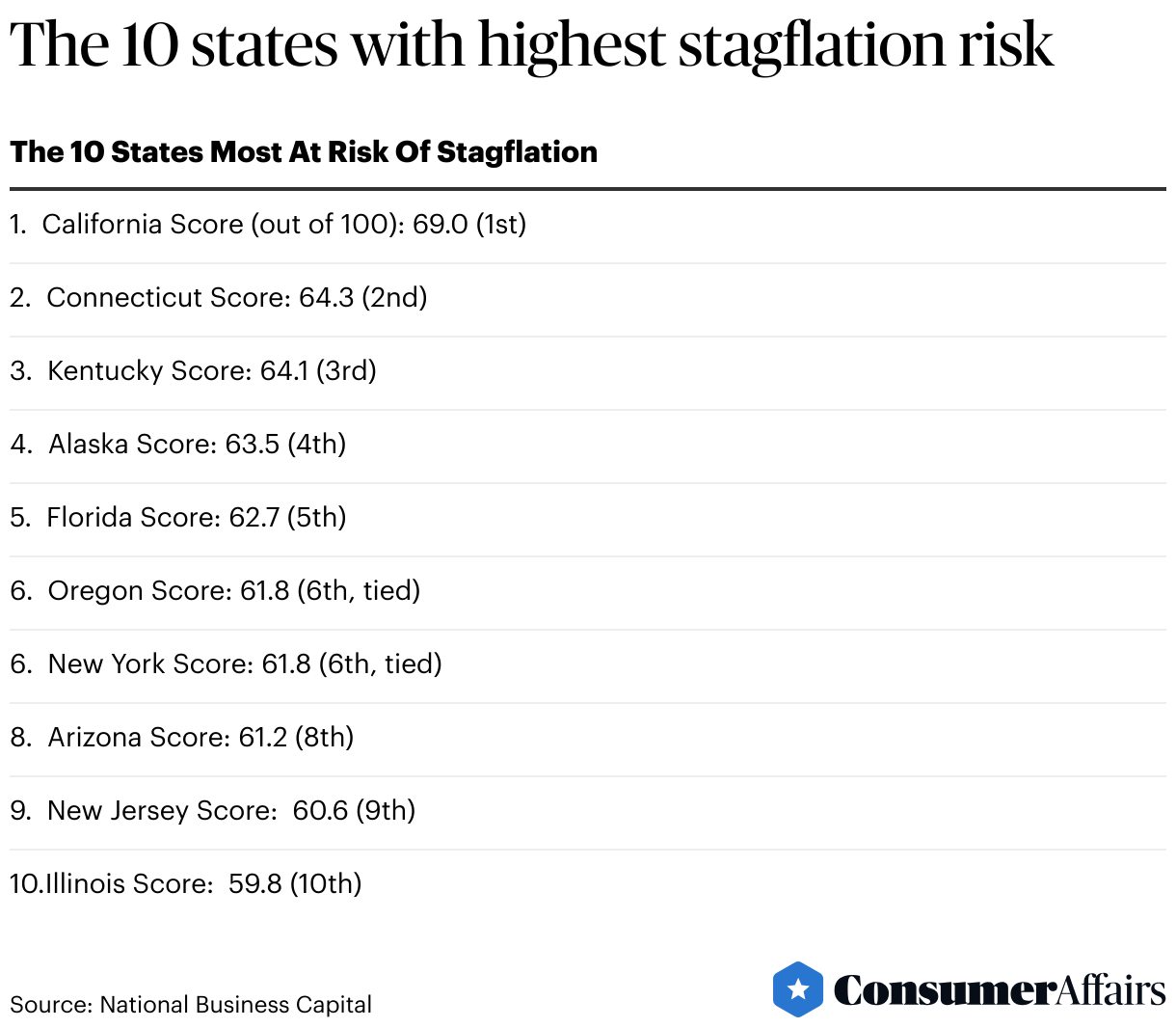
Researchers found that “blue” states, led by California and Connecticut, are more likely to experience stagflation due to high shelter and energy costs, as well as elevated underemployment rates.
On average, blue states recorded a stagflation score of 53.4 — nearly 6.5% higher than red states at 50.1. Six of the 10 most vulnerable states were Democratic-leaning.
Red states, while less affected by inflation, reported heavier household financial strain. Roughly 38% of residents in Republican-leaning states said they struggled to pay bills, compared with 34% in blue states. These states also endured sharper GDP declines in early 2025 and posted slower productivity growth, leaving many families with thinner paychecks.
Regional breakdown
By region, Pacific states had the highest average stagflation risk score at 60.6, well above the Northeast (53.1), Midwest (50.5), South (49.2), and Mountain states (48.5). California’s top ranking stemmed from steep housing costs, soaring utility bills, and high underemployment. Connecticut placed second, while Kentucky ranked third due to sluggish GDP growth and low salaries.
Nationwide, more than one in three households reported struggling to cover monthly bills, highlighting the widespread financial stress behind the macroeconomic data. Kentucky households were hit the hardest, with 45.6% reporting difficulty, while Minnesota fared best at 27.4%.
“The economy can go in any direction from here,” said Joe Camberato, CEO of National Business Capital. “However, this report shows if stagflation hits, the rest of 2025 could look very bleak.”