





2025 Consumer News and Alerts

Article Image

Court halts business opportunity scheme Click Profit

A federal court has temporarily shut down Click Profit, an online business opportunity scheme that falsely promised consumers massive profits through online sales. The Federal Trade Commission (FTC), which requested the action, alleges that the company misled consumers into paying tens of thousands of dollars for a fraudulent system powered by artificial intelligence.

According to the FTC complaint, Click Profit lured customers by claiming they could earn “passive income” through online platforms such as Amazon, Walmart, and TikTok. The company also falsely claimed to be affiliated with major brands like Nike and Disney to gain credibility.

“Click Profit misled consumers by falsely promising them guaranteed passive income using cutting-edge AI technology and exclusive brand partnerships,” said Christopher Mufarrige, Director of the FTC’s Bureau of Consumer Protection. “Their deception caused individual consumers to lose tens of thousands of dollars while Click Profit’s operators enriched themselves.”

Expensive fees and false promises

Click Profit, which also operates under names such as FBALaunch, Automation Industries, and PortfolioLaunch, marketed its program as a “safe, secure, and proven” way to generate wealth. The company promised six-to-eight-figure earnings, even stating that consumers’ stores could be bought by venture capital firms for three to six times their value.

To participate, consumers were required to pay a “management fee” of at least $45,000, plus additional thousands for store inventory. However, most customers never saw a return on their investment, and some were left with credit card debt and unsold products. The complaint cites statistics showing that over one-fifth of Click Profit’s Amazon stores earned no money at all, and another third made less than $2,500 in gross lifetime sales.

The FTC also noted that Amazon blocked, suspended, or terminated about 95% of Click Profit’s stores, making it nearly impossible for customers to generate income. Even when stores were operational, Click Profit allegedly pressured consumers to reinvest any earnings into more inventory, further increasing their financial losses.

Threats and no customer support

Many customers found Click Profit unresponsive after making their payments and only received refunds after filing complaints with outside organizations such as the Better Business Bureau (BBB) or law enforcement. In some cases, the company threatened customers with lawsuits for speaking out, citing an unlawful non-disparagement clause in its contracts.

Legal action against operators

The FTC complaint names Click Profit’s co-founders Craig Emslie and Patrick McGeoghean, as well as partners Jason Masri and William Holton, accusing them of violating multiple laws, including the FTC Act, the Business Opportunity Rule, and the Consumer Review Fairness Act.

The FTC is now working to hold the defendants accountable and recover funds for victims who collectively lost millions of dollars.


Article Image

Chinese firm claims it can charge an EV in five minutes

“Range anxiety” has been one of the primary reasons consumers have been slow to embrace electric vehicles, but if claims by a Chinese company are true, EVs may have taken a big step forward.

EV firm BYD has introduced its “Super e-Platform” technology, which it said can reach charging speeds so fast that it can produce nearly 250 miles of range in about five minutes. That’s about how long it takes to fill a vehicle’s gasoline tank.

“The ultimate solution is to make charging as quick as refueling a gasoline car,” Wang Chuanfu, chairman and president of BYD, said in a press release.

Currently, Tesla’s superchargers offer a charging rate of up to 500 kilowatts, translating into around 168 miles of range in about 15 minutes.

BYD said it plans to build more than 4,000 ultra-fast chargers in China using the new technology but did not say when the project would begin.

Though the company’s claims have not been independently verified, investors appear to take them at face value. BYD’s Hong Kong-listed  stock rallied nearly 6% on the announcement.

Article Image

Hair loss your biggest problem? Try finasteride and you may have a worse problem

Believe it or not, there's something worse than male pattern baldness. It's depression, plunging libido and shrinking genitals. Those are the symptoms doctors say are caused by finasteride, a popular hair-loss treatment heavily promoted by "telehealth" companies like Hims.com. The drug is sold commercially as Propecia and Proscar.

In a Wall Street Journal report, Dr. Justin Houman, a urologist at Cedars-Sinai Medical Center in Los Angeles, said the unpleasant side effects of finasteride are "very very common" and cautioned that young men should avoid it.

Finasteride is, it should be noted, a legitimate treatment for prostate enlargement, where the beneficial effects may outweigh the possible side effects. 

Risks of finasteride

One of the most widely reported risks of finasteride is sexual dysfunction, which includes:

  • Reduced libido (low sex drive)
  • Erectile dysfunction (ED)
  • Decreased semen volume and fertility issues
  • Delayed ejaculation

It also has serious mental health effects, including depression, anxiety and thoughts of suicide and possible cancer risks, according to the Mayo Clinic.

While finasteride can shrink the prostate and reduce the risk of low-grade prostate cancer, studies suggest it may slightly increase the risk of aggressive, high-grade prostate cancer in some men. The reason is unclear but may be due to delayed detection of cancerous cells.

Other studies, including one by the University of Illinois, suggest it may cut the risk of heart disease. 

Carnival barker tonics

Hair-loss cures are an old standby in the carnival barker school of health care and have most likely been around since the first human male started losing hair. But lately, they and other unproven and unregulated tonics have gained a certain air of respectability because of clever marketing by "cool" telehealth sites.

Telehealth products have expand the loophole long used by dietary supplements, which relieve consumers of millions of dollars per year for unproven substances that may not only be ineffective but also dangerous.

Since they're not legally drugs, supplements and many cosmetics aren't subject to regulation by the U.S. Food and Drug Administration and their safety and effectiveness are not guaranteed.

But finasteride is a prescription drug and is not approved for over-the-counter sale, so how are men buying it online? That's where telehealth companies come in. It's another miracle of technology that the old-fashioned carnival barker has been replaced by companies like Hims, which last year enjoyed $1.5 billion in revenue from more than 2 million customers. 

How they work

Many telehealth platforms offer finasteride through online consultations. These companies typically:

  • Require you to fill out a medical questionnaire.
  • Some may offer a brief video consultation with a doctor.
  • If approved, they ship the medication directly to you (often as a subscription).

These services operate legally by connecting customers with licensed doctors or healthcare providers who write prescriptions, even though they have not seen the patient in person. 

Online pharmacies also sell finasteride and other prescription medications. The patient simply forward their physician's prescription. Compounding pharmacies can also brew up a custom version of a prescription drug under certain cicumstances. 

But a large network of shady sites, many operating overseas, also sell prescription medicines and may not screen patients effectively or at all. 

In the case of finasteride, it's important to take the drug only under a doctor's supervision. In many cases, it may be best to avoid it as a hair-loss treatment.

Why avoid it? Very simply, it is effective only as long as you take it. Stop taking the drug and your hair starts falling out again but the unpleasant side effects remain.

Article Image

Stocks are down. Is it time to invest in gold?

President Trump promised to shake things up and that's at least one promise he's delivered on. His tariffs on imports from Canada, Mexico and China have shaken up Wall Street and put stocks in a steep dive.

So is this the time to dump stocks and buy gold? Well, it might be if you like to sell low and buy high. On the other hand, no one ever knows how low stocks will go, so both gold and cash can be a good way to hedge your bets. Be sure to calculate the tax consequences of selling stock. You don't want to incur a big capital gains tab.

The advantage of gold is that it's considered a safe-haven asset, historically attracting investors during times of economic uncertainty, which is what we're living through right now. Gold is trading around $2,916 per troy ounce as of March 11, according to GoldPrice.org, reflecting a significant rise from previous years.

Meanwhile, the Dow Jones Industrial Average is down more than 450 points Tuesday afternoon, prompting an outbreak of angina in many households. The tech-heavy Nasdaq Composite index also fell into correction territory, meaning it fell from 10% from its most recent high, and the S&P 500 is nearing a correction.

Historically, economic uncertainty drives many investors toward gold, seeking stability amid market volatility.​ Investors who are well-diversified nearly always have some gold in their portfolio and there's no reason smaller investors shouldn't do the same, even if they don't unload all their equities.

These days, it is typical for investors to buy gold through exchange-traded funds, such as the iShares Gold Trust Micro and SPDR Gold MiniShares Trust.

Gold's performance and forecasts

Gold's price trajectory has been notably bullish.In early 2025, prices reached a new high of $2,915 per ounce, marking a 100% increase from the March 2020 low of $1,451 per ounce. This upward trend is anticipated to continue, with Goldman Sachs revising its year-end 2025 forecast to $3,100 per ounce, up from the previous $2,890.

Similarly, J.P. Morgan predicts an average gold price of $2,950 in 2025, potentially reaching $3,000 per ounce. These projections are underpinned by factors such as sustained inflation, geopolitical risks, and robust demand from central banks.

Still, the World Gold Council has cautioned the rally may cool in 2025 after gold's stellar performance in 2024.

Investment considerations

While gold's recent performance and optimistic forecasts are compelling, potential investors should approach with caution, as they would with any investment.

David Rosenberg, founder of Rosenberg Research, advises following Warren Buffett's prudent investment strategy, emphasizing the importance of "de-risking" portfolios during uncertain economic times.

Rosenberg, in a Marketwatch report, highlights the necessity of increasing cash reserves and investing in defensive sectors, including assets like gold that traditionally perform well during periods of instability.

Keep in mind that market corrections can occur, and gold is not immune to price fluctuations.Factors such as changes in interest rates, currency strength, and shifts in investor sentiment can influence gold's value. Therefore, diversification remains a key principle in investment strategies, ensuring that portfolios are balanced across various asset classes to mitigate potential risks.

Newcomers considering exposure to gold without directly purchasing the physical metal, investing in gold mining companies presents an alternative. Others argue that, although it's a little bulky and needs careful handling, actual, physical gold is still king. ConsumerAffairs reviews gold dealers​ here.

Be bold but careful

Given the current economic landscape, characterized by trade tensions and inflationary pressures, gold continues to serve as a viable hedge against uncertainty.The metal's strong performance and favorable forecasts suggest potential for further appreciation.However, investors should consider a diversified approach to their portfolios.

Consulting with financial advisors and conducting thorough research are prudent steps to ensure alignment with individual financial goals and risk tolerance.

Article Image

Losses from scams broke records in 2024, FTC says

Losses from fraud, such as imposter scams and identity theft, reached record amounts last year.

Consumers reported losing more than $12.5 billion to fraud in 2024, a 25% increase from more than $10 billion in 2023, according to a yearly report by the Federal Trade Commission.

Victims filed the reports to the FTC, other government agencies and organizations such as the Better Business Bureau, but the reports don't capture all fraud in the U.S.

If you're a victim of fraud or identity theft, you can report it via the website ReportFraud.ftc.gov.

The FTC said the higher losses are because more people said they lost money since reports on fraud and identity theft have stayed stable at around 3.7 million over the last three years.

In 2024, around 38% of the reports involved a loss, up from 27% in 2023 and the highest share on record.

Median losses have also trended higher, reaching $497 in 2024 versus $311 in 2020.

What are the most common types of fraud?

Imposter scams, when fraudsters pretend to be businesses, governments or other organizations, was the most common scam.

The FTC said losses from government imposter scams in particular rose by $171 million in 2024 from 2023.

Imposter scams were followed by online shopping scams and business and job scams.

Employment-agency scams saw major growth, with reports tripling between 2024 and 2024 and losses jumping to $501 million from $90 million.

For the second year in a row, email was the most common way scammers reached people, accounting for a quarter of the fraud reports and $502 million in losses.

It was followed by phone calls, accounting for 19% of the reports, and text messages, accounting for 16%.

Younger people were more likely to lose money than older people: 44% of people aged 20 to 29 reported losing money, versus 24% among people aged 70 to 79.

Still, losses for older people was higher: People aged 70 to 79 reported a median loss of $1,000, compared with $417 for people aged 20 to 29.

Where is fraud happening more in the U.S.?

Fraud is more rampant in scattered parts of the U.S.

Florida had the highest rate of fraud with a rate of 2,163 reports per 100,000 peoople in 2024, followed by Georgia (2,108), Delaware (1,876), Nevada (1,867) and Maryland (1,799).

South Dakota had the lowest rate of fraud reports with 676 reports per 100,000 people, followed by North Dakota (696), Iowa (715), West Virginia (836) and Kansas (848).

Article Image

U.S. GDP forecast flashes recession warning

A closely-watched forecast of America's economic growth is warning of a recession.

Gross domestic product (GDP) growth is expected to be -2.4% for the first quarter of 2025 after forecasts, which are published every few days, fell into the negative starting on Feb. 28, according to the Federal Reserve Bank of Atlanta.

GDP is a key metric on the pace of the economy's health and two consecutive quarters of negative GDP growth would signal a recession.

The worrying numbers follow economic uncertainty from Trump's tariffs, which are expected to raise prices on numerous goods and services, including cars and home construction.

Price hikes from tariffs could reduce spending, lower production and cause job cuts.

The stock market has also reacted negatively in recent days.

On Thursday, the S&P 500 fell another 1.8% and brought its multiday decline to 7%.

And the tech-heavy Nasdaq 100 index fell into a correction, bringing it down more than 10% from recent highs.

Before Trump's tariffs, there were already fears of a U.S. stock market bubble.

Some 89% of investors said they think stocks are overvalued, according to a February survey by Bank of America.

Bank of America likened the current market scenario, which involves a high concentration in few stocks, to the dot-com crash of the late 1990s.

"If history is any indicator, the current market scenario could lead to a significant downturn, potentially dragging the S&P 500 down by as much as 40%," World Economic Magazine reports.

Article Image

Pure Green Coffee customers getting refunds

The Federal Trade Commission (FTC) is distributing over $905,000 in refunds to nearly 40,000 consumers who purchased Pure Green Coffee, which it said was a fraudulent weight-loss product falsely marketed with deceptive health claims and fake testimonials.

The alleged scam, run by NPB Advertising, misled consumers by promoting the product on fake news websites, featuring bogus success stories and unproven claims about its weight-loss effects.

The FTC first sued NPB Advertising and its associates in May 2014, alleging that they engaged in false advertising and consumer fraud. In 2015, most of the defendants settled the charges. However, in 2016, the FTC won its case against the ringleader of the operation and has since worked to recover funds to compensate affected consumers.

Now, after years of legal action, the FTC is returning money to those who were tricked into buying Pure Green Coffee.

How refunds will be distributed

  • 39,977 consumers will receive payments through checks or PayPal.
  • Consumers receiving checks should cash them within 90 days of the issue date.
  • PayPal recipients must redeem their refunds within 30 days.
  • Anyone with questions about their refund can contact the refund administrator, Epiq Systems, at 877-839-1696 or visit the FTC’s website for more details.

The FTC reminds consumers that it will never ask for money or personal information to issue refunds.

Article Image

Americans nix Daylight Saving Time in latest poll

As the March 9 shift to daylight saving time (DST) approaches, a new Gallup poll reveals that a majority of Americans favor eliminating the practice altogether. According to the survey, 54% of U.S. adults support ending DST, while 40% are in favor of keeping it, and 6% remain uncertain.

This marks a dramatic shift in public opinion since Gallup last measured views on daylight saving time in 1999. Back then, 73% of Americans supported DST, compared to the sharp decline in support seen today.

Daylight saving time was first implemented at the national level in 1918 to conserve energy during World War I. For decades, states followed a patchwork of rules regarding DST, leading Congress to pass the Uniform Time Act in 1966 to standardize time changes. Over the years, several states have opted out, including Hawaii and most of Arizona, while others have pushed for permanent daylight saving time.

In 2022, the U.S. Senate passed a bill to make DST permanent, but the legislation stalled in the House. More recently, lawmakers have introduced bipartisan proposals to end the twice-yearly clock changes.

Public preference changes

A separate Gallup survey found that nearly half of Americans (48%) prefer year-round standard time, compared to 24% who favor year-round DST and 19% who support maintaining the current system. The findings suggest that while some Americans appreciate extended daylight in the evenings, most would rather avoid the disruption of changing clocks.

Support for DST varies across demographics. Democrats are slightly more likely to favor DST (44%) than Republicans (34%), while lower-income Americans (53%) show more support than middle-income (35%) and higher-income (33%) individuals. However, the majority of all groups still favor eliminating clock changes.

Health and safety concerns

Research has shown that transitioning in and out of DST can have adverse effects, including sleep disruption, increased traffic accidents, and higher rates of heart attacks and workplace incidents. Additionally, studies indicate that extended daylight hours have minimal impact on energy savings, which was one of the original purposes of DST.

With public opinion shifting away from DST, lawmakers may face increased pressure to act on the issue. While some states have pushed for changes, any nationwide adjustment would require federal legislation. As debate continues, the American public seems increasingly ready to move away from the century-old practice of adjusting clocks twice a year.

Article Image

Beware of imposters posing as your electric company

Among the scams causing the most harm to consumers is a scheme in which an imposter pretends to be from a utility company and tells the victim their power is about to be disconnected for non-payment, unless the victim makes an immediate payment.

During National Consumer Protection Week, utility companies around the country are working with the Federal Trade Commission to raise awareness of this scam. In 2024, Pacific Gas and Electric alone reported over 26,000 scam attempts, with customers losing $646,000 to fraudsters impersonating the utility company. 

Unfortunately, these figures likely represent only a fraction of the actual scam attempts, as many incidents go unreported. The trend has continued into 2025, with over 1,700 scam reports in January alone, resulting in nearly $22,000 in losses.

Ron Rose, PG&E's lead customer scam investigator, said scammers will attempt to create a sense of urgency by threatening immediate disconnection of your utility services if you don't make immediate payment.

He said PG&E, like other utility companies, will never ask you for financial information over the phone. He points out that a demand for an unusual method of payment, such as pre-paid debit cards or money transfer services like Zelle, is a sure sign of a scam.

Businesses are also targets

Small and medium-sized businesses are particularly vulnerable, with over 1,200 reports of scam attempts targeting these customers in 2024. Scammers exploit business owners' urgency to maintain operations, often during peak business hours.

Signs  of a utility scam include:

Article Image

Economic indicators flashed mixed signals in January

How will the economy fare under the second Trump Administration? It began with a step backward.

The Conference Board reports its Leading Economic Index fell by 0.3% in January to a reading of 101.5, following a modest 0.1% increase in December. This decline reverses most of the gains observed in the previous two months and highlights ongoing economic challenges. 

Over the six-month period ending in January, the LEI recorded a 0.9% decline, which is an improvement compared to the 1.7% decline in the preceding six months.

Justyna Zabinska-La Monica, senior manager of Business Cycle Indicators at The Conference Board, noted that consumer pessimism regarding future business conditions and reduced manufacturing work hours contributed significantly to the January decline. 

Despite these challenges, there are signs of stabilization, as manufacturing orders have nearly steadied, and the yield spread has positively impacted the index for the first time since November 2022. 

Growth rates trending upward

Only four of the LEI's ten components were negative in January, and the index's six-month and annual growth rates continue to trend upward, suggesting milder economic obstacles ahead. The Conference Board forecasts a 2.3% expansion in U.S. real GDP for 2025, with stronger growth anticipated in the year's first half.

But a new administration’s economic policies could be a wild card, especially if steep tariffs are widespread. Insurance comparison website Insurify has predicted that 25% tariffs on vehicles imported from Mexico and Canada would lead to a significant increase in insurance rates for U.S. motorists.

Tariffs on steel and aluminum might have the unintended consequence of making cans of beer and soft drinks more expensive. But that’s in the future. For now, the economy appears stable.

Current conditions show improvement

In January, The Conference Board’s Coincident Economic Index, which reflects current economic conditions, rose by 0.3% to 114.3, maintaining the same growth rate as in December. Over the six-month period from July 2024 to January 2025, the CEI increased by 1.0%, slightly above the previous six months' growth of 0.9%. 

All four components of the CEI—payroll employment, personal income less transfer payments, manufacturing and trade sales, and industrial production—improved in January, with industrial production making the largest positive contribution for the second consecutive month.

Meanwhile, the Lagging Economic Index also showed positive movement, increasing by 0.5% to 119.3 in January, marking the first positive six-month change since summer 2024. This growth indicates a potential shift in economic momentum, as the index had previously shown no change in December.

Overall, while the decline in the LEI points to some economic uncertainty, the positive trends in the CEI and LAG suggest that the U.S. economy may overcome these challenges, with expectations of continued growth in the coming months.

Article Image

Medicare patients facing higher drug costs

A new study from the USC Schaeffer Center shows that out-of-pocket costs for brand-name medications have increased sharply for Medicare Part D patients. This is because more drug plans are tying patient costs to the full list price of medications instead of using fixed copayments.

Why are costs rising? 

  • In 2020, only 9.9% of stand-alone Medicare drug plans used coinsurance (where patients pay a percentage of a drug’s list price).
  • By 2024, that number jumped to 71.9%.
  • Patients in these plans are now paying more as drug list prices continue to rise.

While drugmakers offer rebates and discounts, these savings usually benefit insurance companies and pharmacy benefit managers (PBMs), not patients. In fact, large rebates may even drive higher list prices, making things worse for those on coinsurance.

Big cost increases for popular drugs

For patients in stand-alone Part D plans, out-of-pocket costs more than doubled for several widely used medications, including:

  • Eliquis (blood thinner): from $46.76 to $102.32 per month.
  • Trulicity (diabetes): from $54.04 to $128.43 per month.
  • Xarelto (blood clots): from $46.54 to $94.50 per month.
  • Ozempic (diabetes/weight loss): from $56.95 to $135.43 per month.

Patients in Medicare Advantage plans, which offer more comprehensive coverage, saw only small cost increases in comparison.

Impact on patients

Many seniors are shocked by sudden price jumps for medications they’ve been taking for years. While Medicare’s new out-of-pocket cap will help reduce total yearly expenses, some patients may struggle with high upfront costs—potentially leading them to skip medications and risk their health.

Lead researcher Erin Trish warns, “Medicare beneficiaries taking highly rebated drugs are paying more while generating savings for insurers. That’s the opposite of how insurance should work.”

The findings highlight the growing financial burden on Medicare patients and the need for reforms to ensure fair pricing and affordable prescriptions.

The full text of the study is available online

Article Image

Want a California omelette? It'll cost you

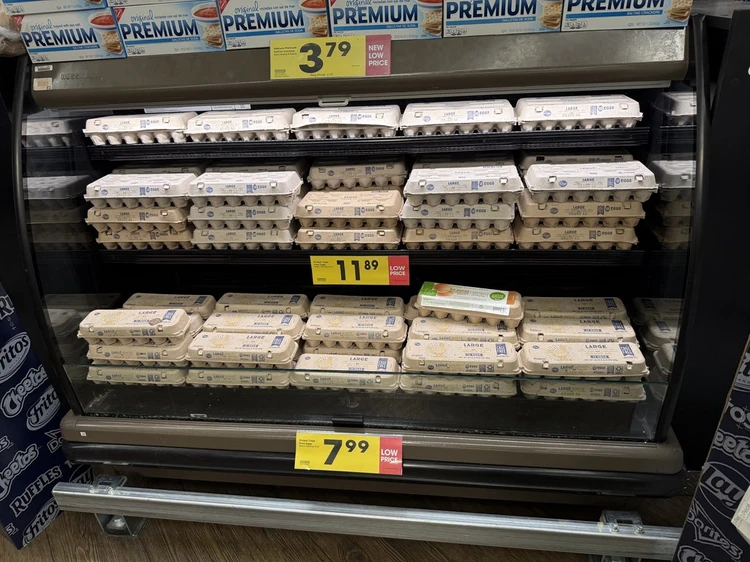
You can't make an omelette without breaking eggs, and if it's a dozen nice big fat brown eggs you want, you'll need a dozen dollars at many stores in California, if you can even find any eggs.

In Missouri, you can whip up as many over-easy or scrambled eggs as you want for about $4.24, thanks to all the Midwestern chicken farmers who work their hens hard and ship their products to nearby cities.  

Besides raising prices, many supermarkets have limited purchases to just a few dozen. Meanwhile, egg experts caution against hoarding. Eggs keep well but they don't last forever and can lose taste and texture in just a few weeks. Four to five weeks is the maximum recommend refrigerated storage time. 

Nationwide, the average price of a dozen eggs hit $4.95 in January, nearly twice the price of a year ago. You can blame bird flu, which has caused egg ranchers to cull their herds in hopes of preventing the outbreak from spreading.

It takes time to find and train successors to the hens who've been sacrificed to save others, assuming the outbreak is contained sometime soon. It takes several months for a fledgling hen to mature enough to get the knack of daily egg-laying. 

Some critics say California makes matter worse by requiring that laying hens have access to the great outdoors as a humane measure. Others say it's more a matter of demographics and geography; the state is heavily populated and far from other states so it relies largely on its own flocks of chickens rather than importing eggs from alien climes.

It's similar to the price of gas and other commodities, which tend to be higher in the West at least partly because of transportation costs.

Growing your own 

Many of those who just can't face the day without a smiling yolk on their plate are starting to think about raising a few hens in their backyard.

That's fine but, sadly, many backyards are so polluted that home-grown eggs may carry more toxins than you'd find in commercially available eggs. There's also the little matter of predators that like eggs and absolutely love hens. 

There's also the problem of salmonella and other infectious parasites. They can spread just as easily and quickly, if not more so, in backyard flocks as in commercial hatcheries. 

Article Image

'Record-breaking demand for help' from sports gambling addicts

A new study finds a dramatic increase in sports betting and gambling addiction help-seeking since the landmark Murphy v. NCAA Supreme Court decision in 2018 paved the way for states to legalize sports betting.

The study was published in JAMA Internal Medicine and led by researchers from the University of California San Diego.

“When the Supreme Court legalized sportsbooks — a venue where people can wager on various sports competitions — in Murphy v. NCAA, public health experts paid little attention,” said the study’s senior author John W. Ayers, Ph.D. “Now, sportsbooks have expanded from a single state to 38 states, with hundreds of billions of wagers, mostly online, coinciding with record-breaking demand for help with gambling addiction as millions seek help.”

Unprecedented growth in sports betting

Since the 2018 Supreme Court ruling, the study documents staggering growth in the sportsbook industry:

  • The number of states with operational sportsbooks grew from 1 in 2017 to 38 in 2024.
  • Total sports wagers skyrocketed from $4.9 billion in 2017 to $121.1 billion in 2023, with 94% of wagers during 2023 placed online.

“Sports betting has become deeply embedded in our culture,” said Matthew Allen, a third-year medical student. “From relentless advertising to social media feeds and in-game commentary, sportsbooks are now everywhere. What was once a taboo activity, confined to the fringes of society, has been completely normalized.”

A blind spot

“Despite gambling addiction as a recognized disorder ... it remains largely overlooked in healthcare and public health with no formal ongoing surveillance,” said Kevin Yang, M.D., a third-year resident physician in the Department of Psychiatry. “Without systematic surveillance, we are flying blind while millions bet on sports.” 

To fill this gap, the research team analyzed aggregate Google search trends for queries that mentioned gambling, addiction, addict, anonymous or hotline, from January 1, 2016, through June 30, 2024.

“Many people struggling with addiction don’t openly discuss it, but they do turn to the internet for answers,” said Davey Smith, M.D., professor of medicine. “By analyzing search trends, we can gain real-time insight into the true scale of gambling addiction in the U.S.”

Record Levels of Gambling Addiction

Parallel with the growth in sportsbooks, internet searches for help with gambling addiction, such as “am I addicted to gambling”, have cumulatively increased 23% nationally since Murphy v. NCAA through June 2024. This corresponds with approximately 6.5 to 7.3 million searches for gambling addiction help-seeking nationally, with 180,000 monthly searches at its peak.

By state, the opening of sportsbooks consistently corresponded with increased demand for gambling addiction help seeking:

  • Illinois (35%),
  • Massachusetts (47%),
  • Michigan (37%),
  • New Jersey (34%),
  • New York (37%),
  • Ohio (67%),
  • Pennsylvania (50%) and
  • Virginia (30%).

These states all experienced significant increases in gambling addiction-related searches following the opening of any sportsbooks in their state. 

Online sportsbooks drive greater risk

The study found that online sportsbooks had a substantially greater impact on gambling addiction help-seeking than traditional brick-and-mortar sportsbooks. For example, in Pennsylvania: 

  • The introduction of retail sportsbooks led to a 33% increase in gambling addiction help seeking searches during the five months before online sportsbooks launched.
  • When online sportsbooks became available, searches surged 61%—a significantly greater and more sustained increase that persisted for years

Health reforms needed

“The expansion of legalized sports betting to always be at arm’s reach has outpaced our ability to understand and address its public health consequences,” said Nimit Desai, a third-year medical student. “Our findings are a wake-up call for policymakers, healthcare professionals and public health advocates to act now.”

To reduce the risks posed by the expansion of sports betting, the researchers recommend interventions increased funding for addiction treatment, stronger advertising regulations and stronger safeguards for online sportsbooks, including betting limits, age limits, enforced breaks and restrictions on credit card use for gambling.

“Sportsbook regulations are lacking because the Supreme Court, not legislators, legalized them,” concluded Ayers. “Congress must act now by passing commonsense safeguards. History has shown that unchecked industries—whether tobacco or opioids—inflict immense harm before regulations catch up. We can either take proactive steps to prevent gambling-related harms or repeat past mistakes and pay the price later." 

The article, “Growing Health Concern Regarding Gambling Addiction in the Age of Sportsbooks” is available online on the JAMA Internal Medicine website.

Article Image

How's your love life? Don't guess — there's a quiz

It's pretty easy to know about most things that affect you closely. The weather? Look out the window. Your finances? Look at your bank account. Your health? Check your smart watch (you do have one, don't you?)

Ah, but what about your love life? If you don't know — or you're just not sure — whether you're truly, wholly, undeniably happy with your significant other, researchers at Stockholm University have devised a seven-question test that will clear everything up and let you get on with your day.

“This scale makes it possible to quickly and efficiently get an idea of how a relationship is doing, without having to go through long and complicated interviews or questionnaires. It can even be used during couples counselling to monitor progress over time,” said Per Carlbring, professor of psychology at Stockholm University and one of the researchers behind the study, in a news release.

The test is called, naturally enough, the Valentine's Scale. The professors tried it out on 1,300 participants and found that it has "high reliability." There's no word on whether those 1,300 lucky lab rats are still entwined with their mates.

What could be better?

Let's face it. Everything could always be better and the researchers say their goal is to "encourage open communication and understanding, not to create unnecessary stress."

On the other hand, “If the test result raises concerns, it may be a good idea to talk about what lies behind the answers. Relationships are dynamic and affected by many factors. It may be stress, communication difficulties or other life circumstances. By reflecting together, you can find ways forward, whether it’s strengthening the relationship or making other decisions,” said Carlbring.

Time waits for no person

Enough idle chatter. It's time to face facts. The Valentine’s Scale is available online free of charge.

By answering the seven questions, you can get an indication of how you feel about your relationship right now. Don't complain to us about your score. Talk to your mate instead. 

Article Image

Record-high gold prices may get another boost from U.S. tariffs

The price of gold hit record highs in 2024. It looks like 2025 could continue the streak. At least, that’s the way the year is starting.

The price of gold rose to a new record high on January 30 but pulled back slightly to end the week. Still, its 12-month gain is impressive.

One reason many investment analysts think gold prices will continue to rise is the economic uncertainty by the U.S. tariffs on Mexico, Canada and China.

Kevin Rusher, founder of the real-world asset tokenization platform RAAC, says the tariffs have already “caused a bloodbath” across the stock and cryptocurrency markets.

“However, while equities and cryptocurrencies are bleeding, commodities have held very stable,” Rusher said in an email to ConsumerAffairs. “The price of gold is flat at around $2,800 per ounce at the time of writing, while crude oil futures are up 2.4%, driven by fears of oil supply disruptions from Canada and Mexico.”

Rusher said Canada makes up some 60% of U.S. crude oil imports, and Mexico supplies another 7%, suggesting that’s why oil prices moved in the opposite direction to equities and digital assets.

“When everything becomes clearer and the dust settles, we need to look at this as a reminder of the importance of having stable assets such as real estate, gold, and oil in a balanced portfolio,” he said. 

Questions or comments? Email Jim Hood at jhood@consumeraffairs.com.

Article Image

Wise ordered to pay $2.5 million for misleading customers of its money transfer service

The Consumer Financial Protection Bureau (CFPB) has ordered Wise, a global remittance company, to pay nearly $2.5 million for several violations, including deceptive advertising and failure to disclose accurate fees.

Wise, which offers international money transfer services through a mobile app and prepaid accounts, was found to have misled U.S. customers regarding ATM fees, exchange rates, and other charges.

Wise, headquartered in the UK, operates in the U.S. through Wise US, a nonbank remittance provider. The company provides services such as money transfers and prepaid accounts to over three million U.S. customers. Wise markets its services via a mobile app, and customers can also use prepaid debit cards to store and send money across borders.

However, the CFPB's investigation uncovered a series of misleading actions by Wise, leading to harm for hundreds of thousands of consumers.

One of the main violations identified by the CFPB involved Wise advertising inaccurate ATM fees and perks to U.S. customers. Wise had sent multiple communications to its customers, claiming lower fees and free withdrawals. The company advertised that 80% of its customers would experience lower ATM fees, but this benefit largely did not apply to U.S. consumers.

Additionally, U.S. customers were led to believe they would receive two free withdrawals of over $200 each, but in reality, the withdrawals were capped at $100 each.

Furthermore, the CFPB said, Wise failed to disclose accurate fees when consumers funded their prepaid accounts through credit cards using Apple Pay or Google Pay. The company also failed to properly disclose exchange rates and did not refund fees when funds were delayed and not available to recipients on time. 

As a result of these violations, the CFPB has required Wise to pay $450,000 in redress to harmed consumers, with the funds being distributed to those who lost money due to the company's deceptive practices. Additionally, Wise has been fined $2.025 million, which will be paid into the CFPB’s victims' relief fund.

Article Image

Aldi is offering 25% off food, snacks ahead of the Super Bowl

With the countdown on for Super Bowl Sunday, Aldi is preparing consumers with a special 25% off sale on game day necessities. 

The discount grocer is offering shoppers the discount on just about everything you’d need to watch the big game, including appetizers, chips, and more. 

"No matter which team fans root for, we can all agree that food is the MVP of the Big Game,” Dave Rinaldo, COO at ALDI, said in a news release.  

“We’re showing customers how to feed a crowd without sacrificing time, quality, or their budgets. Year-round, shoppers can fill their carts for less through the many actions we take, from displaying products in the boxes they arrive in, to our quarter cart system. Now we’re taking savings even further by offering up to a quarter back on game day favorites.”

What’s on sale

Here’s a look at what shoppers can expect from Aldi’s “Get a Quarter Back” savings event: 

  • Season’s Choice Potato Puffs: $2.29 (originally $2.89)

  • Appetitos Frozen Mozzarella Sticks or Cream Cheese Stuffed Jalapenos: $2.39 (originally $3.19)

  • Kirkwood Buffalo Hot WIngs: $5.89 (originally $7.79)

  • Clancy’s Restaurant Style Tortilla Chips: $1.49 (originally $1.95)

  • Clancy’s Assorted Kettle Chips – Original or Jalapeno: $1.49 (originally $1.95)

  • Mama Cozzi’s 16” Pepperoni Deli Pizza: $5.99 (originally $7.19)

  • Casa Mamita Chunky Mild or Medium Salsa: $2.99 (originally $3.99)

  • Park Street Deli Spinach or Dill Dip: $2.99 (originally $3.99)

  • Bremer Original or Italian Meatballs: $5.49 (originally $6.49)

  • Casa Mamita Salsa Con Queso: $1.79 (originally $2.19)

Shoppers can expect to find more discounted items part of the “Get a Quarter Back” savings event. Any eligible items will be marked with sale stickers throughout Aldi stores and on the Aldi website. 

However, Aldi says that exact prices – and availability – may vary slightly by location, though the discounts will hold up nationwide. 

The deals will run through the Super Bowl, which is Sunday, February 9. Shoppers can make the most of the discounts in-store, with curbside pickup orders, or with delivery orders on Aldi’s website. 

Article Image

Late rent payments suggest increased financial distress among consumers

The Consumer Financial Protection Bureau (CFPB) finds that renters are continuing to have a hard time paying their rent on time, and many are getting stuck with late fees averaging $85.

The agency issued two reports today looking at national rental payment data from September 2021 to November 2024. The percentage of renters who paid late fees in the last year reached 23% in February 2023.

While the rate declined to slightly less than 14% in November 2024, the CFPB’s analysis found that the median outstanding rental balance rose 60% between September 2021 and November 2024, suggesting increased financial distress among affected households.

Renters who pay late fees often pay multiple late fees in a year, and the average late fee is $85, up significantly from September 2021. Only about half of renters behind on their rent catch up in one month.

Rent is a major expense

For the 35% of American households that live in rental housing, rent is one of their largest expenses. Falling behind on rent payments often indicates financial stress and puts families at risk of eviction.

While the data show that fewer renters are incurring late fees and that about 50% of renters who do incur a fee are able to bounce back to on-time payments, the data also reveal continued financial struggles for many renters.

The CFPB found a significant portion of renters who incur an initial late fee struggle to recover. Just under 60% of those who incur any late fees experience two or more. More than 20% of renters with at least one late fee have five or more late fees in the last twelve months.

Late fees have also risen, along with the median outstanding rental balance, have increased since 2021. Late fees have risen steadily since September 2021 to $85 in November 2024. The reported outstanding rental balance has increased sharply from $2,000 in September 2021 to $3,200 in November 2024.

The CFPB’s reports also examine the incidence of non-sufficient funds fees and write-offs of unpaid amounts.

Article Image

Fashion Nova customers getting $2.4 million in refunds

The Federal Trade Commission (FTC) is giving back millions of dollars to people who bought clothes from Fashion Nova, which was accused of hiding negative reviews from their website.

The FTC says that Fashion Nova made it look like all the reviews on their website were positive, when in fact they were not. Fashion Nova did not immediately respond to a request for comment.

Fashion Nova has agreed to stop hiding negative reviews and to make payments to the people who were affected. The FTC is sending checks and PayPal payments to over 148,000 people.

“Deceptive review practices cheat consumers, undercut honest businesses, and pollute online commerce,” said Samuel Levine, Director of the FTC’s Bureau of Consumer Protection. “Fashion Nova is being held accountable for these practices, and other firms should take note.”

The company was obligated to pay $4.2 million in the settlement, of which $2.4 million is being returned to verefied customers. 

We asked the FTC about the difference in the amounts. An agency spokesperson replied:

"Most FTC matters, including Fashion Nova, require that the cost of administering redress be deducted from the fund. The cost for a claims process depends on the number of claims submitted and the steps needed to identify duplicate or fraudulent claims. In this case, we received nearly 800,000 claim submissions of which 600,000 claims were determined to be fraudulent or duplicate."

If you have any questions about your payment, you can contact the refund administrator at 855-678-0018 or visit the FTC's website.

Four-star minimum

In a complaint first announced in January 2022, the FTC alleged Fashion Nova misrepresented that the product reviews on its website reflected the views of all purchasers who submitted reviews, when in fact it suppressed reviews with ratings lower than four stars out of five.

The California-based retailer, which primarily sells its “fast fashion” products online, was the first to be charged by the FTC with trying to conceal negative customer reviews.

According to the FTC's complaint, Fashion Nova used a third-party online product review management interface to automatically post four- and five-star reviews to its website and hold lower-starred reviews for the company’s approval.

But from late-2015 until November 2019, Fashion Nova never approved or posted the hundreds of thousands of lower-starred, more negative reviews. Suppressing a product’s negative reviews deprives consumers of potentially useful information and artificially inflates the product’s average star rating, the FTC said.

Article Image

Chinese chip maker throws Wall Street into turmoil

Your 401(k) account may have taken a hit this week after Chinese chipmaker  DeepSeek announced it could produce artificial intelligence chips more cheaply than Nvidia and other U.S. semiconductor firms.

Nvidia lost about 20% of its value in Monday’s trading and many other tech companies sold off as well. But Ed Yardeni, president of Yardeni Research, thinks the market reaction may be a little overdone.

In an interview with CNBC, Yardeni said DeepSeek’s progress may pose a problem for Nvidia, but other tech companies could stand to benefit since there may be a cheaper source of AI chips.

“I think what is happening in the AI market means that competition is increasing and competition is a good thing for users of AI,” Yardeni said.

After digesting the news, Chris Chung, founder of Solana swap platform Titan, said an important fact is being overlooked. DeepSeek isn’t doing anything revolutionary or new – it’s simply offering a cheaper version of what Nvidia can offer.

“In fact, Nvidia came out with a statement to say that DeepSeek was ‘leveraging widely-available models and compute’ – which is essentially another way of saying there’s nothing new to see here,” Chung said in an email to ConsumerAffairs. 

“So, while China has managed to cut down on the costs, I don’t see how it changes anything on a fundamental level. The U.S. remains the objective global leader in AI development.”

You may be asking, how does this all affect your portfolio? At this point, it may be hard to tell. That’s why it’s always a good idea to get advice from an objective and trusted financial advisor before making significant changes to your investments.

Article Image

The rich are more likely to rip off online merchants

Younger Americans earning more than $100,000 a year have sticky fingers and have no problem finding reasons to cheat a little every now and then, a recent survey reveals.

After all, they're more likely to have several credit cards and are adept at manipulating the cyberworld, so it's easy to claim a package never showed up. Perhaps more significantly, Gen Z and Millennials are inclined to justify their larcenies as some sort of public service. 

Many say they feel no regret, and 46% of them say they see their illegal actions as consumer advocacy, the survey by digital fraud prevention company Socure found. 

This kind of theft is known as "first-party fraud" or "friendly fraud" and many younger, more affluent consumers not only admit to it but use social media to brag about their exploits and pass on tips to friends. Socure's findings indicate that this type of fraud costs U.S. financial institutions and merchants over $100 billion annually.

Some of the most common examples:

  1. "Friendly Fraud" or "Chargeback Fraud": This is when a customer makes a legitimate purchase online but later disputes the charge with their bank or credit card provider, falsely claiming the transaction was unauthorized. This tactic can be seen more often with wealthier individuals who may be less concerned about the financial consequences and may use the chargeback system to get products for free.

  2. Digital Piracy and Subscriptions: Wealthier, younger consumers are also more likely to engage in piracy or "streaming theft," where they may access subscription-based services like music, video streaming platforms, or even software without paying. This can involve bypassing paywalls, using cracked or illegal software, or taking advantage of free trial loopholes.

  3. Use of Stolen Payment Information: Younger, tech-savvy consumers may also use stolen payment information, such as credit card details, to make fraudulent online purchases. This is more common with individuals who understand how to evade detection through VPNs or by using disposable or stolen payment methods.

  4. Online Reselling: Some wealthy young people may buy luxury items through legal means and then resell them at a profit. While this isn't necessarily illegal, it can blur the lines with practices like "scalping" or reselling items at much higher prices than their original value. The rise of "resale" culture online, especially in markets like sneaker reselling, is an example of this.

  5. Social Media and Peer Influence: Wealthy younger consumers may be influenced by social media and peer groups that glamorize expensive purchases. This can sometimes lead to dishonest behavior, including theft, to "keep up" with online trends or display their social status.

  6. Anonymity and Lack of Consequences: Younger consumers, especially those who are highly connected online, may take advantage of anonymity or the lack of immediate consequences that can come with digital theft. This might include engaging in cyberbullying, hacking, or making unauthorized purchases with stolen credentials because they perceive online theft to have fewer risks than traditional crimes.

Not much risk

The kind of fraud is basically the flip side of retail theft from brick-and-mortar stores, which gets a lot more attention from the press and from law enforcement. 

Poorer young consumers can wind up in jail if they get caught heisting a pair of sneakers but a college grad armed witih a Visa card might, at most, wind up admitting they really did get those sneakers they claimed went astray and have the charge put back on their card.

No one really worries much about it, except the online merchants and credit card companies and they're not exactly seen as sympathetic figures. 

Critics point out that it's not a giant step from feeling that it's OK to rip off Amazon or American Express, to thinking it's OK to shoot an insurance executive in the back, as occurred recently. You might get by with it but, as the saying has it, it's not your father's consumer advocacy.  

Article Image

Fitbit to pay $12 million for failing to report burn injuries

The U.S. Consumer Product Safety Commission (CPSC) is announcing that Fitbit LLC, of San Francisco, California, has agreed to pay a $12.25 million civil penalty.

The settlement, which has been provisionally accepted by CPSC, resolves CPSC’s charges that Fitbit knowingly failed to immediately report to CPSC, as required by law, that its Ionic smartwatches contained a defect that could create a substantial product hazard and created an unreasonable risk of serious injury or death to consumers.

During 2018 and 2019 and continuing into 2020, Fitbit received numerous reports of the Ionic smartwatches overheating while being worn by consumers, causing some consumers to sustain burns including second-degree and third-degree burns on their arms or wrists. 

Issued a firmware update

In early 2020, Fitbit initiated a firmware update to lessen the potential for battery overheating; however, Fitbit continued to receive reports of consumers suffering burns due to the product overheating.   

Despite possessing information that reasonably supported the conclusion that the smartwatches contained a defect that could create a substantial product hazard or created an unreasonable risk of serious injury, Fitbit did not immediately report the problem to the commission as required. 

The commission and Fitbit jointly announced a recall of the Ionic smartwatches on March 2, 2022. The recall stated that the firm had received at least 115 reports in the United States of the battery in the smartwatch overheating, with 78 reports of burn injuries in the United States including two reports of third-degree burns and four reports of second-degree burns.

In addition to the $12.25 million civil penalty, the settlement agreement requires Fitbit to maintain internal controls and procedures designed to ensure compliance with the Consumer Product Safety Act (CPSA), including enhancements made to its compliance program. 

Fitbit has also agreed to submit an annual report regarding its compliance program, internal controls, and internal audit of the effectiveness of compliance policies, procedures, systems and training.

About Fitbit

Acquired by Google in 2021 for about $2 billion, Fitbit is a well-known brand of wearable technology devices that track health and fitness data.

What they are:

  • Activity trackers and smartwatches: Most Fitbits are wrist-worn devices that look like watches or bands.

  • Health and fitness focus: They use sensors to track various metrics like steps taken, distance traveled, calories burned, heart rate, sleep patterns, and more.

  • Data syncing: Fitbits connect to smartphones or computers via Bluetooth to sync data to the Fitbit app, where users can view detailed information and track progress over time.

  • Variety of models: Fitbit offers a range of devices with different features, styles, and price points to cater to various needs and preferences.

Article Image

Lexus owners having meltdown over sun damage to their mirrors

The $84,249 Lexus GX 550 is a big brawny SUV that looks like something you'd take on an African safari. You'd better not, though, unless you park it under an elephant or find something else that's shady.

Owners of these behemoths are taking to social media to bemoan the state of their mirrors -- their outside mirrors, that is. The problem is that they've melted, or at least gotten kind of soft and squishy looking.

Why would this happen? Toyota fans are saying it's symptomatic of a general decline in the quality of Toyota products. It's not just mirrors either. The plastic trim that manufacturers slap on SUVs to make them look rugged is also getting that wavy look on some of the trucks and, some say, getting pretty hot to the touch. That's perhaps not too surprising for something that's been out in the sun but maybe $84,249 should guard against that somehow.

All goopy looking

A motoring fan named Paul Yelton is the poster boy for this crusade. He has complained that he left his GX 550 parked in his driveway for four days and when he came back, the mirror was all goopy looking. He was shocked to find out that Lexus didn't think it was a warranty issue.

There is one fact to take note of in Yelton's tale. He lives in Arizona.

Arizona is known for nothing if not its heat, so it's logical that if something was going to melt, Arizona would be a good place to do it. The author of this piece is embarrassed to admit that he once left a very expensive tape recorder on the white leather seat of his red sports car while he had lunch and kept a careful eye on it from his booth at Bob's Big Boy in Tucson. (It wasn't an expense account lunch).

When he returned to his car to race off to yet another news story, he discovered the tape recorder's black plastic case had melted all over his white leather seats. Now this was back in the day when professional audio gear qualified as portable as long as it had a handle, so it was not a delicate little flower.

So, somehow, to confirmed desert dwellers, Yelton's mishap doesn't seem that unusual. We all carry a supply of towels that can be draped over exposed parts if no nearby saguaro cactus casts its shade-giving arms over our parking spot.

Article Image

How to help LA fire victims without getting scammed

Money is pouring into relief efforts for victims of the Los Angeles fires and you can be certain that scammers are trying to cash in, setting up dummy organizations with names that often mimic legitimate charities.

To make sure your donation actually helps someone and doesn’t line the pockets of a scammer, don’t respond to an unsolicited email asking for money. Instead, proactively contact an organization you know to be real.

Charity Watch monitors and grades charitable organizations, based on their administrative costs and overhead. The lower the amount spent on running the organization, the higher the grade.

Charity Navigator is another platform that helps donors ensure a charity group is legitimate. By entering the name of the group in the database, you not only learn if the group is real, Charity Navigator also rates it.

GoFundMe has set up a special page with different fundraising campaigns for fire relief, many of them narrowly targeted. In many cases, most of the donated money goes for the intended purpose.

Because anyone can set up a fundraising campaign, GoFundMe has assured donors that it makes sure anyone asking for donations for a cause is on the up and up.

GoFundMe says it uses a number of ways to verify that a campaign is legitimate and not a scam. The company uses a Trust & Safety team that constantly monitors fundraising efforts. It holds funds at a payment processor and only releases them once the campaign has been verified.

Article Image

If you want to hang out at Starbucks, you have to buy something

Starbucks has taken another step back from its coffee house roots, where anyone could sit for hours in a comfortable chair, use the restroom and access the internet using store wi-fi. You can still do it, as long as you buy something.

The coffee retailer has reversed a 2018 policy that basically made its stores public gathering spaces. Before the end of the month, people will be required to make a purchase before using restrooms or hanging out.

The policy shift comes early in the tenure of new CEO Brian Niccol and is part of the company’s “Back to Starbucks” strategy. The company said requiring a purchase  in order to hang out was pushed by employees, who told management “there is a need to reset expectations for how our spaces should be used."

The change in policy was first reported by Investopedia, which cited a letter from Starbucks North America President Sara Trilling to store managers, telling them the policy change will take effect on Jan. 27.

The letter said the new rules, part of a “Starbucks code of conduct,” will be displayed in stores at that time.

Article Image

FTC sues Evoke Wellness, claiming it misled consumers seeking substance abuse treatment

The Federal Trade Commission (FTC) has filed a lawsuit against Evoke Wellness, LLC, Evoke Health Care Management, and their executives Jonathan Mosley and James Hull for using misleading Google ads and telemarketing to trick people seeking addiction treatment.

The FTC claims Evoke used fake Google search ads that looked like ads from other addiction treatment clinics.

These ads led people to call Evoke’s own call center, where telemarketers pretended to be from a central admissions office or another clinic, misleading callers about which clinic they had reached. Even when people asked for a specific clinic, the telemarketers continued the deception, the suit alleges.

“Preying on consumers suffering from addiction and other substance use disorders is wrong, and it’s illegal,” said Samuel Levine, Director of the FTC’s Bureau of Consumer Protection.

“The use of deceptive online ads to trick consumers into selecting one clinic over another is unacceptable, and the Commission will continue taking action against clinics, marketers, and others in this space, as well as their executives, when they break the law.”

Between 2021 and 2023, Evoke ran over 68,000 misleading ads, leading to at least 3,500 calls to their call center. The FTC says this violates both the FTC Act and the Opioid Addiction Recovery Fraud Prevention Act. The lawsuit is asking the court to stop Evoke’s deceptive practices and impose penalties.

Article Image

Teamsters' contract with Costco expires Jan. 31; talks not going well

The union representing 18,000 Costco workers says executives at the warehouse retailer “abruptly ended” collective bargaining negotiations last week. 

“In the middle of a workday, Costco walked away from the bargaining table. With less than a month until the contract expires, the company should be working overtime to reach a fair agreement — not walking away from negotiations,” said Teamsters General President Sean M O’Brien in a news release.

The Costco Teamsters National Master Agreement is set to expire on Jan. 31.

“Our national negotiating committee is fully committed to securing an agreement with Costco, but the company has shown little interest in working constructively to reach a fair deal,” O'Brien said.

Costco recently announced annual net profits of $7.4 billion — up from $6.3 billion last year, and a 135 percent increase from 2018, the Teamsters noted. 

"These soaring profits are only possible because of the tireless work of Costco employees, who deserve a contract that reflects their critical role in the company’s success, the union said. "The company has offered a counterproposal that fails to reflect its historic financial success and provides no increased retirement benefits."

Costco opened its 897th warehouse during the quarter and achieved the highest-ever opening-day sales of $2.9 million.

Costco also increased membership dues for the first time since 2017. On Sept. 1, the basic membership fee rose to $65 per year, while Costco’s Executive Membership jumped to $130 annually.