Car Recalls and Safety Alerts

The topic of automotive safety and recalls is centered on the rising number of traffic deaths, the dangers posed by larger vehicles like SUVs and trucks, and the specific issues related to electric vehicles (EVs). It covers a wide range of concerns including vehicle design flaws, safety features like automatic emergency braking and helmet laws for motorcyclists, and the increasing trend of unrepaired recalled vehicles being sold to consumers. Recent reports highlight the need for better vehicle design and road safety measures, especially for vulnerable road users like pedestrians and cyclists. The content also addresses specific vehicle recalls, such as those affecting Tesla and other EVs, and the role of legislation in either protecting or potentially endangering consumers.

Latest

Auto Safety Recall Derby - Week of March 23

Volkswagen, Mack, and Chrysler are part of this week's recalls

Featured Automotive News photo

Here are the latest vehicle and equipment recalls announced by the National Highway Traffic Safety Administration (NHTSA).

Issue: Loose transmission ground wire may cause fire

Issue: ECU software error may cause unexpected vehicle movement (FMVSS 102)

Issue: Carbon monoxide may enter the passenger cabin

Issue: Liftgate hinge cover may detach

Issue: Intake pipe may contact the fuel line

Issue: Loose bolts may damage seat belt webbing

Issue: High voltage cable may overheat

Issue: ...

Read Article
Featured Automotive News photo
2025
Article Image

Minivans and pickups lag in rear seat safety, IIHS finds

  • Updated crash tests show back seat passengers face higher risks than those up front

  • Stricter standards cut the number of Top Safety Pick award winners to 48, down from 71 last year

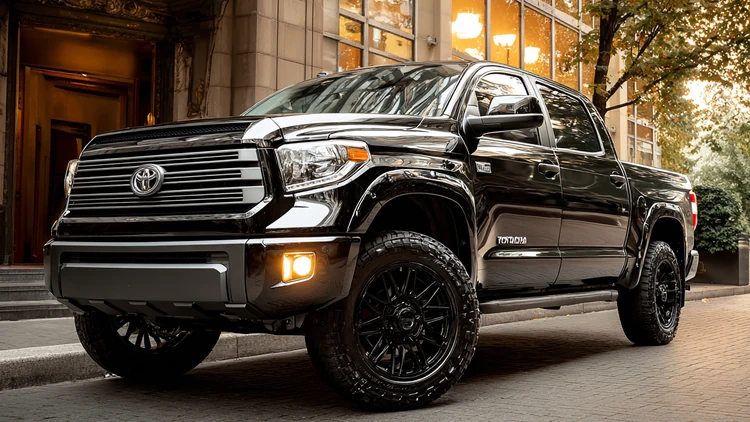
  • Only two large pickups — the Rivian R1T and Toyota Tundra — made the 2025 list


Back seat protection falls behind

Minivans and pickups are falling short when it comes to protecting rear seat passengers, according to new safety testing by the Insurance Institute for Highway Safety (IIHS).

The group’s 2025 Top Safety Pick awards reveal that belted adults riding in the back seat of newer vehicles face a higher risk of fatal injury compared with those in the front. The shortfall reflects how much faster automakers have improved front-seat safety features, leaving the back seat lagging behind.

IIHS now requires that second-row occupants have protection equal to what’s offered in the front. As a result, only 48 vehicles earned safety awards this year — down from 71 at this point in 2024.

SUVs dominate, minivans and pickups falter

Small and midsize SUVs claimed the majority of honors, with 12 vehicles earning the “Top Safety Pick” rating and the rest achieving the higher “Top Safety Pick Plus.”

But the picture was bleak for other categories. Not a single minivan, large car, small pickup, or minicar made the list. Only two large pickups — the Rivian R1T and Toyota Tundra — qualified under the tougher rules.

Detroit automakers struggled as well. Ford landed two models — the Mustang Mach-E and Lincoln Nautilus — in the Top Safety Pick Plus category, while Chevrolet’s Traverse managed a Top Safety Pick. Stellantis failed to place any vehicles.


What to know

  • Back seat safety lags: IIHS finds rear passengers in new vehicles face higher risks than those in the front.

  • Tougher standards shrink the list: Only 48 vehicles won Top Safety Pick awards this year, down from 71 in 2024.

  • SUVs shine, minivans flop: Small and midsize SUVs dominated, while no minivans or small pickups qualified.

  • Few pickups make the cut: Only the Rivian R1T and Toyota Tundra passed the new tests.

  • Detroit 3 struggle: Ford placed two models, Chevrolet one, and Stellantis none.

  • Key tech missing in back seats: Features like pre-tensioners and load limiters, common up front, are rare in the rear.


Automakers urged to step up

IIHS President David Harkey said he was disappointed with the lack of strong performers from U.S. brands, particularly in family-oriented vehicles such as minivans.

“Some of the automakers behind vehicles advertised as family-friendly need to step up and make improvements quickly,” he said.

Harkey pointed to two key safety technologies that are now common in the front seat but rare in the back: pre-tensioner belts, which tighten before a collision to position passengers properly, and load limiters, which loosen slightly during impact to reduce chest injuries.

How the tests worked

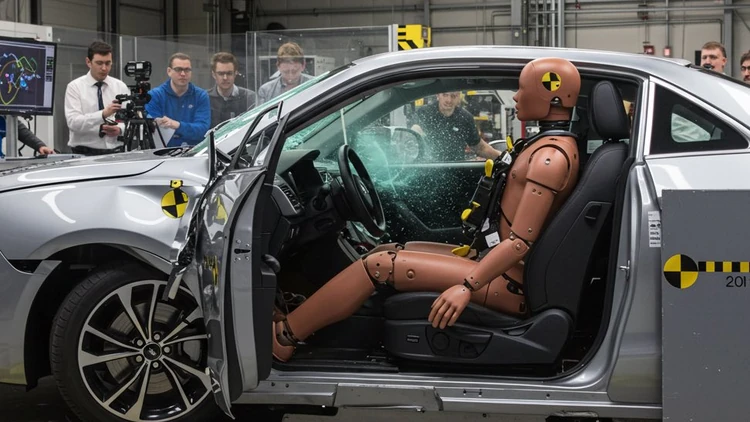
IIHS researchers simulated head-on collisions at 40 mph with 40% overlap, measuring how well seat belts protected rear passengers. A new, smaller crash-test dummy — representing either a petite woman or a 12-year-old child — was placed behind the driver to highlight risks to smaller occupants.

The tests tracked chest injuries, abdominal trauma from “submarining” under the lap belt, and how far forward a passenger’s head traveled on impact.

“It wasn’t that the back seat has become less safe — it’s just that we’ve continued to make all these advancements in the front seat, and we’ve left the back seat behind,” Harkey said.

Bottom line for families

Despite the weaker scores, IIHS continues to recommend the back seat as the safest place for children under 13. Still, the findings highlight how far automakers must go to bring rear passenger protection in line with the front.

Article Image

Consumer group opposes heavier trucks on federal highways

  • Truckers and shippers are pushing for heavier weight limits for trucks on federal highways.
  • Congress is considering a measure that would allow trucks up to 91,000 pounds.
  • The National Consumers League opposes the measure, saying it would be a "significant threat" to public safety and infrastructure.

Congress is considering a measure that would allow heavier trucks on federal highways — something the National Consumers League (NCL) thinks is a bad idea.

The organization says the move would be "a significant threat to public safety, infrastructure, and taxpayers."

The proposal under consideration is H.R. 3372, introduced by Rep. Dusty Johnson (R-SD), which seeks to establish a 10-year pilot program allowing six-axle trucks to operate at weights up to 91,000 pounds — an increase from the current federal limit of 80,000 pounds. Participation would be voluntary for states.

In an opinion piece published today in The Hill, NCL’s Senior Director of Consumer Protection & Product Safety, Daniel Greene, joined David Williams, the President of the Taxpayers Protection Alliance, to warn lawmakers and the public about the dangers of weakening truck size and weight limits.  

“Increasing size and weight limits would exacerbate the nation’s traffic safety crisis,” write Greene and Williams. “The heavier the truck, the greater the crash forces, increasing the lethality accidents.”  

400% more likely to crash

Data cited in the article show that trucks weighing 91,000 pounds or more are up to 400 percent more likely to be involved in major crashes and cause significantly more damage to roads and bridges. Replacing weakened infrastructure to accommodate these trucks could cost taxpayers $80 billion, according to a 2023 analysis.  

“Politicians and advocacy groups across the political spectrum may not always agree on the best way to fix America’s roads, but they should agree that introducing larger and heavier vehicles is a recipe for disaster,” Greene and Williams continued. “ Lawmakers should swerve away from these policy potholes and commit to real bipartisan protections.”  

Supporters say the heavier weight limits would enhance supply chain efficiency, address the truck driver shortage by maximizing freight per trip and lower fuel consumption per unit of freight. 

Proponents, including the Shippers Coalition and the American Farm Bureau Federation, contend that the additional axle required for these heavier trucks would maintain or even improve safety by distributing weight more effectively and reducing stopping distances.

But NCL is calling on Congress to uphold current truck size and weight limits and reject efforts to allow heavier trucks or longer multi-trailer rigs on U.S. highways. 

Article Image

Pedestrian deaths rising faster than overall U.S. population growth

Article Image

Virginia to require speed-limiting tech for reckless drivers

In brief ...

  • đźš— New law mandates speed-limiting technology for drivers convicted of reckless speeding—specifically those caught going over 100 mph.

  • ⚖️ Starting July 2026, judges will order enrollment in “intelligent speed assistance” (ISA) programs; repeat offenders may be offered the program in lieu of license suspension or jail.

  • 📉 Advocates say the tech could help reduce speeding-related fatalities, which accounted for over 12,500 U.S. deaths in 2022.

Details

A new Virginia law aimed at cracking down on reckless driving will require some convicted speeders to install intelligent speed assistance (ISA) technology in their vehicles—a move hailed by road safety advocates as a potential life-saver.

Signed into law as HB2096, the policy applies to drivers convicted of reckless driving at speeds exceeding 100 miles per hour. Starting in July 2026, courts will be required to enroll those individuals in an ISA program, which uses GPS and speed-limit databases—or cameras that detect road signs—to either alert drivers when they're speeding or actively limit the vehicle’s speed.

“This will make our streets safer,” said Del. Patrick A. Hope (D-Arlington), a lead sponsor of the bill.

Better than jail ...

The law also offers ISA as an alternative to license suspension or jail time for repeat traffic offenders who have accumulated enough demerit points. Under the program, drivers will be barred from operating any vehicle not equipped with ISA and will be required to pay for installation themselves.

An emotional push for the bill came from Tammy McGee, whose teenage son, Conner Guido, was killed by a reckless driver. “I hope that by installing speed-limiting technology on the vehicles of those who choose to repeatedly speed, we can save lives,” she said.

A proposed amendment by Gov. Glenn Youngkin would give judges discretion over how long a driver remains in the program—pending approval from the state legislature.

The law applies only to private passenger vehicles, not commercial ones, but it reflects growing national momentum for ISA. New York City, for example, has reported a 64% drop in high-speed driving in areas where ISA-equipped fleet vehicles are in use. Other cities, including Ventura County (CA), Somerville (MA), and Washington, D.C., have already launched pilot programs.

With speeding involved in nearly 30% of U.S. traffic fatalities, according to the National Highway Traffic Safety Administration, safety groups like the Insurance Institute for Highway Safety and Families for Safe Streets are calling for broader adoption of the tech—including federal mandates.

In January, the National Transportation Safety Board (NTSB) recommended ISA be required in all new vehicles—either as a passive alert system or one that actively limits speed.

Article Image

More than 7,000 Jaguar Land Rovers recalled

Jaguar Land Rover is recalling 7,276 2025 Range Rover and Range Rover Sport vehicles. The second-row center seat belt buckle may not latch correctly due to a manufacturing error.

An unlatched seat belt will not properly restrain an occupant, increasing the risk of injury.

What to do

Dealers will replace the center seat belt buckle and buckle retaining bolt, free of charge. Owner notification letters are expected to be mailed by May 2, 2025. Owners may contact Land Rover's customer service at 800-637-6837. Land Rover's number for this recall is N989.

Owners may also contact the National Highway Traffic Safety Administration Vehicle Safety Hotline at 888-327-4236 (TTY 888-275-9171) or go to nhtsa.gov.

To determine if your vehicle is included in the recall, visit the NHTSA recall page and enter the license plate number or 17-digit VIN.

Article Image

How to stay safe on the road during daylight saving time

With daylight saving time just days away, many consumers may not think about some of the unintended risks associated with this bi-yearly event. 

One such risk: an increase in traffic accidents. Several recent studies have highlighted the association between daylight savings time and more traffic accidents. 

To help keep consumers safe this weekend – and beyond – ConsumerAffairs interviewed Katie Ekstrom, the assistant vice president of Auto Product Development for Personal Insurance at Travelers. She shared the biggest risks to consumers on the road, how to stay safe behind the wheel, and the importance of being proactive. 

What are the biggest risks to drivers? 

Though the clocks only shift forward one hour, Ekstrom explained that we’re likely to feel the effects of that one hour. Drowsiness behind the wheel in the wake of daylight savings can be a major factor for drivers. 

“It can take several days to adjust to the time change fully,” Ekstrom told ConsumerAffairs. “Disruptions to sleep schedules can impact reaction times, alertness, and awareness of hazards, increasing the risk of accidents.” 

On top of that, while many consumers won’t complain about having the extra sunlight, it can be a hazard to drivers. 

“Morning sun glare, which is more common after the clocks move forward, can make it difficult to see other vehicles, contributing to crashes. In fact, sun glare is responsible for approximately 9,000 accidents each year, according to the National Highway Traffic Safety Administration,” Ekstrom said. 

How can drivers stay safe? 

With this information, consumers can still stay safe on the roads. Ekstrom’s biggest piece of advice is for consumers to be proactive and prepared when they’re driving this weekend. 

“To protect yourself, plan ahead by adjusting your sleep schedule and going to bed a little earlier each night. If you’re on the road and start to feel drowsy – do not push through, pull over and rest,” Ekstrom advised. 

When it comes to cutting down glare, the solution is simple: sunglasses. 

“Keep a pair of sunglasses in your car and use your sun visor to help cut down on glare,” she said. “Be extra cautious at intersections, as bright sunlight can make it difficult to see traffic lights and harder to spot pedestrians crossing the street.” 

Another way to stay safe on the road: eliminate potential distractions. 

“With focus already impacted by sleep loss, it’s best to keep distractions to a minimum by programming your navigation before you leave, saving meals for your destination, and staying off your phone,” Ekstrom said. 

It takes time to adjust to the time change

Ekstrom explained that it takes time for our bodies to fully adjust to the time change from daylight savings. This means that these impacts are not just immediately present, but can also have lingering effects in the following days.

“Make sure you’re giving yourself time to adjust to the changes,” Ekstrom said. “Drivers around you may also be impacted by the time change, so ensuring that you are following safe driving practices can contribute to improved driving safety overall.” 

Her final piece of advice: patience goes a long way. 

“Since all drivers are in the same boat, practicing patience can go a long way,” Ekstrom said. “Defensive driving, staying alert, and planning ahead can make all the difference.” 

2024
2023
2022