Best Flooring Companies in Atlanta, GA of 2026
 Empire Today
 Peach State Hardwood
 Atlanta Flooring Solutions

+2 more


Best Flooring Companies in Atlanta, GA of 2026
Atlanta's humid summers, damp crawl spaces and century-old heart pine floors put real demands on whoever installs your next floor. We researched independently owned flooring companies in Atlanta, comparing services, free estimates and installation lead times, so you can find the right installer for your home.
Why trust ConsumerAffairs?
Our editors, fact-checkers and moderators work to uphold standards for accuracy, transparency and trust.
Our editorial standards
- Our editorial team reviews and fact-checks all content before it’s published.
- We rely on expert input and trusted sources to verify our articles.
- All articles published must meet our editorial standards and independence policy.
Our review standards
- Our moderation team evaluates reviews to make sure they meet our guidelines.
- We require contact information to verify reviews come from real customers.
- Financial relationships do not influence whether we publish a consumer review.
To find the best flooring companies in Atlanta, we analyzed aggregate rating data across major review platforms, giving more weight to ConsumerAffairs reviews than third-party reviews. Read our full methodology below.
Compare the best Atlanta flooring companies
| Company | Customer rating | ConsumerAffairs Score | Free in-home estimate? | Time to installation* | Year founded | Location | |
|---|---|---|---|---|---|---|---|
 Empire Today | Get Pricing | 4.5
10,646 reviews
10,646 reviews
| 9.0/10 |  | Usually in 2 days or fewer | 1959 | Nationwide |
 Peach State Hardwood | Write a Review | No rating | 9.7/10 | | Within 1 week | 2015 | 1201 W. Peachtree St. NW, Suite 2349, Atlanta, GA 30309 |
 Atlanta Flooring Solutions | Write a Review | No rating | 9.6/10 | | Call to confirm | — | 4538 Hugh Howell Road, Tucker, GA 30084 |
 Moda Design Center | Write a Review | No rating | 9.4/10 | | Within a few weeks | 2003 | 1417 Chattahoochee Ave. NW, Atlanta, GA 30318 |
 Your Floor | Write a Review | No rating | 9.4/10 | | Call to confirm | 1996 | 5172 Brook Hollow Parkway, Unit C, Norcross, GA 30071 |
 Flooring Atlanta | Write a Review | No rating | 9.3/10 | | Same week | 2008 | 5894 Goshen Springs Road, Norcross, GA 30071 |

Flooring in Atlanta, GA Buyers Guide
Jump into our guides and start learning
In this guide

Between August humidity that can cup a new oak floor and intown bungalows perched over damp crawl spaces, Atlanta is hard on floors that aren't chosen and installed with care. We'll cover everything you need to know about costs, materials that handle Georgia's climate and what to ask before you hire.
Key insights
The installer matters more than the showroom, since many flooring failures in Atlanta trace back to skipped moisture tests and rushed acclimation.
Jump to insightAtlanta homeowners usually pay $4 to $14 per square foot installed, with carpet at the low end and solid hardwood and tile at the top. Premium materials can cost much more.
Jump to insightCrawl space moisture is the big one in Atlanta, where humid air under older homes can cup hardwood from below.
Jump to insightHow to choose a flooring company in Atlanta
To choose a flooring company in Atlanta, confirm who will physically do the installation, check reviews from local homeowners and compare itemized quotes with written warranties. Skipping any of those steps is where things go sideways — especially in a city where sticky summer humidity and crawl spaces can expose every shortcut an installer takes.
1. Decide what kind of flooring company you need
Three broad categories of flooring companies operate in Atlanta, each with a different model:
- Showroom retailers: These companies operate a physical store where you browse and select materials, then schedule installation — often through subcontracted labor. Best for homeowners who want to see a wide range of samples side by side before committing.
- Shop-at-home companies: A sales rep drives to your home with samples, takes measurements and can often schedule installation within days using products the company keeps in stock. The tradeoff is a narrower product selection.
- Independent installers: These contractors either supply the flooring or install what you've already purchased. Labor costs tend to be lower, but product and workmanship warranties come from separate sources, so you'll need to manage both.
Moisture management should be part of every installer's process, and many area homes are built on crawl spaces, so look for a company that understands what this means for subfloor prep. If you own an older home in a neighborhood like Inman Park or Grant Park, prioritize installers with experience restoring or matching original hardwood.
2. Check online reviews from locals
Reviews from Atlanta homeowners give you a ground-level view of how a company actually performs — from the first sales call through any warranty follow-up. ConsumerAffairs reviews of flooring companies point to a recurring set of problems worth watching for:
- Warranty claims that go nowhere: Complaints frequently describe damage that surfaces months after installation — lifting planks, separating seams, buckling boards — only to be denied as a warranty claim or attributed to something the homeowner did.
- Rushed or sloppy installation: Reviewers report visible gaps at walls, uneven transitions, seams in high-traffic areas and planks that begin separating within weeks of install, often tied to crews cutting corners to finish faster.
- Sales promises that don't make it into the contract: Customers describe reps who verbally committed to discounts, extra services or warranty coverage that the company later refused to honor, sometimes alongside a final bill that didn't match the original quote.
- No-shows and last-minute cancellations: Some reviewers describe clearing out rooms and taking time off work, only to get a day-of cancellation because materials hadn't arrived or the crew was double-booked.
- Damage to walls, trim and belongings: Installers have been reported to scuff freshly painted walls, gouge door casings or damage furniture, leaving homeowners to push for repairs.
Stockbridge resident Keesha shared that the crew left dings on the furniture and didn't reassemble a bed correctly: "We just had some dings on our furniture that we didn't appreciate. We saw some light deep scratches on the dresser and the bed wasn't put back together correctly."
Pay close attention to how a company handles complaints in its public responses. A business that resolves problems promptly and professionally is often the more reliable choice, even if its overall rating isn't perfect.
3. Find out who will actually install your floors
It's common for flooring retailers and shop-at-home companies to use subcontracted crews rather than direct employees. That arrangement can work fine, but you deserve to know who's coming to your home. Ask how long that crew has worked with the company, what vetting process it uses for subcontractors and who you call if something needs to be fixed after the job is done.
Flooring-only contractors in Georgia generally don't need a state residential contractor license. Wood flooring, carpet and tile are recognized as exempt specialty trades. Larger remodeling projects involving work outside those specialties may require a licensed residential contractor when the project value exceeds $2,500. Verify applicable licenses through the Georgia Secretary of State Licensee Search before signing anything.
4. Look for experience with your material
Hardwood, tile and floating floor systems each demand a different skill set, and an installer who excels at luxury vinyl plank (LVP) may not be the right person to sand and refinish 100-year-old heart pine. Ask how frequently the company works with your chosen material and request photos of comparable jobs. Though not necessarily required for flooring installation, industry certifications are a reliable indicator of serious training:
- The National Wood Flooring Association (NWFA) certifies hardwood installers and refinishers.
- The International Certified Flooring Installers Association (CFI) certifies carpet and resilient flooring installers.
- The Ceramic Tile Education Foundation (CTEF) runs the Certified Tile Installer (CTI) program.
For referrals, ask neighbors who've had floors done recently, browse the member directory of the Greater Atlanta Home Builders Association or reach out to a real estate agent or general contractor for names they trust.
5. Insist on an in-home measurement and subfloor check
Any quote worth trusting begins with a physical visit to measure your actual rooms and inspect the subfloor up close. The estimator should assess whether the subfloor is level, check for soft or damaged areas and test for moisture, particularly over crawl spaces and concrete. Moisture is a major cause of flooring failures in Atlanta.
Ask how your flooring will be acclimated before installation. Requirements vary by product: hardwood may need several days or longer, laminate often requires at least 48 hours and some luxury vinyl plank products need no acclimation. Any company that offers a full-home price based solely on a phone call or a photo is cutting corners before the job even starts.
6. Compare itemized quotes and warranties
Collect at least three written quotes and make sure each covers the same scope so you're comparing apples to apples. Every quote should break out:
- Square footage
- The exact product
- Underlayment or padding
- Removal and disposal of old flooring
- Subfloor preparation
- Furniture moving
- Stairs
- Transitions
- Trim
Most quotes also add 5% to 10% extra material to cover cuts and waste, and more for diagonal or herringbone layouts. Compare total installed prices rather than headline sale prices, since promotions, removal, subfloor preparation and other services can add to the final cost.
Warranties deserve the same scrutiny. The product manufacturer covers material defects; the installer covers workmanship. Installation warranties range from one year to a lifetime, and improper installation can void the manufacturer's coverage entirely — one more reason to vet your installer carefully before signing.
» COMPARE: Top flooring companies across the U.S.
Average flooring costs in Atlanta
The cost of flooring in Atlanta runs $4 to $14 per square foot installed on average, but budget materials may cost less and premium options may cost more. Your final cost also depends on the total area being covered and how much subfloor work is needed.
Here’s a breakdown of estimated flooring and related service costs:
Get a per-square-foot subfloor repair rate in writing before demo day.
In-home estimate: Free
Carpet with pad (installed): $2 to $7 per square foot
Luxury vinyl plank or tile (installed): $4 to $15 per square foot
Laminate (installed): $4 to $13 per square foot
Engineered hardwood (installed): $7 to $19 per square foot
Solid hardwood (installed): $10 to $24 per square foot
Ceramic or porcelain tile (installed): $9 to $46 per square foot
Hardwood refinishing: $3 to $7 per square foot
Old flooring removal: $0.65 to $1.50 per square foot for carpet; $2 to $6.50 per square foot for tile or glue-down floors
Single room (about 250 square feet): $1,000 to $3,500
Whole-home flooring (about 1,500 square feet): $6,000 to $21,000
Larger whole-home projects are typically quoted as a package that folds in removal, underlayment, stairs and trim.
» MORE: Costs of different flooring types
Other factors that affect price
Several variables can push your final bill up or down:
Material grade and category — carpet and laminate sit at the lower end of the price range, while solid hardwood and large-format tile cost considerably more
Total square footage, since many companies charge a minimum on smaller jobs
Removing old flooring, particularly glued-down tile, sheet vinyl or mortar-bed installations
Subfloor repair, replacement or leveling work
Stairs, which are typically priced per individual step
Complex layout patterns such as herringbone, diagonal runs or rooms with many closets and angled walls
Moving furniture and disconnecting appliances
Underlayment, padding and moisture barriers
Transitions, baseboards and trim work
Best flooring types for Atlanta homes
For most Atlanta homes, LVP is the most practical all-around choice. It shrugs off Atlanta's wet summers and crawl space moisture, stands up to pets and red clay grit and suits a city proper where more than half of homes are rentals. Here's how the most common flooring options stack up locally:
- Luxury vinyl plank (LVP): Waterproof, scratch-resistant and pet-friendly. Luxury vinyl plank is the default for finished basements in Brookhaven and Decatur split-levels and for Midtown rentals, where landlords want waterproof floors that survive tenant turnover.
- Laminate: A budget-friendly wood look that resists scratches, though most products handle standing water worse than LVP. Laminate works for budget-minded flips in neighborhoods like West End. Choose a water-resistant core, since standard boards swell.
- Solid hardwood: The priciest of the common options, but it can be refinished many times and tends to add the most resale value. Solid oak and heart pine remain the resale standard in intown neighborhoods like Inman Park and Virginia-Highland, where buyers expect original wood floors to be refinished, not covered.
- Engineered hardwood: A real wood top layer over a stable core that handles humidity swings and concrete better than solid hardwood. Engineered hardwood is the safer wood choice over the concrete slabs and basements common in newer suburban builds around Atlanta, since its layered core resists humidity swings.
- Tile: Extremely durable and water-resistant, but it has the highest labor cost and feels hard and cold underfoot. Porcelain tile suits Atlanta kitchens, baths and mudrooms, and it stays cool underfoot through summers that regularly top 90 degrees.
- Carpet: The least expensive option per square foot and the most comfortable underfoot. Carpet is still common in upstairs bedrooms of two-story suburban homes around Atlanta, though buyers increasingly expect hard surfaces on the main floor.
Room-by-room flooring guide for Atlanta homes
The right material for a kitchen isn't always the right call for a bedroom or a staircase. Here's what to weigh in each part of a typical Atlanta home:
- Kitchens: Kitchens need flooring that handles spills, heavy foot traffic and dropped dishes, which is why LVP, tile and engineered hardwood are the most popular choices. Renovated Atlanta bungalows often open the kitchen into the living room, so choose a floor that handles spills and can run continuously through both spaces.
- Bathrooms and laundry rooms: Choose fully waterproof flooring like porcelain tile or LVP. Avoid solid hardwood and most laminate in any room where water can pool. Bathrooms over crawl spaces in older Atlanta homes need a stiff, dry subfloor before tile goes down, or grout lines can crack as the floor flexes.
- Crawl space ground floors: These floors sit closest to ground moisture, so materials that tolerate moisture, like LVP, tile and engineered hardwood usually outperform solid hardwood. Before installing any floor over an Atlanta crawl space, have it checked for standing water and a vapor barrier, since ground moisture rises through the subfloor all summer.
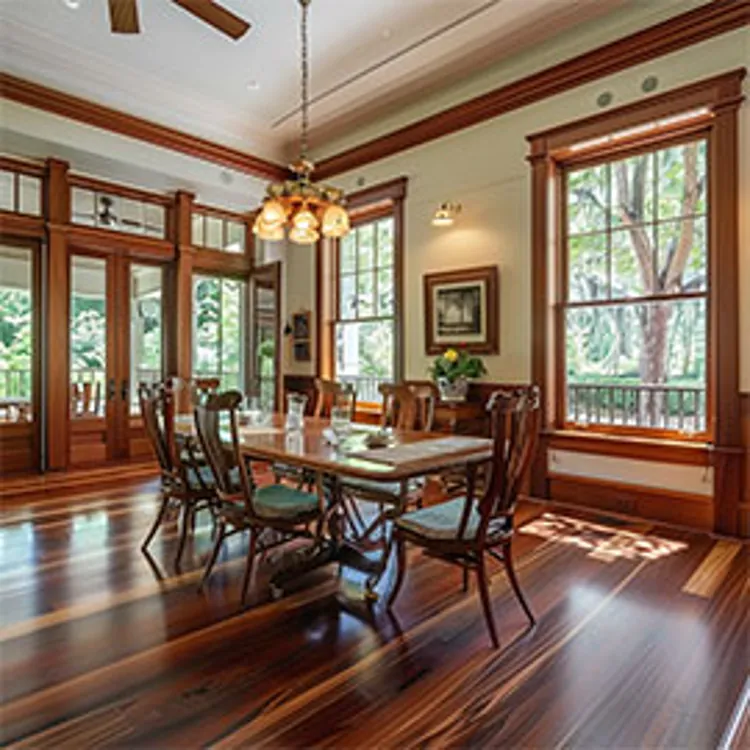
- Living and dining rooms: These rooms set the visual tone of the home, so many homeowners choose hardwood or a wood-look option and carry it through connected spaces for a cohesive feel. Older Craftsman bungalows in Atlanta neighborhoods like Grant Park and Inman Park may still have original oak or heart pine floors. If the wood is in good condition, refinishing can preserve the home's historic character and may offer better value than replacing it.
- Bedrooms: Comfort and quiet matter most here, which keeps carpet popular in bedrooms. Bedrooms in Atlanta's two-story suburban homes are often the last carpeted rooms, and many owners keep carpet there to quiet footsteps over the main floor.
- Entryways and mudrooms: The first few feet inside the door take the most grit and moisture, so tile or LVP paired with a sturdy entry mat holds up best. A tough, easy-to-clean entry floor matters in Atlanta, where the thick yellow pollen of March and April coats shoes and gets tracked through every room.
- Stairs: Stairs take a lot of wear and are priced per step, so choose a durable, slip-resistant material with stair nosing that matches the surrounding floors. Many Atlanta two-story and split-level homes still have carpeted stairs, and swapping to hardwood treads with iron balusters is one of the most requested upgrades.
FAQ
Can I keep the original heart pine floors in my historic Atlanta home?
Yes, you can usually keep the original heart pine floors in your historic Atlanta home by having them sanded and refinished. Heart pine in Inman Park and Grant Park homes is dense and often has enough wood left for another refinish. Replace only damaged boards, using reclaimed heart pine to match.
Is it safe to install hardwood in an Atlanta basement?
No, it isn't safe to install solid hardwood in most Atlanta basements, because below-grade concrete releases moisture that cups and warps solid boards. Engineered hardwood or luxury vinyl plank (LVP) over a moisture barrier is a better fit, especially in walkout basements on sloped lots.
When is the busiest time of year for flooring companies in Atlanta?
The busiest time of year for flooring companies in Atlanta is spring, when sellers prep homes for the market and new buyers renovate before moving in. Fall gets busy too as homeowners race to finish before Thanksgiving. Book two to four weeks ahead during these stretches.
How do I protect new floors from Atlanta's climate?
You can protect new floors from Atlanta's climate by keeping indoor humidity between 35% and 55% with AC or a dehumidifier all summer. Let wood acclimate before installation, put mats at every entry to catch red clay and pollen, add felt pads to furniture and wipe up spills and tracked-in rain quickly.
Could my old floors in Atlanta contain asbestos?
Yes, your old floors in Atlanta could contain asbestos if they were installed before the 1980s, especially 9-inch vinyl tiles and black mastic adhesive. Have suspect materials tested before removal. The Georgia Environmental Protection Division (EPD) regulates asbestos abatement and licenses removal contractors.
Methodology: How we chose the best flooring companies in Atlanta, GA
To rank the best flooring companies in Atlanta, we analyzed thousands of customer reviews across popular review platforms. Weightings were based on how much review data each platform had available, with additional weight given to ConsumerAffairs reviews. Companies were scored on a zero to 10 scale using a blend of their ratings from all review sites.
To keep things fair, a perfect score from 20 reviews carries less weight than a perfect score from 5,000. The more reviews a company has, the more its rating is taken at face value. Companies with very few reviews on one platform were assigned a neutral score for that platform rather than leaving it out entirely.
Thanks for subscribing.
You have successfully subscribed to our newsletter! Enjoy reading our tips and recommendations.
Guide sources
ConsumerAffairs writers primarily rely on government data, industry experts and original research from reputable publications to inform their work. Specific sources for this article include:
- Federal Trade Commission, “How To Avoid a Home Improvement Scam.” Accessed Nov. 9, 2026.
- National Wood Flooring Association, “Problem Prevention.” Accessed Nov. 9, 2026.
Learn more about flooring companies in Atlanta

24/7 customer service available. Offers free in-home consultations. Includes all-inclusive price estimates and next-day installation. Financing and referral programs. Low-price guarantee.
Solid and engineered hardwood installs, including custom inlays and herringbone. Waterproof flooring, stair carpet runners and handrail upgrades. Sanding and refinishing by in-house crews. Lifetime labor warranty.
Tucker showroom plus shop-at-home service for luxury vinyl plank, carpet, laminate, tile and hardwood. Hardwood sanding and refinishing a specialty. Old flooring removal and subfloor prep. Commercial installs too.

Design-led showroom with in-house designers guiding every project. Hardwood, luxury vinyl, carpet, tile and natural stone. Custom rugs and stair runners. Commercial flooring. Two-year installation warranty.

Dustless and sandless hardwood refinishing plus new hardwood installs. Waterproof luxury vinyl plank and carpet. Staircase makeovers with wood treads and iron spindles. Two-year labor warranty and financing.

Four metro showrooms stocking luxury vinyl plank, hardwood, laminate and carpet for faster installs. Handles removal, subfloor prep and furniture moving. Custom rugs and stair runners. One-year labor warranty.

Looking for other services in Atlanta, GA?
From moving and renovations to homeownership and maintaining a car, the right company matters. Explore local guides and resources.
Find Local Companies