The Income Needed to Afford Daycare in Every State (2026)

+1 more

In 2025, the fertility rate in the U.S. dropped to a historic low, according to the National Center for Health Statistics. With Americans reporting feelings of financial insecurity, a number of factors may be contributing to the decline. A piece of the puzzle? Childcare.
A ConsumerAffairs analysis found the average cost of daycare — at over $14,000 annually — is more than 14% of the median family pretax income — twice the 7% affordability benchmark set by the U.S. Department of Health and Human Services.
According to experts, families are absorbing the cost by running tighter budgets, having fewer children or leaving the workforce. “The (childcare) system may appear more functional than it is because families are absorbing much of the instability themselves,” said Brittany Walsh, senior associate director at the Bipartisan Policy Center. And for families already struggling with debt, the financial burden of daycare can feel even heavier.
The ConsumerAffairs Research Team analyzed the cost of childcare in each state and used the 7% benchmark to calculate how much residents need to earn to put their child in center-based daycare. Keep reading to see how your state ranks.
Nationally, families need to earn about $205,000 to afford toddler care, more than twice the median family income of about $100,000.
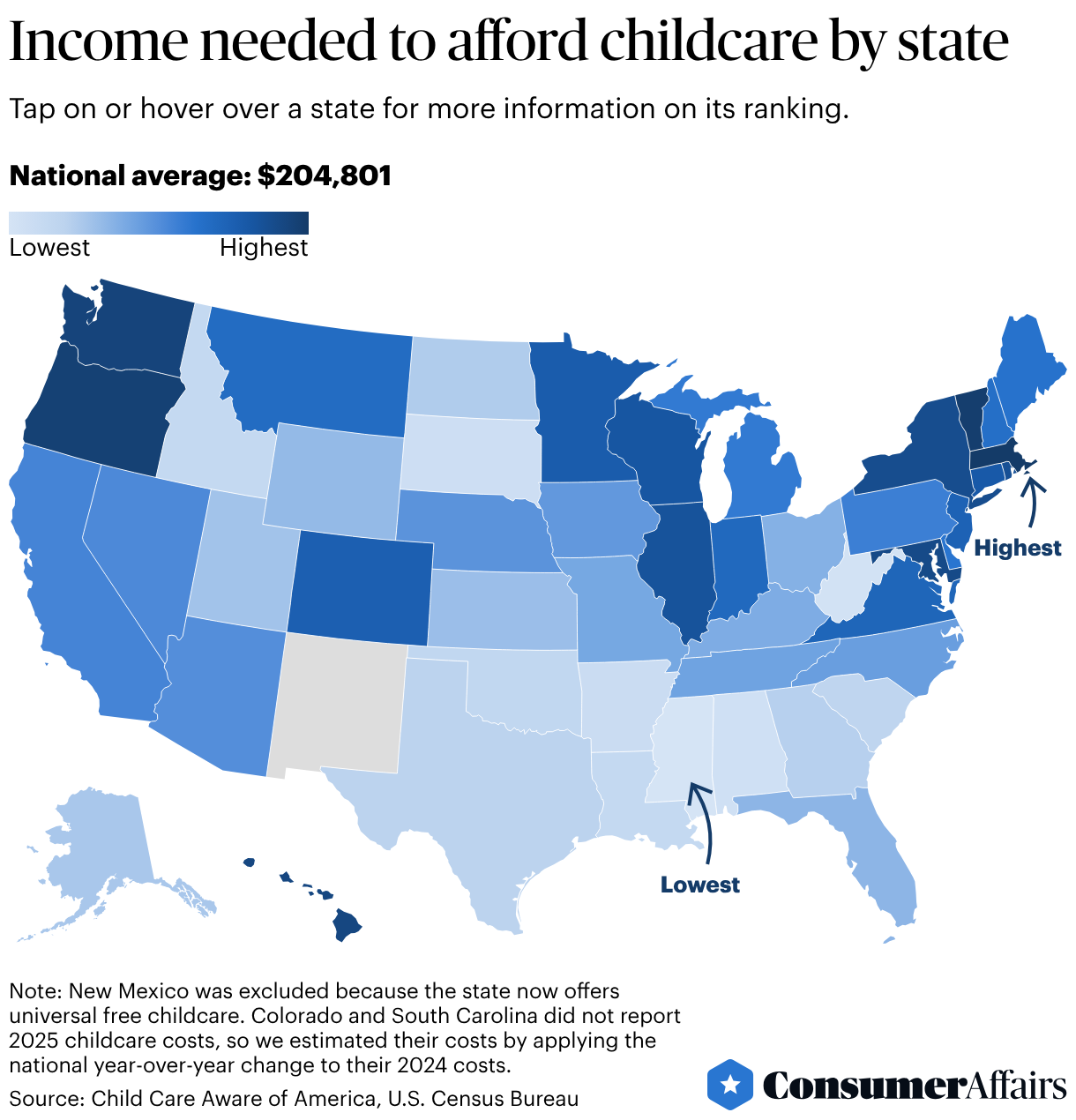
Jump to insightMassachusetts requires the highest household income to afford daycare — about $350,000 a year.
Jump to insightMississippi requires the lowest household income to afford childcare (about $93,000), but that's still about $19,600 more than the state’s median family household income.
Jump to insightAnnual toddler care costs more than a year of in-state public college tuition in 37 states.
Jump to insightHow much income does toddler care really require?
The federal government established 7% as a limit for what working families should pay for childcare. Today, a family making the median income is spending over twice that, on average, to send their toddler to childcare full-time.
Our analysis found that to adhere to this guideline, the typical U.S. household needs to earn $205,196 — yet the median family income is $99,999. (Families sending a younger child or more than one child to daycare need to earn more.) In every state, the cost of childcare exceeded the 7% benchmark.
However, one state was excluded from our affordability analysis: New Mexico. In late 2025, it became the first to offer universal no-cost childcare to all residents, regardless of income.
Check out the map below to explore the relationship between childcare costs and income in each state.
Where families need the highest income to afford childcare
The states with the highest income needed are largely concentrated in the Northeast and West. This may come as no surprise; states in these regions struggle with affordability across the board, including having some of the least affordable homebuying metros in the country.
Daycare costs vary for a number of reasons. “States … play a critical role in shaping the policies that influence childcare access, affordability, quality and long-term stability,” said Elise Cranston, director of federal policy and advocacy at Child Care Aware of America, an organization that promotes high-quality childcare.
In each of the five states where families need the highest income to afford childcare, the average cost of care as a percentage of median income is at least 16.7% — over two percentage points higher than the national average of 14.3% , and 10 points higher than the 7% benchmark.
1. Massachusetts
Household income needed to afford childcare: $349,543
In Massachusetts, daycare for a toddler costs families an average of $2,039 each month. Childcare expenses in the Bay State are over 50% higher than annual in-state college tuition, and 10% higher than the median rent. With the current price of childcare, a typical Massachusetts family would need to earn an extra $218,000 to keep costs at 7% —the largest gap in the country.
However, the state has made recent efforts to curb childcare costs. In June 2026, Gov. Maura Healey signed budget legislation that allocated $31.2 million to help families on waitlists pay for early education and care.
- Average annual cost of full-time, center-based toddler care: $24,468
- Median family income: $131,675
- Childcare as a share of median family income: 18.6%
2. Vermont
Household income needed to afford childcare: $294,586
Vermont ranks as the second-most expensive state for childcare, with average daycare costs around $1,718 a month for a toddler. That’s 30% higher than the median rent statewide, a staggering gap exceeded only in Wisconsin (34.6%). There is nuance, though: In 2023, a new childcare law, Act 76, expanded eligibility for childcare financial aid.
Under Act 76, a family of three earning up to 575% of the federal poverty level (FPL) — around $157,090 — may qualify for subsidized childcare. Though this threshold may sound relatively high, remember that how far your salary stretches depends on where you are. To keep childcare costs under the 7% affordability standard, a Vermont household needs to earn nearly $300,000.
- Average annual cost of full-time, center-based toddler care: $20,621
- Median family income: $105,211
- Childcare as a share of median family income: 19.6%
3. Oregon
Household income needed to afford childcare: $293,814
In Oregon, average childcare costs currently take up the largest percentage of median family income (20.1%) of any state in the country. There, the average monthly childcare cost is just $4 less than second-place Vermont, at $1,714. A family with a median income in the state would need to make nearly triple their pay for current childcare costs to be considered affordable. State subsidies in Oregon are limited to households making under 200% of the federal poverty level ($54,640 for a family of three).
“High prices should not be misunderstood to mean that childcare providers are earning large profits,” said Walsh of the Bipartisan Policy Center, instead describing “razor-thin” profit margins. High operating costs, particularly for staffing that complies with state-mandated staff-to-child ratios, can make it difficult for centers to keep their doors open.
- Average annual cost of full-time, center-based toddler care: $20,567
- Median family income: $102,281
- Childcare as a share of median family income: 20.1%
4. Washington
Household income needed to afford childcare: $293,486
In Washington, annual childcare costs are 140% higher than average in-state college tuition — a larger gap than anywhere but Florida (154%). The average monthly cost of daycare in the Evergreen State, $1,712, is not far behind that in Oregon and Vermont.
Washington does break a trend: It’s the highest-ranking state on the list where childcare costs do not exceed the median rent — though this is largely because it has some of the highest rents in the nation, and not necessarily because childcare is more affordable. Nonetheless, childcare subsidies are available for Washington families earning up to 60% of the state median income.
- Average annual cost of full-time, center-based toddler care: $20,544
- Median family income: $118,075
- Childcare as a share of median family income: 17.4%
5. Hawaii
Household income needed to afford childcare: $283,314
The average price of toddler childcare in Hawaii is $1,653 per month; a household making the median family income an additional $164,400 annually, or $13,700 more per month, for this cost to be 7% of income.
About 95% of children under 6 in Hawaii live in a “childcare desert,” according to the Center for American Progress, defined as an area “with limited or no access to quality child care.” The shortage forces some families to rely on family members, drive further for care, leave their jobs or even move. Families who need financial assistance and make less than 500% of the federal poverty level ($157,100 for a family of three) apply through a program called Preschool Open Doors.
- Average annual cost of full-time, center-based toddler care: $19,832
- Median family income: $118,909
- Childcare as a share of median family income: 16.7%
Where families need the lowest income to afford childcare
The states with the lowest childcare costs are concentrated in the South, including four of the five least expensive and eight of the 10 least expensive. Mississippi is by far the cheapest, with an average monthly cost of $541 for full-time toddler daycare.
Still, “least expensive” doesn’t necessarily mean affordable. Mississippi has the lowest income needed to afford childcare in the U.S., at about $93,000 a year, yet the state’s median family income is just $73,163, the lowest nationwide. The gap is even wider for single parents: Single mothers in Mississippi earn a median of about $28,000, while single fathers earn about $49,000.
Although there is no state where a family making the median income can spend less than 7% and afford the average cost of childcare, some come much closer than others. In Mississippi and South Dakota, average childcare costs only take up around 9% of the median family income. But these states also have among the highest family poverty rates in the nation,
Check out where families need the lowest incomes to afford childcare below.
1. Mississippi
Household income needed to afford childcare: $92,743
- Average annual cost of full-time, center-based toddler care: $6,492
- Median family income: $73,163
- Childcare as a share of median family income: 8.9%
2. West Virginia
Household income needed to afford childcare: $121,986
- Average annual cost of full-time, center-based toddler care: $8,539
- Median family income: $77,710
- Childcare as a share of median family income: 11%
3. Alabama
Household income needed to afford childcare: $123,514
- Average annual cost of full-time, center-based toddler care: $8,646
- Median family income: $83,032
- Childcare as a share of median family income: 10.4%
4. South Dakota
Household income needed to afford childcare: $126,557
- Average annual cost of full-time, center-based toddler care: $8,859
- Median family income: $96,562
- Childcare as a share of median family income: 9.2%
5. Arkansas
Household income needed to afford childcare: $127,614
- Average annual cost of full-time, center-based toddler care: $8,933
- Median family income: $76,968
- Childcare as a share of median family income: 11.6%
How does daycare compare with other major household expenses?
We’ve seen how much childcare costs in relation to household incomes, but how does it look next to other big-ticket expenses?
As it turns out, you’d actually save money if you were paying for college instead. On average, yearly childcare for a toddler costs 35% more than in-state tuition at a four-year public school. (There are just 13 states where the average cost of daycare is less than average in-state college tuition.) Daycare costs, however, are lower than median mortgage and rent payments in most states (by about 41% and 20%, respectively).
Childcare costs put families in challenging financial positions, Sandra Bishop, senior director of research at Child Care Aware of America, told ConsumerAffairs. “This affordability problem means they are faced with difficult choices, such as forgoing paying for other family expenses to afford childcare,” she said.
Income needed to afford childcare in every state
Cost is an important consideration for households choosing childcare, but price alone doesn’t tell the whole story. Lower prices may come from higher staff-to-child ratios, meaning each caregiver is responsible for more children. “That's a cost, too; it just doesn't show up in the price data,” said Katharine Sadowski, an assistant professor at the Stanford Graduate School of Education who researches the economics of early childhood education.
State-level policies and economic conditions also play a key role in childcare costs. Staff-to-child ratios, minimum wages, public funding and local operating costs all vary by state. But even in states with the lowest average costs, childcare can consume a substantial share of families’ income.
In the table below, see each state’s average childcare costs and the income families would need to keep those costs at 7% of their earnings.
Calculate the income you need to afford childcare
Wondering if childcare is affordable for you? Enter your household income and where you live to see how much full-time, center-based care would cost. You’ll also see how much of your income would go toward childcare and how much you’d need to earn for care to be considered affordable.
Childcare affordability calculator
Estimated annual cost
—
Share of your income
Income needed
—
How this works: Costs are 2025 state averages for full-time, center-based care from Child Care Aware of America. The U.S. Department of Health and Human Services has in the past defined affordable childcare as being at or below 7% of household income, so the income needed is each state's annual cost divided by 7%. Median family income is from the U.S. Census Bureau (2024).
Estimates assume full-time, center-based care at the state average price for every child listed and do not account for sibling discounts, subsidies, tax credits, home-based care or in-state cost variation. New Mexico is excluded from the cost rankings and state comparisons because it now offers universal childcare; selecting it returns an explanation instead of a cost estimate. Colorado and South Carolina did not report 2025 costs; their figures are estimated by applying the national year-over-year change to their 2024 costs and are marked with an asterisk.
Results are estimates only and do not constitute financial advice.
Methodology
The ConsumerAffairs Research Team analyzed average annual full-time, center-based toddler childcare costs in each state using 2025 data from Child Care Aware of America.
To evaluate affordability, we calculated the household income needed to keep average toddler childcare costs at or below the 7% benchmark previously set by the U.S. Department of Health and Human Services by dividing each state's average annual toddler care cost by 7%.
We also compared childcare costs with:
- Median family income (U.S. Census Bureau, 2024)
- Median rent (U.S. Census Bureau, 2024)
- Median monthly mortgage costs (U.S. Census Bureau, 2024)
- Average annual in-state tuition and fees at public four-year colleges (Education Data Initiative, 2025)
Additional notes:
- New Mexico was excluded because the state now offers universal free childcare.
- Colorado and South Carolina did not report 2025 childcare costs. We estimated their 2025 values by applying the national year-over-year change in childcare costs to each state's most recent reported costs (2024).
Reference policy
We love it when people share our findings! If you do, please link back to our original article to credit our research.
Questions?
For questions about the data or if you'd like to set up an interview, please contact jrodriguez@consumeraffairs.com.
Article sources
ConsumerAffairs writers primarily rely on government data, industry experts and original research from other reputable publications to inform their work. Specific sources for this article include:
- Child Care Aware of America, "Research and Data." Accessed Aug. 7, 2026.
- U.S. Census Bureau, "Explore Census Data." Accessed Aug. 7, 2026.
- EducationData.org, "Average Cost of College by State." Accessed Aug. 7, 2026.
- U.S. Department of Health and Human Services, "Overview of 2024 CCDF Final Rule: Improving Child Care Access, Affordability, and Stability in the Child Care and Development Fund." Accessed Aug. 7, 2026.
- U.S. Centers for Disease Control and Prevention, "Births: Provisional Data for 2025." Accessed Aug. 7, 2026.
- New Mexico Early Childhood Education & Care Department, "Universal Child Care." Accessed Aug. 7, 2026.
- Commonwealth of Massachusetts, "Governor Healey Signs Budget Delivering Major Investments in Early Literacy, Tutoring, Child Care and Public Transportation." Accessed Aug. 7, 2026.
- Vermont Department for Children and Families, "Act 76 (H.217) Frequently Asked Questions (FAQs)." Accessed Aug. 7, 2026.
- Vermont Department for Children and Families, "Child Care Financial Assistance Income Guidelines." Accessed Aug. 7, 2026.
- Oregon Department of Early Learning and Care, "Child Care Assistance: Employment Related Day Care (ERDC) program." Accessed Aug. 7, 2026.
- Washington State Department of Children, Youth, and Families, "Working Connections Child Care." Accessed Aug. 7, 2026.
- Center for American Progress, "America's Licensed Child Care Deserts." Accessed Aug. 7, 2026.
- The 19th, "The island without childcare for babies." Accessed Aug. 7, 2026.
- PATCH, "Preschool Open Doors." Accessed Aug. 7, 2026.
- National Institutes of Health, "Poverty (Families below poverty) by State." Accessed Aug. 7, 2026.
Figures