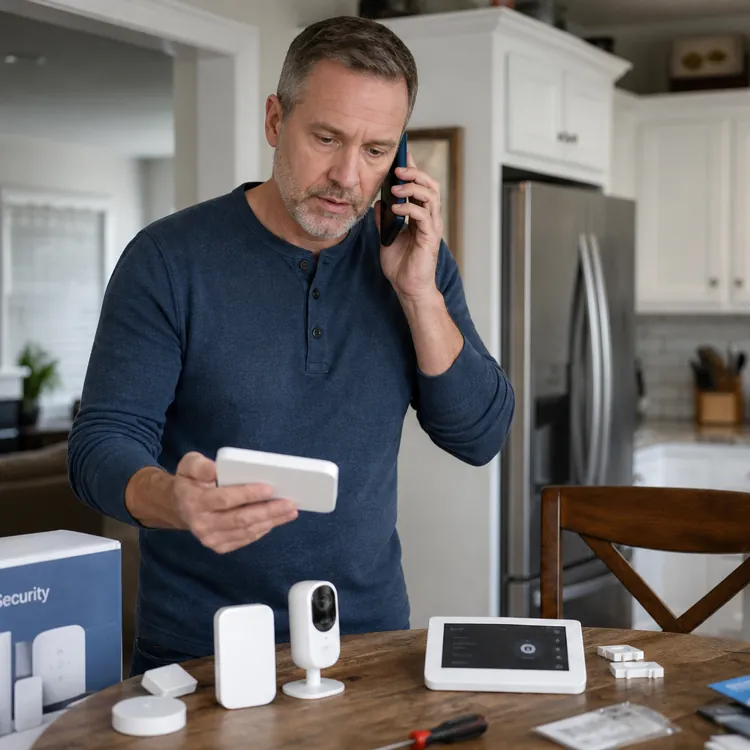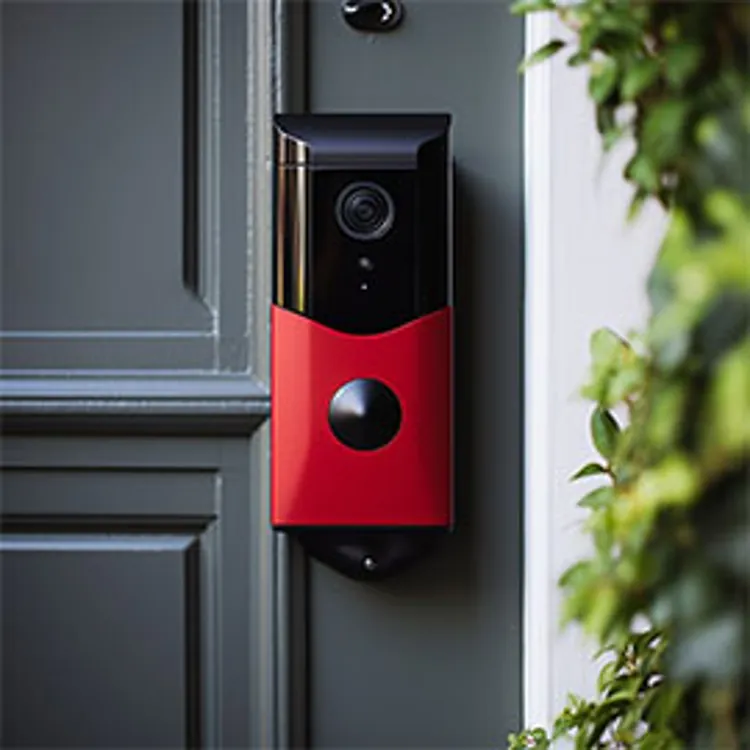


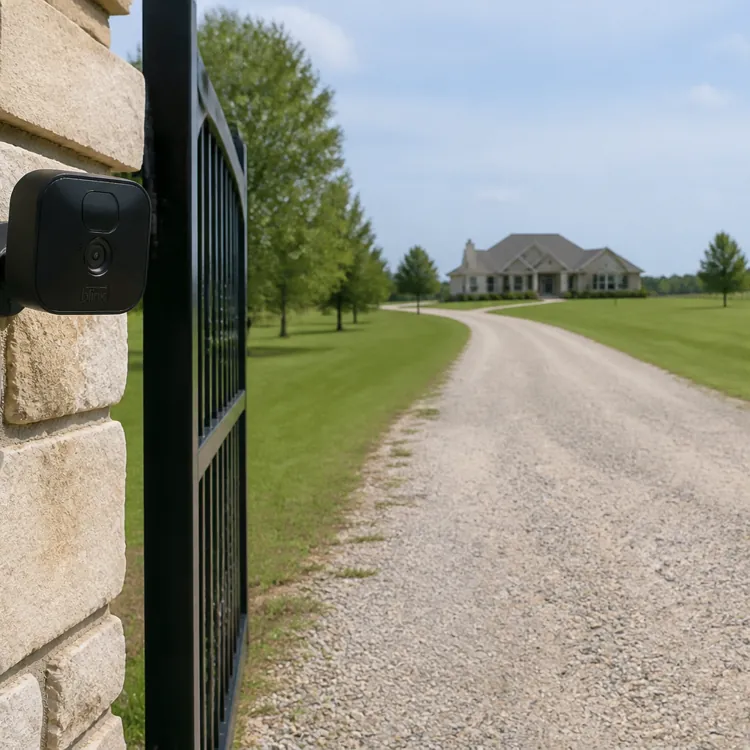
Our top home alarm and security systems picks:
- Best overall: Vivint
- Best balance of price and quality: ADT
- Best customer care: Vector Security
Compare our top rural home alarm and security systems picks
| Company | Customer rating | Best for | Outdoor camera included | Cellular backup | Availability | |
|---|---|---|---|---|---|---|
 Vivint | Get a Quote | 4.5 | Best overall |  | | Nationwide |
 ADT | Get a Quote | 4.2 | Best balance of price and quality | | | Nationwide |
 Vector Security | Learn More | 3.6 | Best customer care | | | 17 states |
Vivint

- Equipment package cost
- Starting at $199.99
- Monitoring price range
- $24.99 to $59.99 per month
- Monitoring options
- Professional
- Cancellation fee
- $150 to $300
ADT

- Equipment package cost
- Starting at $199
- Monitoring price range
- $24.99 to $59.99 per month
- Monitoring options
- Professional or DIY
- Cancellation fee
- 75% of remaining contract
Vector Security

- Equipment package cost
- Start at $680.04
- Monitoring price range
- $44.95 to $69.95 per month
- Monitoring options
- Professional
- Cancellation fee
- Remainder of contract
Methodology: How we chose the best cameras for rural areas
The ConsumerAffairs Research Team evaluated outdoor security cameras using a structured scoring model. We assessed performance across four core areas: installation and service experience, cost and value, app and technology experience, and online reputation.
Our analysis combined verified customer feedback with company-reported service details to identify the providers that offer the strongest home security experience for rural properties. Review data reflects verified feedback submitted to ConsumerAffairs between June 1, 2023, and May 31, 2026.
1. Installation and service experience (based on verified reviews): We measured satisfaction with:
- Installation
- Customer service
- Technicians
- Staff
- Punctuality and speed of service
These factors help show how well companies deliver on their promises after customers sign up for monitoring, which matters more when a home sits far from the nearest service center.
2. Cost and value: We reviewed company-reported pricing details to evaluate starting monthly monitoring cost and the equipment return policy window. We turned to verified reviews to measure customers’ satisfaction with price.
Companies offering lower costs, stronger price satisfaction and more flexible equipment return policies received higher scores.
3. App and technology experience: We evaluated the strength of each company's mobile app based on its available features and functionality. Companies with more full-featured, higher-rated apps received higher scores.
4. Online reputation: We considered the volume of reviews submitted in the past six months and how quickly and consistently each company responded to customer reviews. Companies with more recent review activity and higher response rates received higher scores.
How scoring works
Companies earned a 0 to 10 score for every factor:
- The top-performing company for a given factor earned a 10.
- Other companies were scored relative to that leader.
This standardized scoring system allowed us to compare customer satisfaction, pricing, technology and online reputation on the same scale.
How we chose the winners
Every company was evaluated using the same core factors, but we adjusted the weighting for each award to reflect what matters most in that category. The company with the highest weighted score earned the corresponding “Our pick for” designation:
- Best overall: weighted evenly across the installation, service, cost, equipment return and app factors, with less weight on review volume and response rate.
- Best customer care: emphasized customer service, installation, staff and punctuality scores over cost, technology and reputation factors.
- Best balance of price and quality: emphasized starting monitoring cost and price satisfaction, which together made up half of the category’s weighting.
Buyers guide for home alarm and security systems in rural areas
The best home security cameras and systems for rural properties combine reliable connectivity, remote access and flexible power options. Professional monitoring can provide an added safety net for rural homeowners who may be far from their property or unable to respond to every security alert.
Around 20% of the U.S. population lives in rural areas, and rural properties face distinct security challenges. A strong security system can help address challenges that come with living in the country, such as crop and farm chemical theft, and repeated crimes targeting unsecured or poorly lit areas.
Key insights
Rural security systems may cost more because properties often need additional cameras, cellular data plans and solar accessories.
Jump to insightReliable connectivity and power sources should take priority over video resolution and smart home features.
Jump to insightCellular cameras can cover areas without Wi-Fi, but typically cost more and require separate data plans.
Jump to insightCost of home alarm and security systems for rural areas
Home alarm and security systems for rural homes often cost a bit more than other security systems due to extras like cellular signal, solar panel power add-ons and more cameras to cover larger properties.
Standard home security kits with cameras often run around $350, but they depend on Wi-Fi and include limited cameras. Adding specialty cameras, such as a wired outdoor camera with floodlights, can run around $280 each.
Watching for specials, shopping bundles and building out systems over time are common ways to manage rural system costs.
What to look for in a home alarm and security system for a rural area
For rural homes, signal and power options are often the most important factors to consider when looking for the best home security systems. While features such as professional monitoring, video resolution and smart home compatibility are important, ensuring cameras and sensors can function without reliable Wi-Fi or power often trumps those needs.
For many rural homeowners, comparing wired vs. wireless home security is the first step of shopping. Hybrid systems that combine wired and wireless features often provide the best solution.
Gates, long driveways and remote outbuildings typically add to the complexity of rural home security systems. Choosing a home security system provider that offers in-home consultations often helps you choose the best camera placements and figure out how many cameras you need.
Features and coverage
Overcoming rural security challenges requires a different way of choosing home security than for suburban or urban homes.
Top rural home security features solve specific problems for homeowners and include:
- Alternative power: Solar power units for security cameras allow for remote camera placement without power lines or the need to change batteries on a schedule.
- Weatherproofing: Gate, driveway, barn and property line cameras are typically exposed to the elements far more than security cameras on homes. Strong weather sealing and cameras designed with rain hoods are often used in rural systems.
- Field of vision: Wide-angle cameras provide the most coverage with fewer cameras, but in some areas, such as outbuildings or gates, pan-tilt-zoom cameras may be needed for intruder identification.
- Cellular signal: Not all security cameras work without Wi-Fi. In remote locations where Wi-Fi internet or peer-to-peer Wi-Fi isn’t available, cellular-enabled security devices provide alternative communication options. However, these require additional cellular data plans, and high-quality video often takes significant bandwidth.
Ease of use
Any home security system with many sensors can quickly become problematic to manage. For rural properties, ease of use with intuitive control panels and a strong mobile app makes managing your security much simpler. Professional monitoring also simplifies security for homeowners.
Limitations or risks
For most rural properties, complete coverage of entry points is impossible due to long property lines. In addition to outbuildings and water sources, most systems focus on the most accessible entry points, such as those near roads or powerline corridors.
Sandra Yang Scirpo, chief customer officer at SimpliSafe, said that “For rural homes, cellular backup is essential because you may not have a reliable internet connection. Additionally, emergency response times may be longer in rural areas, so I recommend cameras and sensors that can detect potential threats sooner.“
False alarms from livestock and small wildlife typically require security systems that let you adjust sensitivity settings. Other limitations of rural security include signal strength and power issues.
Pros and cons of home alarm and security systems in rural areas
As with all home security, there are pros and cons. Rural homes and properties present unique challenges for home security systems. Lack of strong internet availability, remote outbuildings out of Wi-Fi reach and the risk of false alarms from wild animals or livestock make rural home security systems unique.
Pros
- Cellular security cameras offer coverage without Wi-Fi
- Peer-to-peer Wi-Fi security cameras are available to bypass the need for internet coverage
- Cameras with automatic lighting are good deterrents for human and animal intruders
- Security systems help offset the lack of nearby neighbors
- Mobile app security system control helps rural homeowners manage alerts
Cons
- Lack of strong internet connections often requires purchasing more expensive cellular cameras
- Remote buildings and gates covered by security may require additional power sources, such as solar
- Livestock and wild animals can trigger false alarms
- Additional power supplies are often needed for remote cameras and lights
- Rural systems often require more cameras, which adds to the costs of the system
FAQ
What is the best outdoor security camera for rural areas without Wi-Fi?
The best outdoor security cameras without Wi-Fi are usually cellular signal security cameras. While some cameras provide local storage that you must check on-site, cellular cameras allow remote, real-time alerts.
Are cellular security cameras better than Wi-Fi cameras for farms?
Many farms find cellular security cameras to be a better solution than Wi-Fi because cameras are often too far from routers.
Is it better to have wired or wireless security cameras on a rural property?
Many rural properties use a combination of wired and wireless security cameras. Wired cameras are often used where outbuildings have power, while wireless cameras with solar panels are used in areas without power.
Which security camera is least likely to be hacked?
Wired or cellular security cameras are far less likely to be hacked than Wi-Fi cameras.
Why do rural properties need long-range security cameras?
Rural properties typically have large areas to cover, so long-range security cameras reduce the total number of cameras needed.
Article sources
ConsumerAffairs writers primarily rely on government data, industry experts and original research from other reputable publications to inform their work. Specific sources for this guide include:
- International Association of Chiefs of Police, “Evidence-Based Crime Reduction Strategies for Small, Rural, and Tribal Agencies.” Accessed July 23, 2026.
- California Legislative Analyst’s Office, “Rural Crime Prevention Program.” Accessed July 20, 2026.
- United States Census Bureau, “What is Rural America?” Accessed July 27, 2026.