

Compare our top wired home alarm and security system picks
| Company | Customer rating | Our pick for | Installation options | Contract terms | Availability | |
|---|---|---|---|---|---|---|
 ADT | Get a Quote | 4.2 | Best overall | Professional or DIY | 1 to 36 months | Nationwide |
 Vector Security | Learn More | 3.7 | Customer service | Professional | 36 months | 17 states |
 Brinks Home Security | Get a Quote | 4.3 | Value | Professional | 36 months | Nationwide |
ADT

- System type
- Wireless
- Camera type
- Wired and wireless
- Camera options
- Indoor, outdoor, doorbell and floodlight
- Starting equipment costs
- $199
Partner Disclosure
ADT disclosure
Theft Protection Guarantee: Customer may receive reimbursement of up to five hundred dollars ($500) of Customer’s homeowner’s insurance deductible (if any) if, and only if, ALL requirements for Theft Protection Guarantee are met to ADT’s reasonable satisfaction. Requires purchase and continual monthly payment of professional monitoring from the time of original activation to be eligible. Customer must request reimbursement within 60 days of property loss. Request must be mailed to ADT and include: Theft Protection Guarantee certificate signed by Customer, a letter from Customer requesting reimbursement, a copy of the police report, and a copy of the accepted insurance claim. ADT reserves the right to reject any application for reimbursement that does not comply with all of the requirements.
ADT Money-Back Guarantee: Money-back guarantee only applies after ADT has made attempts to resolve a system-related issue and has not been able to resolve that issue within the first six (6) months of your original activation. Requires purchase and continual monthly payment of both QSP (Quality Service Plan, ADT’s extended limited warranty) and professional monitoring from the time of original activation. ADT Money-Back Guarantee is not transferable. Equipment must be returned before a refund will be processed. Conditions preventing normal system operation cannot be caused by the customer.
Vector Security

- System type
- Wired and wireless
- Camera type
- Wireless
- Camera options
- Indoor, outdoor and doorbell
- Starting equipment costs
- Approximately $680
Brinks Home Security
- System type
- Wired and wireless
- Camera type
- Wireless
- Camera options
- Indoor, outdoor and doorbell
- Starting equipment costs
- $500
Methodology: How we chose the best wired home alarm and security systems
The ConsumerAffairs Research Team evaluated wired home security companies across four core areas based on verified reviews submitted to ConsumerAffairs between June 1, 2023, and May 31, 2026.
1. Installation and service experience (based on verified reviews):
- Installation
- Customer service
- Technicians
- Staff
- Punctuality and speed of service
These factors help show how well companies deliver on their promises after customers sign up for monitoring.
2. Cost and value:
- Price satisfaction
- Starting monthly monitoring cost
- Equipment return policy window
Companies offering lower costs, stronger price satisfaction and more flexible equipment return policies received higher scores.
3. App and technology experience: We evaluated the strength of each company's mobile app based on its available features and functionality. Companies with more full-featured, higher-rated apps received higher scores.
4. Online reputation: We considered the volume of reviews submitted in the past six months and how quickly and consistently each company responded to customer reviews. Companies with more recent review activity and higher response rates received higher scores.
How scoring works
Companies earned a 0 to 10 score for every factor:
- The top-performing company for a given factor earned a 10.
- Other companies were scored relative to that leader.
This standardized scoring system allowed us to compare customer satisfaction, pricing, technology and online reputation on the same scale.
How we chose the winners
Every company was evaluated using the same core factors, but we adjusted the weighting for each award to reflect what matters most in that category. The company with the highest weighted score earned the corresponding “Our pick for” designation:
- Best overall: weighted evenly across installation, service, cost and app factors, with slightly less weight on review volume and response rate.
- Best customer service: emphasized customer service, installation, staff and punctuality scores over cost and reputation factors.
- Best value: emphasized starting monitoring cost and price satisfaction, which together made up half of the category's weighting.
Wired home alarm and security systems buyers guide
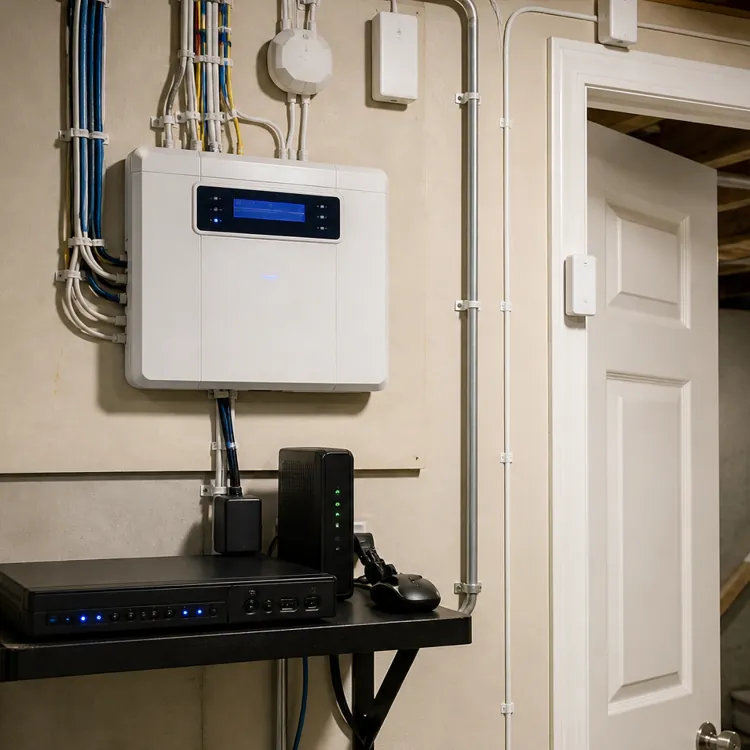
Wired home security systems help deter criminal behavior and, when integrated with smart home features, often increase your home’s value. Choosing a wired system over Wi-Fi reliance typically increases security and performance with more reliable signals and faster data transfers that are less susceptible to jamming or hacks.
Key insights
Look for customizable equipment packages, certified installers and quality alarm monitoring.
Jump to insightHome security costs can start around $350 but go to the thousands, based on equipment and monitoring.
Jump to insightWired home security is more reliable, but installation may require drilling or cutting into walls.
Jump to insightWhat to look for in a wired home alarm and security system
Wired home security systems often provide more reliability and less obvious installation than wireless systems. Some of the best home security companies also offer hybrid systems, with a wired central control panel and a mix of wired and wireless sensors or cameras to minimize new wiring required while still providing strong coverage.
Annie Potter, Head of Marketing, North America, at Reolink added that “Wired systems offer the most reliable, continuous recording and are a great fit for homeowners looking for 24/7 coverage with a permanent installation. Wireless systems make installation easier and provide greater flexibility, especially for renters or areas where running power or network cables isn’t practical. There's no one-size-fits-all answer.”
Wired systems offer the most reliable, continuous recording and are a great fit for homeowners looking for 24/7 coverage with a permanent installation.”
When shopping for a wired home security system, look for companies with local certified installers, options for in-home consultations before installation, what types of sensors are available, battery backup options and strong monitoring.
Ease of use
Wired security systems should be simple to use and require less maintenance than wireless in many cases. Maintenance for wired systems varies by provider but typically means changing batteries in any wireless components and running test cycles on the system itself as prescribed by the manufacturer.
The systems should operate through an easy-to-navigate central control panel. While not all brands offer them, a mobile app for remote control is often a valuable add-on, especially with integrated smart home features.
Downsides of wired security
One of the biggest downsides to wired security systems is that you can’t take it with you if you move. However, a wired system staying with the home can be a selling point and increase value. Other concerns include backup battery power limitations in case of power outages and risks of poorly installed wiring.
While wireless devices tend to be more susceptible to hacks and jamming, wired systems can be vulnerable to tampering from external wire cuts. Most people find home security is worth it, but it’s important to weigh the pros and cons of security before making a purchase. Comparing wired vs. wireless security systems is a good place to start.
Home alarm and security system cost
Wired home security typically costs more than wireless systems due to more complex installation. Wired systems often start around $350 and can run into thousands depending on the number of sensors and setup complexity, plus installation costs. However, installation costs typically start low, between $99 and $125, with some providers waiving installation if you agree to a longer-term monitoring contract.
However, in-home consultations are commonly required to provide an accurate quote for equipment and installation. The final installation price varies widely by sensor types, number of sensors and how much wiring is needed in your home. For installations with large numbers of sensors or complicated wiring, installation fees could be much higher.
Carefully choosing the best camera placements and following guidelines on window sensors can help ensure efficient coverage while minimizing equipment costs.
When shopping, look for clear information on pricing, long-term contracts and cancellation fees. Remember that cancellation fees can apply to monitoring and add costs to equipment, much like if you cancel a cell phone plan early, you may owe extra on your phone.
Pros and cons of wired home alarm and security systems
For homeowners with large properties or those planning on staying put for the foreseeable future, wired home security systems offer better performance and more durability in the long term that offset higher installation costs.
However, for renters or those expecting to move within a few years, wired systems are usually not viable solutions.
Pros
- Fewer batteries to change
- Less susceptible to hacking
- Reliable signals not reliant on WiFi
- Less maintenance than wireless systems
- Typically support higher resolution video without lag concerns
Cons
- More expensive to install
- Installation can include drilling or cutting into walls, doorframes or windowsills
- Can’t be moved to a new house
- Sensors more likely to be affected by power outages than wireless sensors with onboard batteries
- Not allowed by landlords in most rental properties
FAQ
Is it better to have wired or wireless security cameras?
Wired and wireless security have good use cases, with neither being the right answer all the time. Wired security is often more reliable, but wireless offers less permanent installations and DIY installation.
What is the best wired security system?
The best wired security system is the one that is active and monitored. Consumer Affairs recommends ADT, Vector and Brinks Home when shopping for a wired security system.
What security system do burglars hate?
Burglars hate any security system regardless of brand. Studies show that having any active security system is a deterrent to criminals.
Why do experts recommend wired systems in areas with weak Wi-Fi or cellular coverage?
Most wireless security cameras and sensors rely on Wi-Fi to work. Wired home security typically sends signals via wires and doesn’t need Wi-Fi.
How does a wired security system protect against Wi-Fi jammers?
A wired home security system protects against Wi-fi jammers by not using Wi-Fi. By sending signals via cables, the system bypasses the need for Wi-Fi and isn’t susceptible to that form of jamming.
Article sources
ConsumerAffairs writers primarily rely on government data, industry experts and original research from other reputable publications to inform their work. Specific sources for this guide include:
- Rutgers Today, “Rutgers Study Finds Alarm Systems Are Valuable Crime Fighting Tool.” Accessed July 27, 2026.
- University of Fairfax, “The Pros and Cons of Home Automation.” Accessed July 20, 2026.
- Michigan State University, “MSU Faculty Member Tongtong Li: Working to Make Wireless Communication More Secure and Efficient.” Accessed July 23, 2026.
- Kennesaw State University, “A Survey on Wireless Security: Technical Challenges, Recent Advances, and Future Trends.” Accessed July 27, 2026.