

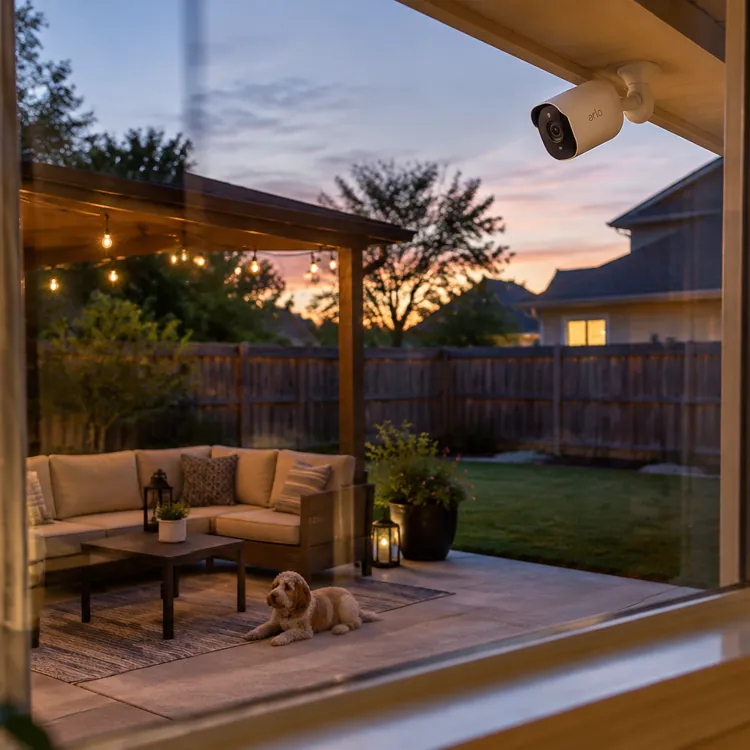
Types of security cameras by form
What your security camera looks like is more than just aesthetics. The overall design and camera housing support specific features such as wide-angle field of view, panning and zoom. Form also affects whether security cameras act as visible crime deterrents or if they’re designed to be discreet and provide hidden surveillance to reduce tampering.
Compare the type of camera design and its primary features below:
| Camera type | Description | Primary uses | Notable feature |
|---|---|---|---|
| Dome | Low-profile base with a prominent half-sphere (dome) cover over the camera | Ceiling- or wall-mounted in retail stores and other public locations | Often rated as Vandal-resistant and weatherproof |
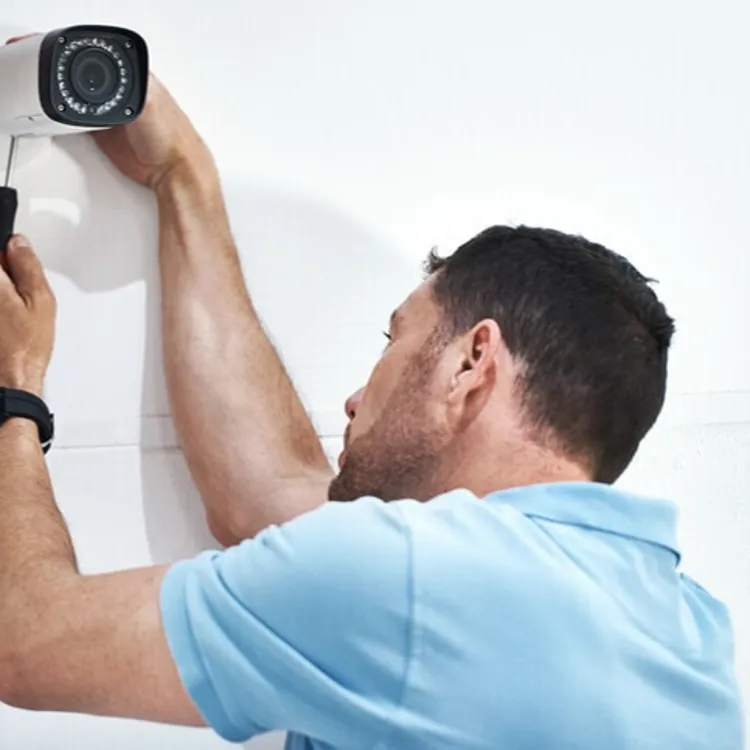
| Bullet | Long, cylindrical tube | Outdoor traffic cameras, building perimeters, long hallways and clusters on building corners | Shape offers room to accommodate zoom and telephoto lenses |
| Turret (eyeball) | A partial sphere mounted on a base with a ball and socket design that allows camera motion | Under overhanging eaves, exterior walls and tight spaces without room for other camera types | Often less prone to infrared glare (IR) and reflection problems than dome cameras |
| Pan-tilt-zoom (PTZ) | May look like a dome or bullet camera | Large spaces such as convention centers or parking lots | Offers wider coverage with fewer cameras due to directional flexibility |
| Fisheye (panoramic) | Wide and mostly flat with a slightly curved housing, similar to a low-profile dome camera | High ceilings and other open areas for a large overview, not close detailed view | Minimizes blind spots with views up to 360 degrees |
| Box | Looks similar to a bullet camera with a rectangular design but larger | Highly specialized locations requiring specific tools for effective surveillance | Modular design allows you to swap out lenses and housings |
The best home security companies typically offer turret and dome cameras, although fisheye, PTZ and modified bullet cameras may be used in larger properties. Some companies, such as ADT, also have commercial and small business divisions that may offer more advanced cameras.
Types of security cameras by connectivity
Beyond camera shapes, security cameras come in several connectivity types. Wi-Fi is the most common, but Power over Ethernet (PoE), cellular and peer-to-peer wireless are also available.
Analog vs. IP security cameras
Analog and IP security cameras use wires to transmit footage to either a physical or virtual video recorder. Analog is the older technology, and IP (Internet Protocol) is the updated version.
However, analog security cameras still have strong uses when coaxial cable infrastructure already exists, the initial cost is a concern or hacking risks outweigh higher-resolution needs.
| Data transmission | Power | Resolution | Storage | |
|---|---|---|---|---|
| Analog security camera | Via coaxial cables | Separate power cable | Typically SD, HD or 4K | Digital video recorder (DVR) |
| IP security camera | Via Cat5 or Cat6 ethernet cables | Power is supplied over the same Ethernet cable as data transmission via PoE | Up to 12K | Typically a cloud-based network video recorder (NVR) |
Wi-Fi security cameras
Wi-Fi security cameras are extremely popular because they don’t require wiring, work with home internet and typically have a low starting price. They’re offered by almost every top home security company, such as Vivint and Vector, plus DIY home security companies such as Arlo and Ring.
If you’re a homeowner or renter looking for an easy setup, most Wi-Fi security cameras are DIY friendly.
Although less secure than wired analog and IP cameras, Wi-Fi networks typically offer security protocols such as WPA2 and WPA3 that reduce risk in conjunction with good security measures such as multi-factor authentication (MFA) and using a reputable company for cloud-based storage.
Peer-to-peer (P2P) connections are often called “direct Wi-Fi,” although they’re not technically Wi-Fi. P2P security cameras may require manual check-ins to download data and lack the encryption tools of Wi-Fi networks. However, P2P cameras offer wireless connectivity in areas that lack Wi-Fi coverage.
Cellular security cameras
Cellular security cameras use cellular networks to transmit data. While they are an excellent option in areas without Wi-Fi coverage, these cameras typically require buying a separate cell plan in addition to your monitoring plan.
Types of security cameras by placement
For most homes, a combination of camera placements and types is recommended. Multiple camera types, connections and locations come together to cover blind spots and fill specialized needs for specific locations. Where you place your security cameras often determines the type and special features needed.
Indoor security cameras
Indoor security cameras have simplified housings because they don’t need to stand up to weather or extreme temperatures. For home security, indoor cameras typically don’t need to be tamper-proof. The best indoor security cameras often offer two-way communication and low-light recording.
Outdoor security cameras
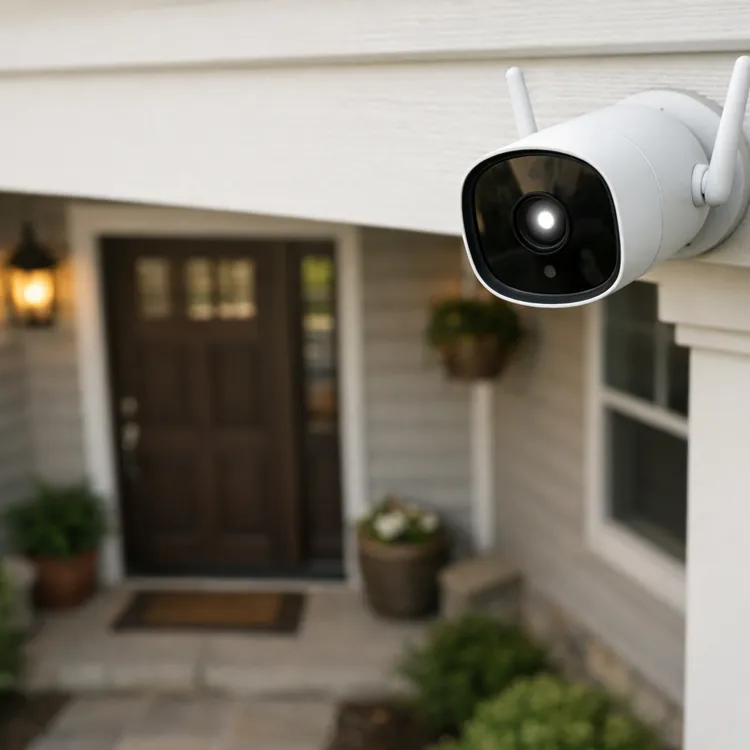
Weather resistance is a key feature for the best outdoor security cameras. Housings often feature brims that deflect rain, clear shields in front of camera lenses and insulation against extreme temperatures.
While most common for commercial applications, home outdoor security cameras may include deterrents against tampering, such as stronger cases and sturdy mounts. However, home Wi-Fi outdoor security cameras often forego tampering protections in favor of easy magnetic mounts that make removal for charging easier.
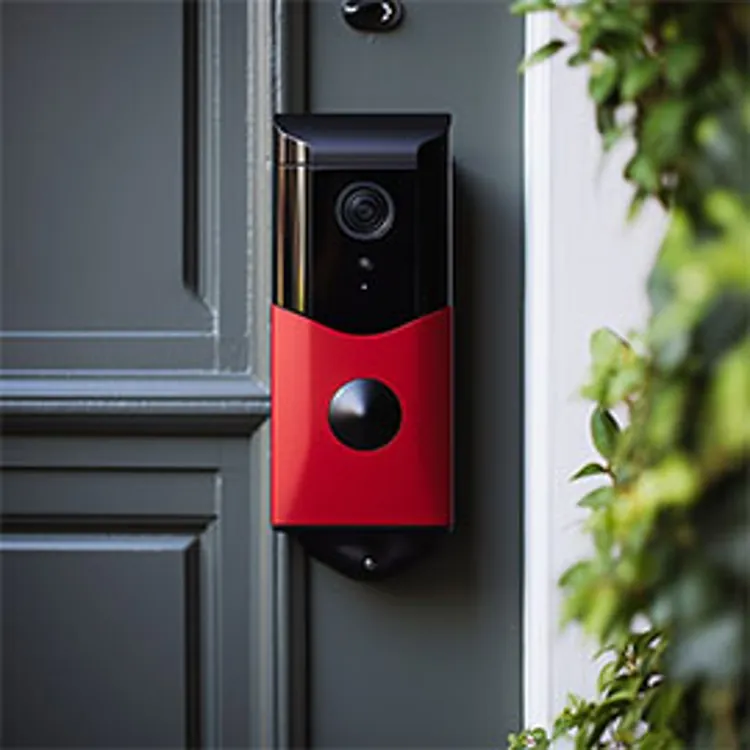
Video doorbells are a subset of outdoor security cameras and typically feature wide-angle camera lenses and two-way communication.
Security camera types by special features
Special features on security cameras usually combat difficult recording situations or high-risk locations. When researching the best security camera for you, it’s important to know what recording challenges you may face.
Low-light security cameras
Property crime rates for residences don’t peak at night. Instead, they peak during working hours when more homes are empty. However, low-light cameras are a good idea regardless, since nighttime crime rates are still quite common.
Low-light security cameras typically record in grayscale and feature high ISOs with built-in lighting — typically infrared (IR). Some cameras also offer false-color processing to improve clarity by colorizing images based on recorded shades of gray
Thermal security cameras
While low-light security cameras offer traditional video and images in low-light conditions, thermal cameras record heat signatures regardless of lighting conditions. The benefit is improved detection, but the downside is that no facial features are recorded.
Thermal security cameras won’t give you an image you can use to identify a suspect in the traditional way. You’ll be able to tell a person's general shape, size and gait, but there won’t be recognizable features.
Varifocal and zoom lens security cameras
Many security cameras focus on an overview of an area. However, detailed and close-up images often help law enforcement identify a suspect or suspect vehicle. Telephoto lenses and specialized software offer the ability to zoom in on suspicious activity, either via automated or AI-enabled systems or manually.
License plate recognition security cameras
Flock gets most of the national attention, but license plate cameras have been around long before the company’s home and business applications. License plate cameras typically come in two types: license plate recognition (LPR) and license plate capture (LPC).
LPC security cameras focus on taking a clear image of a license plate for humans to decipher later. LPR security cameras use AI and infrared pulses to record a captured tag. Plus, it adds analytics to the mix, allowing you to create a database of vehicles, such as tracking your company fleet as it comes and goes from a loading dock.
Automatic license plate recognition (ALPR), a subset of LPR, uses AI to automatically catalog and process captured plate data — Flock uses ALPR systems.
Vandal-resistant security cameras
Often used in retail and other commercial applications, vandal-resistant security cameras have cases that withstand damage better than non-hardened models. Most can withstand attacks such as thrown stones and are either mounted too high to reach or secured with strong mounts to reduce removal.
Cases may look like other security cameras but are built stronger or have external additions, such as wire cages over the camera.
Active deterrence and defensive security cameras
Rather than relying on silent alarms and notifications, active deterrence security cameras offer features to warn off criminals. While a visible camera itself acts as a deterrent, defensive cameras go further by triggering floodlights, emitting loud alarms or giving verbal commands for an intruder to leave the area.
FAQ
What is the difference between DVR and NVR?
A DVR (digital video recorder) is a physical recording system at your location, while an NVR (network video recorder) is typically a cloud-based storage system with data transmitted over the internet.
Are wireless security cameras as reliable as wired ones?
Not typically. Wireless security cameras require recharging or changing batteries and are more susceptible to hacking or jamming than wired security cameras.
How do I choose the right security camera for my home?
Choosing the right security camera for your home means comparing security camera features to your needs. Start with a list of locations to cover, your goals for the system (such as two-way communication or watching your pet) and your budget. Then compare cameras to your list, along with the pros and cons of security cameras in general.
Why do some security cameras need Wi-Fi while others don't?
Wi-Fi is just one connectivity option for security cameras, along with P2P, wired and cellular. Wi-Fi is more popular because most homes have a Wi-Fi system already and the cost is usually lower than some other options.
Article sources
ConsumerAffairs writers primarily rely on government data, industry experts and original research from other reputable publications to inform their work. Specific sources for this guide include:
- Council on Criminal Justice, "Crime Trends in U.S. Cities: Mid-Year 2026 Update." Accessed Oct. 19, 2026.
- Federal Bureau of Investigation, Criminal Justice Information Services Division, "Property Crime." Accessed Oct. 20, 2026.
- U.S. Department of Homeland Security, "Automatic License Plate Readers." Accessed Oct. 19, 2026.
- United States Department of Justice, "CCTV Surveillance for Crime Prevention: A 40-Year Systematic Review with Meta-Analysis." Accessed Oct. 20, 2026.