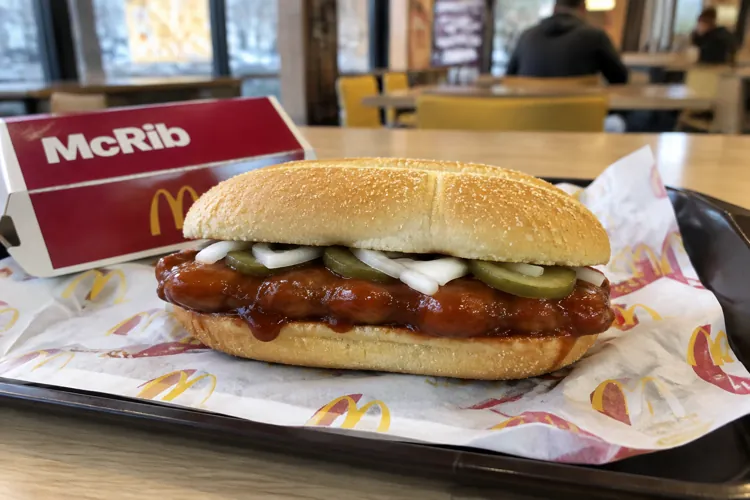

A federal judge has allowed a proposed class-action lawsuit against McDonald's to proceed, rejecting the company's argument that consumers should not expect its McRib sandwich to contain actual pork rib meat.
Four consumers accuse McDonald's of misleading customers through the sandwich's name, rib-shaped patty and premium price, even though they allege it contains no rib meat.
McDonald's denies wrongdoing, maintaining that the McRib contains 100% pork and that its marketing accurately describes the product.
McDonald's has suffered a legal setback in a lawsuit challenging one of its most recognizable menu items — the McRib.
U.S. District Judge April Perry in Chicago ruled that key portions of a proposed class-action lawsuit accusing the fast-food giant of deceptive advertising can move forward.
The lawsuit, filed in December 2025 by four consumers, alleges that McDonald's deliberately leads customers to believe the McRib contains pork rib meat when, according to the plaintiffs, the sandwich is actually made from less expensive cuts of pork.
McDonald's had asked the court to dismiss the case, arguing that its marketing is truthful and that reasonable consumers would not necessarily assume the sandwich contains actual rib meat. But Perry disagreed that the issue could be settled at this early stage.
The judge wrote that the plaintiffs' interpretation of the McRib name was not unreasonable and that consumers should not have to conduct extensive research before purchasing a fast-food sandwich.
The ruling allows several fraud and consumer-deception claims to proceed, although the judge dismissed some other allegations.
What's actually in a McRib?
The McRib, introduced in 1981, consists of a boneless pork patty shaped to resemble a small rack of ribs, covered in barbecue sauce and served with onions and pickles on a bun.
The plaintiffs argue that the sandwich's distinctive shape and name create the impression that the meat comes from pork ribs, which generally command higher prices than some other pork cuts.
Their lawsuit alleges that the McRib instead contains lower-cost pork products, potentially including shoulder meat and organ meats. McDonald's strongly disputes parts of those allegations.
The company says the McRib is made from 100% seasoned boneless pork sourced from American farmers and suppliers. It specifically denies using pork hearts, tripe or stomach in the sandwich.
The distinction is important because the lawsuit is not claiming that McDonald's is selling something other than pork. Instead, it argues that consumers are being misled about which part of the pig the pork comes from.
McDonald's maintains that its ingredient descriptions have always been accurate.
Judge says consumers shouldn't have to investigate their lunch
In rejecting McDonald's request to dismiss the entire lawsuit, Perry focused on what an ordinary consumer might reasonably believe.
McDonald's argued that the sandwich's name is simply a brand name and that its website accurately identifies pork as the primary ingredient.
But the judge found that the combination of the name, rib-like appearance, advertising and relatively high price could plausibly lead consumers to expect actual rib meat.
The court also considered allegations involving consumer surveys. One survey cited by the plaintiffs found that 72% of respondents expected the sandwich to contain rib meat, while another found that 67% considered the presence of rib meat important to their purchasing decision.
Those findings have not been established as proof of deception, but they helped support the argument that the lawsuit should not be dismissed before further examination.
The ruling does not mean McDonald's has been found guilty of misleading consumers. It means the plaintiffs have presented a legally plausible case that deserves further consideration.
What happens next?
The case now moves toward further litigation, potentially including the exchange of company documents, marketing records and other evidence.
The plaintiffs are seeking class-action status, which could eventually allow other McRib purchasers to participate in the case.
They are also seeking financial damages and changes to marketing practices they contend are misleading.
However, no class has been certified, no settlement has been reached and consumers are not currently eligible for payments.
For McDonald's, the ruling comes at an awkward time. The company recently brought back the McRib for a limited run in selected U.S. markets, including Chicago, Los Angeles, Miami, Atlanta, Philadelphia and Dallas.
The case could also have implications beyond McDonald's. Food companies frequently use product names and advertising images that suggest particular ingredients or preparation methods.
If the plaintiffs ultimately prevail, the decision could encourage closer scrutiny of how restaurants describe their products, especially when those descriptions might lead consumers to expect more expensive ingredients.