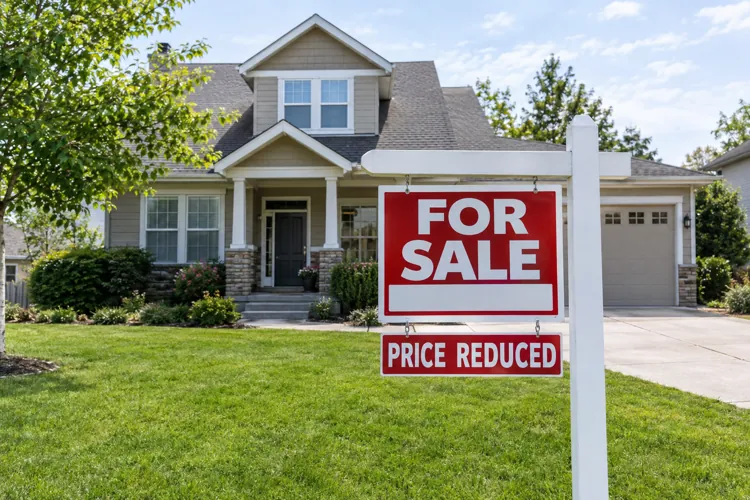

Pending home sales fell 4.7% in October and 16.7% from a year earlier, according to the National Association of Realtors, signaling continued weakness heading into 2027.
Existing-home sales have fallen to their lowest level since 2010, while the median home price remains above $416,000, putting homeownership beyond the reach of many Americans.
Buyers are gaining negotiating power as inventory rises, but high mortgage rates and limited price reductions continue to discourage purchases.
The U.S. housing market is showing new signs of distress, with prospective homebuyers increasingly unwilling or unable to purchase homes at today's prices and mortgage rates.
The National Association of Realtors (NAR) reports that pending home sales declined 4.7% in October from September and plunged 16.7% compared with October 2025. It was the second consecutive month of record-low pending sales contracts, suggesting that the housing market's slowdown is far from over.
Pending sales measure homes that have gone under contract but have not yet closed. Because most transactions close within one or two months, the report provides an early indication of future home sales.
The latest numbers suggest that November and December could be especially weak, potentially pushing annual existing-home sales to their lowest level in more than 30 years.
"October could mark the low point in contract signings for this housing cycle, as mortgage rates appear to have topped out," said NAR Chief Economist Lawrence Yun.
Yun noted that the market's weakness is particularly significant considering how much the country has grown.
"It is somewhat puzzling that home sales would fall to levels last seen three decades ago, even as the U.S. population has grown by roughly 75 million," he said.
Yun suggested two possible explanations: a large pool of potential buyers waiting for better conditions, or homeownership becoming increasingly unaffordable for a significant share of Americans.
The slowdown is nationwide
The decline in pending sales was not confined to a handful of expensive housing markets. Contract signings fell in all four regions of the country.
The West experienced the sharpest annual decline, down 20.3%, followed by the South at 18.7%. The Midwest recorded a 14% decrease, while the Northeast declined 11.1%.
Even metropolitan areas that performed better than most of the country experienced declines. Cincinnati, the strongest of the 50 largest metropolitan areas in NAR's analysis, recorded a 4.7% annual decrease in pending sales. Austin, Texas, was down 9.7%, while Hartford, Connecticut, declined 10%.
The widespread weakness suggests that the housing slowdown is being driven by national affordability pressures rather than isolated local economic problems.
Completed sales are already at recession-like levels
The pending-sales report follows another troubling housing indicator released last week.
NAR reported that existing-home sales fell 5.5% in October to a seasonally adjusted annual rate of just 3.75 million homes. That was the lowest sales pace since August 2010, when the housing market was still recovering from the financial crisis.
But there is an important difference between today's housing market and the one that followed the 2008 financial crisis. During the earlier downturn, falling prices, foreclosures and distressed sales contributed to the collapse. Today, the market is largely stalled because buyers cannot afford homes and many sellers have little financial incentive to lower their prices substantially.
In fact, distressed transactions accounted for just 2% of October sales, according to NAR, indicating that relatively few homeowners are being forced to sell. That helps explain why sales have collapsed without a comparable collapse in home prices.
Home prices remain stubbornly high
Despite the sharp decline in transactions, the median existing-home price was $416,700 in October, up 0.4% from a year earlier.
It marked the 40th consecutive month of year-over-year home price increases.
Although price growth has slowed dramatically, prices have not fallen enough nationally to restore affordability for typical households. Mortgage rates have made the problem considerably worse.
According to Freddie Mac data cited by NAR, the average 30-year fixed mortgage rate was 7.33% in October, compared with 6.25% a year earlier.
Consider a buyer purchasing a $416,700 home with a 20% down payment. At a 7.33% mortgage rate, the monthly principal and interest payment would be approximately $2,290. At 3%, a rate available to many buyers during the pandemic-era housing boom, the same mortgage would cost about $1,405 a month.
That's a difference of roughly $885 every month, or more than $10,600 annually, before property taxes, insurance and maintenance.
The calculation illustrates why even modest home price reductions may do little to restore affordability when borrowing costs remain elevated. For many prospective buyers, the problem is no longer simply finding a house. It's finding one with a monthly payment their income can support.
Buyers have more choices and more negotiating power
One of the few encouraging developments for prospective homebuyers is that the supply of available homes is increasing.
NAR reported that 1.59 million existing homes were on the market at the end of October, up 4.6% from a year earlier. At the current sales pace, that represents a 5.1-month supply, compared with 4.4 months a year earlier.
A supply of roughly five to six months is generally considered consistent with a more balanced housing market, suggesting that the intense competition among buyers seen during the pandemic has largely disappeared in many areas.
Homes are also taking longer to sell. The median time on the market increased to 35 days in October, compared with 33 days in September. And sellers are increasingly reducing their asking prices.
According to Realtor.com data cited by NAR, 20.5% of active listings experienced price reductions in October, the highest share for that month since 2022.
However, a reduction in the asking price doesn't necessarily mean a home is selling for less than a comparable property did a year earlier. Nationally, actual selling prices remain slightly higher. The result is an unusual market in which buyers have more bargaining power but often still cannot afford the homes available to them.
First-time buyers are being squeezed out
The affordability problem is particularly severe for Americans trying to purchase their first home.
First-time buyers accounted for just 29% of existing-home sales in October, down from 32% a year earlier.
Meanwhile, cash purchases accounted for 29% of transactions, and individual investors and second-home buyers represented 20% of sales. Those figures illustrate the challenges facing buyers who must rely on mortgage financing and have limited savings for a down payment.
Unlike existing homeowners, who may have accumulated substantial equity as property values increased, first-time buyers generally must finance most of the purchase price at today's interest rates. That puts them at a significant disadvantage in a market where home prices remain near record highs.
Will falling mortgage rates revive the market?
There is at least one potential reason for optimism.
According to Freddie Mac's weekly mortgage survey, the average 30-year fixed mortgage rate declined to 7.11% on November 12, down from 7.18% the previous week. It was the fourth consecutive weekly decline, bringing rates to their lowest level in seven weeks.
Still, borrowing costs remain considerably higher than a year ago, when the average rate was 6.24%.
The question is whether modestly lower mortgage rates will be enough to persuade buyers to return.
There are reasons to be skeptical. Even if rates fall below 7%, the combination of elevated home prices, property taxes and insurance premiums could continue to strain household budgets.
And while a reduction in mortgage rates would improve affordability, it could also bring more buyers into the market, potentially supporting prices and offsetting some of the savings.
For sellers, the growing inventory of available homes means pricing realistically is becoming increasingly important. For buyers, patience may create opportunities to negotiate lower prices, seller-paid closing costs or mortgage rate buydowns.