Where Property Taxes Are Rising Faster Than Home Values (2026)

+1 more

Rising home values usually feels like good news. But they can come with a catch: a bigger property tax bill. In a number of U.S. metros, taxes are climbing faster than home values. For homeowners with no plans to sell, that difference adds up in a household budget already stretched by insurance, maintenance and mortgage costs.
To see where property taxes are outrunning home values, the ConsumerAffairs Research Team analyzed the 100 largest U.S. metro areas using U.S. Census Bureau data from 2022 to 2024. We compared the percentage change in median property taxes with the percentage change in median home value, then ranked each metro by the percentage point difference.
Key insights
In Lakeland-Winter Haven, Florida, property taxes outran home values more than anywhere else, up 28.1% from 2022 to 2024, compared with a 14.2% increase in home values.
Jump to insightNationally, home value growth outpaced property taxes from 2022 to 2024, rising 12.4%, while property taxes grew 10.6%.
Jump to insightProperty taxes outpaced home values in 46 of the 100 largest U.S. metros between 2022 and 2024.
Jump to insightThe 10 metros with the widest tax-versus-home-value gaps are all in the South or West.
Jump to insightMcAllen-Edinburg-Mission, Texas is where home values rose fastest compared with property taxes; home values were up 32.7%, more than in any other metro.
Jump to insightMetros where property taxes outpace home values
The 10 metros with the widest gap between property tax growth and home value growth are all in the South or West, with a few states featured more than once. Florida has three metros in the top 10, while Colorado and California each have two.
In nearly all 10 metros, property taxes grew faster than the national 10.6% rate and home values grew slower than the national rate of 12.4%.
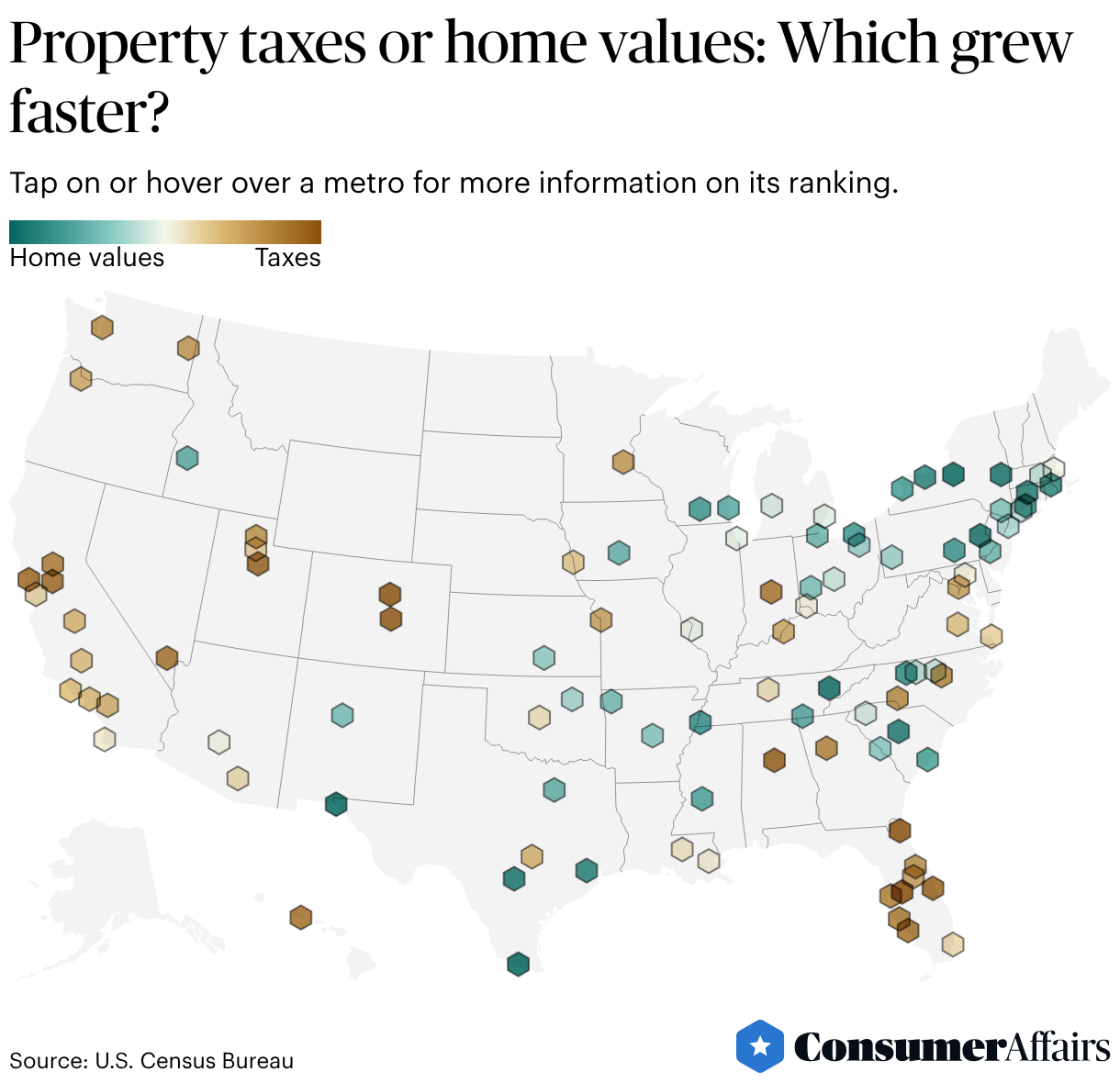
Explore the map below to see how all 100 metros in the study compare, then scroll down for a closer look at the top five:
1. Lakeland-Winter Haven, Florida
No metro pulled further ahead than Lakeland-Winter Haven. Between 2022 and 2024, the typical homeowner’s property tax bill jumped 28.1%, nearly triple the national increase of 10.6%. Home values went up too, by 14.2%, but that wasn’t enough to keep pace with the tax hike.
The picture looks different over five years instead of two, though. Property taxes rose 78.6% from 2019 to 2024. Home values rose at a similar rate, 74.1%. That’s only a 4.5 percentage point gap — much smaller than the 13.9 percentage point gap from 2022 to 2024. So the divergence looks new, not like a trend that’s been building for a while.
Homeowners here may see a change soon. A constitutional amendment headed to Florida’s November 3, 2026, ballot would raise the state’s homestead exemption for nonschool taxes from $25,000 to $150,000 in 2027 and $250,000 in 2028. At the time of publication, the amendment has not yet gone before voters.
- Property tax growth, 2022 to 2024: 28.1%
- Home value growth, 2022 to 2024: 14.2%
- Property tax vs. home value gap: +13.9 percentage points
2. Jacksonville, Florida
Property taxes for the typical Jacksonville metro area homeowner rose 21.7% between 2022 and 2024, while home values only grew 8.1%.
Look back five years, and the trend flips. From 2019 to 2024, home values rose 63.1%, well ahead of the 44.9% increase in property taxes.
Local housing data can help explain the shift. Home values in the Jacksonville metro area jumped by double digits in both 2021 and 2022. Then, in 2023, home value growth slowed sharply as mortgage rates climbed to around 7% for a 30-year loan, according to a U.S. Department of Housing and Urban Development (HUD) analysis of the local market. That cooling lines up with the slower pace of home value growth reflected in census figures over the same stretch.
- Property tax growth, 2022 to 2024: 21.7%
- Home value growth, 2022 to 2024: 8.1%
- Property tax vs. home value gap: +13.6 percentage points
3. Denver-Aurora-Centennial, Colorado
Home values in the Denver metro area grew just 5.7% between 2022 and 2024. Property taxes, meanwhile, climbed more than three times as fast, up 19.1%.
Five years out, the numbers move closer together — taxes up 41.5% since 2019, home values up 44.1% (a gap of less than three percentage points).
Colorado’s tax rules changed in that time frame. Previously, the state split its property tax bill between residential and commercial properties along a fixed ratio. To hold that ratio steady, it had to lower the tax rate on homes whenever their values climbed. Voters repealed this rule in 2020, and without that offset, taxes shot up alongside Colorado’s fast-rising home values in 2020 and 2022.
- Property tax growth, 2022 to 2024: 19.1%
- Home value growth, 2022 to 2024: 5.7%
- Property tax vs. home value gap: +13.4 percentage points
4. Colorado Springs, Colorado
For the typical homeowner in the Colorado Springs metro area, property taxes rose 17.3% between 2022 and 2024. Home values, by contrast, grew just 4.7% — one of the slowest rates of the 100 metros (and well below the national pace of 12.4%). Five years out, the picture looks different. From 2019 to 2024, home values went up 50.5%, ahead of the 43.3% rise in taxes over that stretch.
A local quirk in home value assessment adds important context here. El Paso County, home to Colorado Springs, only reappraises properties every other year, and that value then applies to two full tax years at once.
That’s what happened with the 2023 reappraisal, which landed right around the peak of Colorado’s pandemic-era home-value boom. According to the county assessor’s office, local homeowners saw their appraised values jump significantly that year. That valuation then stuck around through 2024. Tax bills stayed high, even though home values had already cooled off by the time more recent Census numbers came in.
- Property tax growth, 2022 to 2024: 17.3%
- Home value growth, 2022 to 2024: 4.7%
- Property tax vs. home value gap: +12.6 percentage points
5. Birmingham, Alabama
Birmingham rounds out the top five with a smaller dollar impact than the other metros on this list. Property taxes for the typical homeowner rose 17.6% between 2022 and 2024, while home values grew 6.6%. Even so, the typical Birmingham homeowner paid $1,334 in property taxes in 2024 — the lowest of any metro in the top five.
A statewide rule helps explain why the dollar figures stay low. Alabama only taxes 10% of a home’s assessed value if the owner lives there (one of the lowest shares in the country, according to the Alabama Department of Revenue). Start that low, and even a fast percentage jump doesn’t add up to much.
- Property tax growth, 2022 to 2024: 17.6%
- Home value growth, 2022 to 2024: 6.6%
- Property tax vs. home value gap: +11 percentage points
Metros where home values outpace property taxes
In the following 10 metros, home values grew faster than property taxes by the widest margins (the opposite pattern from the metros above). Four of these 10 are in Texas, and two are in New York, hinting at regional patterns worth watching, though the data alone doesn’t explain why.
McAllen-Edinburg-Mission, Texas, and Syracuse, New York, stand out most. They posted the two largest home-value increases of any metro in the study from 2022 to 2024.
The McAllen metro area’s home values jumped 32.7%, while property taxes rose 11.9%. Syracuse saw home values climb 26.7%, with taxes up just 9.1%. That kind of appreciation can boost home equity for existing homeowners, even as their tax bills tick upward. The McAllen metro is also one of the most accessible metros in the country for young homebuyers, a separate strength that makes it a market worth watching for both current owners and people trying to break in.
None of that rapid home-value growth means property taxes are low in these metros, though — it just means home values climbed faster.
Some metros saw taxes barely move, or even fall. San Antonio-New Braunfels, Texas, is one of only two metros in the study where the typical tax bill dropped — down 2.5% from 2022 to 2024.
Sean Leo, the founder and head of analytics at Riverdale Property Tax Relief in Nassau County, New York, said a drop like that usually comes down to a handful of factors:
- Local governments spending less
- More funding flowing in from the state
- A bigger share of tax revenue coming from commercial properties instead of homes
Here are the 10 metros where home values outpaced property taxes by the widest margin:
- McAllen-Edinburg-Mission, Texas
- El Paso, Texas
- Syracuse, New York
- Knoxville, Tennessee
- Allentown-Bethlehem-Easton, Pennsylvania-New Jersey
- Albany-Schenectady-Troy, New York
- San Antonio-New Braunfels, Texas
- Columbia, South Carolina
- Hartford-West Hartford-East Hartford, Connecticut
- Houston-Pasadena-The Woodlands, Texas
Why do property taxes rise?
“The two big levers are your home’s assessed value (what the county thinks it’s worth) and the local tax rate,” explained Colton Pace, the co-founder and CEO of Ownwell, a company in Austin, Texas, that helps property owners appeal and lower their property taxes. “When either of those goes up, your bill goes up.”
Your home’s assessed value isn’t always the same as what it would sell for. Most jurisdictions only tax a slice of that market value, called the assessment ratio. New Hampshire taxes the full 100%. Ohio taxes 35%. Cook County, Illinois, taxes just 10%.
States also reassess homes on different schedules. Some do it every year, others every three years. And some, like Pennsylvania, don’t require regular assessments at all, according to Sara Coers, the director of the Indiana University Center for Real Estate Studies. Two homes of equal value can end up with different tax bills depending on where they sit.
The tax rate is the other half of the equation, and it exists to cover what local governments spend. “Property taxes rise to fund the ever growing needs of the community,” Leo of Riverdale Property Tax Relief noted. Roads, fire departments, police, libraries and schools all draw on that revenue. So rising costs in any of those areas can push tax bills up.
And because every home differs in location, size and condition, no two assessments end up quite the same. That’s why property tax systems can look so different from one street, county or state to the next.
Property tax and home value changes by metro
On average, home values grew faster than property taxes between 2022 and 2024 nationally — up 12.4% versus 10.6%. But that number hides a lot of variation. In 46 of the 100 largest metros, it actually went the other way, with property taxes outpacing home values.
A high tax bill doesn’t always mean taxes are rising the fastest, either.
San Jose-Sunnyvale-Santa Clara, California, had the highest median bill in the study, at $10,000 or more per year. (The Census Bureau caps its reporting at that threshold, so the exact figure isn’t available.) New York-Newark-Jersey City followed close behind, at $9,973.
Yet on our ranking of how fast taxes grew relative to home values, the San Jose metro lands at No. 40 out of 100 and New York metro at No. 62, far from either extreme.
Explore the table below to see how your metro compares:
What can homeowners do about rising property taxes?
Homeowners don’t have to accept a rising tax bill without question.
Experts say three moves can help lower it, or at least keep it from climbing further:
- Check your property record for errors. “If the county thinks your basement is finished but it’s not, that would increase your taxes,” said Leo of Riverdale Property Tax Relief. A wrong bedroom count or square footage can do the same.
- Appeal your assessment. “Every jurisdiction allows homeowners to contest their assessed value, and the success rate is higher than most people think,” Pace of Ownwell pointed out. “If your home’s assessed value is higher than what comparable homes in your neighborhood recently sold for, you likely have a case.”
- Ask about retroactive exemptions. “Homestead, senior, veteran and disability exemptions can meaningfully reduce your taxable value, but most require an application,” Pace explained. “In a few states, like Texas, you can apply retroactively to recover missed savings.”
Exact rules and deadlines vary by state and county, so check with your local assessor’s office for how the process works where you live.
Methodology
The ConsumerAffairs Research Team analyzed the 100 most populous U.S. metro areas to compare changes in property taxes with changes in home values from 2022 to 2024, the most recent two-year period with comparable U.S. Census Bureau data available at the time of publication.
We ranked metros by the percentage-point difference between:
- Property tax growth: The percentage change in median real estate taxes paid from 2022 to 2024
- Home value growth: The percentage change in median home value over the same period
A positive difference indicates that property taxes increased faster than home values, while a negative difference indicates that home values increased faster than property taxes.
Data comes from the U.S. Census Bureau's American Community Survey (ACS) one-year estimates. We also analyzed five-year changes from 2019 to 2024.
Limitations
The 2024 ACS uses metro-area boundaries revised in 2023, while earlier estimates use the prior delineations. Changes in some metros may therefore partly reflect boundary shifts rather than underlying changes in property taxes or home values. We matched metros across years using Census metro-area codes, with manual matches for Cleveland and Kiryas Joel-Poughkeepsie-Newburgh where definitions changed.
The Census reported 2024 median real estate taxes for the San Jose-Sunnyvale-Santa Clara metro as "$10,000+" rather than an exact figure. We used $10,000 as the minimum value, meaning the metro's property tax growth and tax-versus-home-value gap are conservative estimates rather than exact values.
Reference policy
We love it when people share our findings! If you do, please link back to our original article to credit our research.
Questions?
For questions about the data or if you'd like to set up an interview, please contact egomes@consumeraffairs.com.
Article sources
ConsumerAffairs writers primarily rely on government data, industry experts and original research from other reputable publications to inform their work. Specific sources for this article include:
- United States Census Bureau, "Explore Census Data - Total Population." Accessed Sept. 22, 2026.
- United States Department of Labor, Bureau of Labor Statistics, "Historical Consumer Price Index for All Urban Consumers (CPI-U), U.S. City Average, All Items." Accessed Sept. 22, 2026.
- United States Census Bureau, "Explore Census Data - Median Value (Dollars)." Accessed Sept. 22, 2026.
- United States Census Bureau, "Explore Census Data - Mortgage Status by Median Real Estate Taxes Paid (Dollars)." Accessed Sept. 22, 2026.
- United States Census Bureau, "Explore Census Data - Age and Sex." Accessed Sept. 22, 2026.
- The Florida Senate, "CS/HJR 1-F: Save our Homes from Excessive Property Taxes." Accessed Sept. 22, 2026.
- The Florida Senate, "Enrolled Bill Text for 1F (2026F)." Accessed Sept. 22, 2026.
- United States Department of Housing and Urban Development, Office of Policy Development and Research, "Jacksonville, Florida Comprehensive Housing Market Analysis." Accessed Sept. 22, 2026.
- Colorado General Assembly, "Repeal Property Tax Assessment Rates." Accessed Sept. 22, 2026.
- Governor of the State of Colorado, "Executive Order D 2020 299: Proclamation Declaration of Vote on Amendment B - Repeal Property Tax Assessment Rates." Accessed Sept. 22, 2026.
- Colorado General Assembly, "2023 Property Tax Relief." Accessed Sept. 22, 2026.
- El Paso County Assessor's Office, "Appeals Process & Notice of Valuation." Accessed Sept. 22, 2026.
- The Gazette, "Property tax relief coming in El Paso County? 2025 forecast offers a mixed bag." Accessed Sept. 22, 2026.
- Alabama Department of Revenue, "Property (Ad Valorem) Tax." Accessed Sept. 22, 2026.
- Ohio Department of Taxation, "Real Property Tax – General." Accessed Sept. 22, 2026.
- Cook County Assessor's Office, "How Residential Property Is Valued." Accessed Sept. 22, 2026.
- Tax Foundation, "State Provisions for Property Reassessment." Accessed Sept. 22, 2026.
- Pennsylvania General Assembly, "Uniform Property Assessments." Accessed Sept. 22, 2026.
- Urban-Brookings Tax Policy Center, "Mend, Don’t End, the Property Tax." Accessed Sept. 22, 2026.
Figures