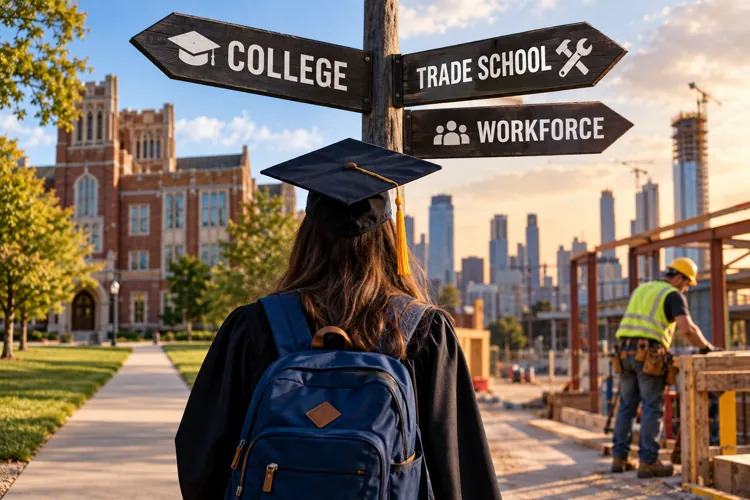

The job market is behaving strangely: Young workers without college degrees are experiencing a strong job market, while young college graduates are going through one of their weakest stretches.
A degree still pays: Workers with bachelor's degrees earn substantially more and have lower unemployment overall, according to federal data.
The calculation is changing: What you study, what your tuition costs, and whether a career actually requires a four-year degree may matter more than ever.
For generations of American families, the advice after high school was pretty straightforward. Go to college. Get a degree. Land a good job. The math isn't looking quite so simple anymore.
Workers ages 22 to 34 without college degrees are experiencing one of their strongest job markets in roughly two decades, according to a recent analysis from the Burning Glass Institute.
At the same time, young college graduates are going through one of their weakest stretches. For much of the past two decades, the fortunes of the two groups generally rose and fell together. Now they're moving in different directions.
But before parents start canceling college tours, there's an important catch. Having a college degree still provides a significant advantage overall. The unemployment rate for prime-age workers with degrees averaged 2.7% during the 12 months ending in July, compared with 4.7% for those with only high school diplomas.
What's changed isn't that high school graduates suddenly have lower unemployment than college graduates. It's that workers without degrees are doing unusually well compared with their historical job market, while young college graduates are doing unusually poorly.
Recent college grads are having a rough time
The Federal Reserve Bank of New York reported that unemployment among recent college graduates was about 5.6% in the second quarter of 2026, while underemployment was roughly 42%.
Underemployment means graduates are working, but it’s in jobs that typically don't require a college degree.
And that first job may matter more than you think. Separate Burning Glass Institute research found 52% of bachelor's degree graduates were underemployed one year after graduation. Ten years after graduation, 45% were still underemployed.
And once you start underemployed, it’s a hard trend to buck as nearly three-quarters remained underemployed a decade later. The takeaway here is that just getting a diploma these days doesn't guarantee you the kind of job you may have envisioned when you made your first tuition payment.
So what's going on?
There isn't one simple explanation.
Burning Glass points to several changes happening at once, including companies operating with leaner staffs, employers becoming more reluctant to hire inexperienced workers, and an increasing supply of college graduates.
Then of course there's AI.
Some of the tasks traditionally handed to entry-level employees can increasingly be performed or assisted by artificial intelligence, potentially allowing experienced employees to do more without as much junior-level help.
But AI shouldn't get all the blame. The weak market for young graduates began before the current AI boom, suggesting technology may be accelerating a problem rather than creating it by itself.
At the other end of the labor market, employers still need people to perform work that can't easily be done by a chatbot.
Construction, manufacturing, and other hands-on industries also face the retirement of older workers, creating opportunities for younger workers who don't necessarily have four-year degrees.
The trades suddenly look pretty attractive
For a teenager deciding what to do after high school, skipping a four-year college doesn't necessarily mean settling for a low-paying job.
For example, consider electricians. The median electrician earned $63,190 in 2025, according to the Bureau of Labor Statistics (BLS), and employment is projected to grow 9% through 2035. BLS expects about 72,700 electrician openings each year over the decade.
Most electricians learn the occupation through an apprenticeship rather than earning a bachelor's degree.
HVAC technicians had median annual pay of $61,010, with employment projected to grow 11% through 2035. The occupation typically requires a postsecondary nondegree credential followed by substantial on-the-job training.
Apprenticeships can also flip the financial equation because participants earn money while learning rather than paying tuition for four years.
The federal government's Apprenticeship.gov says registered apprentices receive paid work experience, classroom instruction, progressive wage increases, and a nationally recognized credential.
But don't write off college just yet
Here's where the "college isn't worth it anymore" argument runs into some trouble.
Over the entire workforce, education still pays. Among workers 25 and older, those with bachelor's degrees had median weekly earnings of $1,578 in 2025, according to BLS.
Workers whose education ended with a high school diploma earned $966.
That's a difference of $612 a week, or roughly $31,800 over 52 weeks, although that simple comparison doesn't account for occupation or hours worked.
And plenty of high-paying careers still do require college as the first step. Registered nurses, for example, had median annual pay of $97,550 in 2025, while software developers earned $135,980.
Interestingly, BLS also projects occupations that usually require a bachelor's degree will grow faster through 2035 than occupations requiring only a high school diploma.
So, college isn't dead by any stretch. But the days of assuming almost any degree is automatically a “good investment” may be behind us and definitely is harder to justify.
What you choose to study may matter the most
One of the biggest takeaways for families is that not all college degrees offer the same financial return.
Research from Burning Glass found that graduates with degrees in engineering, computer science, mathematics, finance, and accounting were more likely to land jobs that actually required a college degree.
Graduates in health and education fields also tended to fare well. But those who majored in public safety, recreation, and wellness studies, or general business fields like marketing, management, and human resources were much more likely to end up in jobs that didn't require a college degree.
So, if you're a high school senior, don't just ask, "Should I go to college?" Instead, ask, "What career do I want, what education or training will get me there, and how much will it cost me?"