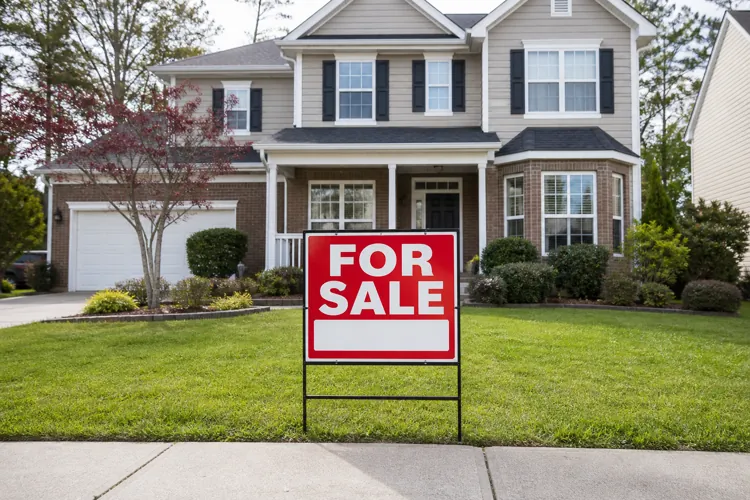

Home sellers are cutting asking prices, giving buyers more room to negotiate — but discounts may not offset higher borrowing costs.
The average 30-year mortgage rate reached 7.40% on October 8, up from 6.30% a year earlier, according to Freddie Mac.
The softer market can benefit buyers with cash or substantial equity, while households dependent on financing still face steep monthly payments.
The housing market is in a rare position. Buyers have an increasing level of bargaining power but many still lack the money to make the purchase. A combination of high prices and rising mortgage rates are keeping homeownership beyond many household budgets.
While sellers are becoming more willing to negotiate, the payment needed to close the deal may still exceed the buyer’s budget.
That gap between bargaining power and purchasing power helps explain why a softer market does not automatically translate into more affordable homeownership.
Realtor.com’s September report found that the median asking price was $419,250, down 1.4% from a year earlier. Meanwhile, 20.8% of listings had price reductions, the highest share since October 2022. The stock of listings under contract fell 4.1% from September 2025. Those figures describe asking prices and listing activity, rather than a uniform decline in completed-sale prices.
Rising mortgage rates
Borrowing costs are moving in the opposite direction. Freddie Mac reported that the average rate on a 30-year fixed mortgage reached 7.40% on October 8, compared with 7.28% the previous week and 6.30% a year earlier.
For buyers, those competing trends can mean a cheaper house comes with a more expensive payment.
Consider a hypothetical $400,000 home purchased with a 20% down payment and a 30-year mortgage at 6%. Monthly principal and interest would total about $1,919.
Here’s an example
Now suppose the seller reduces the price by $20,000, to $380,000, but the buyer’s mortgage rate is 7.4%. With the same percentage down payment, principal and interest would rise to about $2,105 a month.
The buyer saves 5% on the purchase price but pays approximately $186 more each month. Property taxes, homeowners insurance, and any mortgage insurance or association fees would add to the bill.
Selling times also require a closer look. Realtor.com reported a national median of 61 days in September, one day longer than August but one day shorter than a year earlier. However, homes were taking longer to sell in 27 of the 50 largest metropolitan areas, including Baltimore and Charlotte.
The result is a market whose opportunities depend heavily on the buyer’s finances. A cash buyer can benefit directly from a price reduction without facing a higher mortgage rate. A homeowner carrying substantial equity into the next purchase may also need a smaller loan.
Problems for first-time buyers
For a first-time buyer financing most of the purchase, the same discount may provide much less relief. A lender evaluates whether the borrower can support the payment, and a seller’s willingness to bargain cannot make an unaffordable payment fit a household budget.
Buyers who can proceed may be able to negotiate help with closing costs, repairs, or a mortgage-rate buydown. But temporary payment relief should be evaluated against the payment that takes effect when that assistance ends.
Freddie Mac also encourages borrowers to obtain multiple mortgage quotes, saying comparison shopping can potentially save thousands of dollars over a loan’s lifetime.
For sellers, the challenge is that an attractive discount must ultimately translate into a payment someone can manage. For buyers, the key question is whether the full cost of ownership fits their income — even after the seller lowers the price.