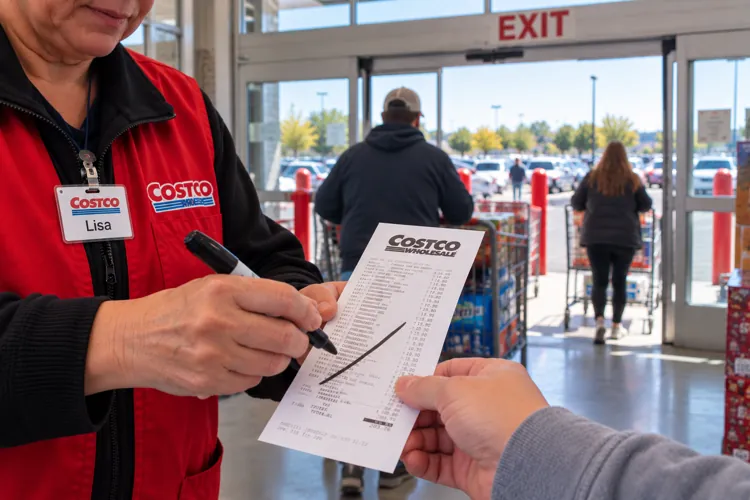

It's not just theft prevention: Costco says the primary reason for checking receipts is to make sure purchases were processed correctly.
It can catch an overcharge: The employee at the door isn't only looking for merchandise you didn't pay for.
And yes, there's a reason for that Sharpie: Marking the receipt shows that it's already been checked.
You paid for your Costco haul. The cashier handed you a receipt. You're 20 feet from freedom and then you inevitably hit another line.
A Costco employee wants to see your receipt. It might seem redundant because after all, didn't a Costco employee, or Costco's self-checkout machine, just ring everything up?
But Costco says there's a practical reason for that final check, and it isn't simply to catch shoplifters: They're checking Costco's work, too.
According to Costco, receipt checks are standard practice at its warehouses because the company wants to make sure purchases were correctly processed by its cashiers. Costco calls the process an effective way of maintaining accurate inventory while also ensuring members were charged correctly.
In other words, the employee isn't just looking for a $50 package of steaks hidden under the toilet paper. They're also looking for checkout mistakes.
For example, perhaps the cashier accidentally scanned a case of drinks twice. Or maybe you bought two of an item but were charged for three. Or maybe you bought gift cards or an expensive item that needed retrieval. The check before you leave verifies that you actually received what you paid for.
The receipt check gives Costco one last chance to catch an error before you reach the parking lot.
Pro tip: Don't automatically treat the receipt checker as an obstacle between you and the Costco food court. If you've got an expensive or unusually large order, pay attention while they're checking. They could potentially spot a mistake you missed.
So what's with the Sharpie?
After looking at your cart and receipt, the Costco employee typically marks the receipt before handing it back. That black mark shows that the receipt has already gone through the exit-check process.
And that's where one of the more interesting Costco urban legends comes in.
The story goes that without the mark, a dishonest shopper could buy a cart full of merchandise, take it to the car, then walk back into Costco with the original receipt.
They could theoretically load another cart with the same merchandise, walk toward the exit, and present the original receipt as proof they'd paid for everything. Essentially getting two carts of merchandise for the price of one.
It's a clever explanation for the Sharpie, and variations of the story have circulated among Costco shoppers for years.
And those smiley faces employees sometimes draw for kids? That's more Costco tradition than sophisticated loss-prevention technology.
Can you just refuse the receipt check?
Costco isn't quite the same as walking out of a typical supermarket. It's a membership club, and its current membership conditions explicitly say that receipts and merchandise will be inspected as members leave the warehouse.
So when you become a Costco member, you're agreeing to the policy as part of the membership rules. That's an important distinction in the perennial debate over whether shoppers have to stop for receipt checkers.
At Costco, the simpler consumer answer is that you agreed to the receipt inspection when you signed up.
Trying to save 30 seconds by blowing past the employee at the door probably isn't worth turning it into a membership issue.
The receipt checker may actually save you money
It's easy to look at Costco's receipt check as loss prevention. And obviously, making sure merchandise leaving the warehouse has been paid for helps Costco control its inventory.
But Costco's own explanation emphasizes something shoppers sometimes overlook: The check also helps make sure you paid the correct amount.
So next time you're standing there wondering why someone needs to inspect a receipt that was printed 45 seconds ago, remember they're not necessarily checking whether you did something wrong — they're checking if Costco did, too.