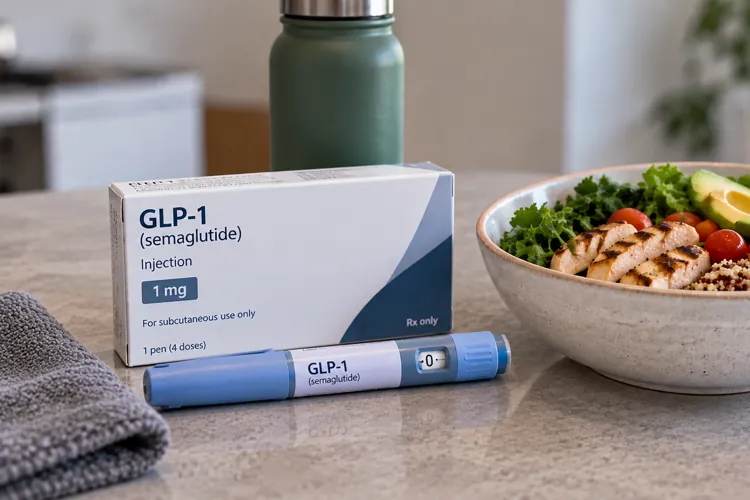

Reduced "food noise" may create an opportunity to work on eating and exercise habits without constantly fighting cravings and thoughts about food.
Protein and resistance training deserve particular attention because weight lost on GLP-1 drugs can include lean mass as well as fat.
Don't wait until you're stopping the medication to start practicing new behaviors. Research suggests habits can take months to become automatic.
For many people taking GLP-1 weight-loss drugs, one of the most noticeable changes isn't just eating less, it's thinking about the foods you crave less.
That reduction in so-called "food noise" can make it easier to pass up dessert, eat a smaller portion, or simply stop thinking about what's for dinner three hours before dinner.
But could that quieter period also be an opportunity to change some of the habits that were difficult to change before? Kyra Bobinet, MD, CEO of Fresh Tri, and author of Unstoppable Brain, thinks so.
She calls it a "habit window," which is the period when someone taking a GLP-1 may be able to practice healthier behaviors while food noise isn't fighting them every step of the way.
There's an important caveat worth noting. "A habit window is still a hypothesis; nobody has run the trial proving that less food noise makes habits easier to build," Dr. Bobinet told ConsumerAffairs.
But if you've been handed a period of time when changing how you eat feels easier, she argues it's worth taking advantage of it.
Don't wait until you stop the medication
One of Dr. Bobinet's biggest pieces of advice is to start practicing new behaviors early because habit formation requires repetition, and repetition requires time.
A 2024 analysis from PubMed Central found that health-related behaviors typically took about two months to begin becoming automatic, although there was enormous variation between individuals and behaviors. Some took weeks while others could take many months.
That's why Dr. Bobinet doesn't like the idea of waiting until someone is preparing to discontinue a GLP-1 before thinking seriously about habits.
"If you wait until you are tapering off of the GLP-1 to start practicing new habits, you may run out of time to rewire your brain into your new healthy lifestyle," she said.
The goal isn't perfection. It's repetition. Every time you choose the behavior you're trying to establish, you're essentially getting another practice rep.
Start with habits that actually matter
You've probably heard the advice to make tiny changes when trying to establish a habit. Dr. Bobinet doesn't disagree, but she thinks there's another consideration that's just as important: Is the habit you're working on actually important to your health?
She recommends looking for behaviors that occur every day, or even things that happen several times a day, as those are the behaviors repeatedly influencing your health.
"The universal part is the instruction: identify troubling old habits — outdated ones, or ones that grew out of stress, trauma, or coping — that are hurting your health, and update each one with a new daily practice," she said.
That could be different for everyone. But Dr. Bobinet points to two behaviors that may deserve particular attention among people taking GLP-1 medications: getting enough protein and doing resistance training.
A body-composition substudy of the SURMOUNT-1 trial found that people taking tirzepatide lost substantially more fat mass than lean mass, but approximately one-quarter of the weight lost was lean mass.
Instead of setting a vague goal like "exercise more," pick something you can repeat and get in the habit of doing regularly. For example, something like two scheduled strength-training sessions every week gives you an actual behavior to practice and track.
How do you know when something has become a habit?
This is where Dr. Bobinet has a wonderfully simple test: Interlace your fingers. Chances are you do it exactly the same way every time, with the same thumb naturally landing on top.
Now reverse them. It probably feels really strange.
That's the difference between something your brain does automatically and something you're consciously forcing yourself to do. Dr. Bobinet says a new eating behavior can eventually begin to feel similarly natural.
The question becomes less, "Am I forcing myself to do this?" And more, "Does this feel like what I normally do?"
"When the new way of eating is part of how you define yourself, the habit is solid," she said.
Think in terms of reps, not streaks
One of Dr. Bobinet's most interesting recommendations is to stop expecting yourself to suddenly become a different person. Practice instead.
"Every time you repeat the new version of a habit, you are making a deposit in that account and telling your brain this is how you want to live," she said.
And when the plan doesn't work? Adjust it rather than abandoning it.
Maybe going to the gym before work fails because mornings are chaotic. That doesn't necessarily mean you've failed at resistance training. It might just mean Tuesday and Thursday evenings work better.
That's a subtle but important shift that changes the method without abandoning the goal altogether.
Don't do it alone
Finally, Dr. Bobinet says one of the most overlooked pieces of successful behavior change is other people. And there's research behind that idea.
A classic weight-loss study found participants who joined the study with friends, and were given social support, were substantially more successful at maintaining their weight loss than participants who did it alone.
That support doesn't necessarily require joining a formal weight-loss program. It could mean lifting weights with a spouse, taking a nightly walk with a neighbor, or simply having someone who knows what you're trying to change.
And that may be the bigger lesson of the so-called GLP-1 habit window: The medication can change your appetite. It can reduce the food noise. It can make weight loss possible for people who've struggled with it for years. But if changing a behavior suddenly feels easier than it used to, don't just take it for granted. Use it to practice where you want to go.