


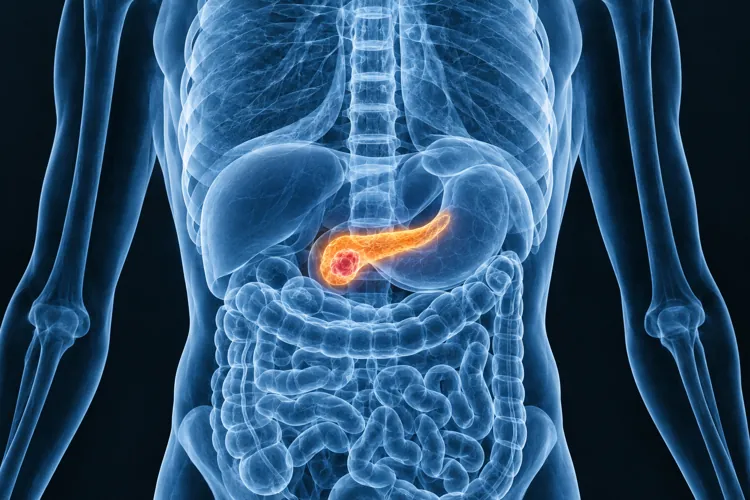

A promising new treatment: A clinical trial involving 61 patients with advanced pancreatic cancer found that tumors shrank or disappeared in nearly 61% of those receiving the drug daraxonrasib combined with chemotherapy.
Encouraging survival results: Nearly 77% of patients were alive one year after beginning treatment, compared with historical survival rates of roughly 40% to 45% among patients receiving conventional chemotherapy.
More research is needed: Although the results represent a potentially major advance, researchers caution that the study was relatively small and did not directly compare the new combination with chemotherapy alone.
A new approach to treating pancreatic cancer is generating excitement among cancer researchers after a clinical trial found that an experimental combination of a targeted drug and chemotherapy produced unusually strong results in patients with advanced disease.
The drug, called daraxonrasib, is designed to interfere with genetic mutations that fuel the growth of pancreatic tumors. When combined with two commonly used chemotherapy drugs, it produced substantial tumor shrinkage in a majority of patients, according to findings presented November 20 at the EORTC-NCI-AACR Symposium on Molecular Targets and Cancer Therapeutics in Barcelona, Spain.
The results are particularly significant because pancreatic cancer remains one of the most difficult cancers to treat. The disease often develops without obvious symptoms and frequently isn't diagnosed until it has spread to other organs.
For patients with metastatic pancreatic cancer, the five-year survival rate is approximately 3%.
Researchers say the new findings could represent an important step toward improving those odds.
Tumors disappeared in some patients
The Phase 1/2 clinical trial followed 61 patients with metastatic pancreatic cancer who had not previously received treatment for their advanced disease.
Participants received daraxonrasib, an oral medication taken once daily, along with the chemotherapy drugs gemcitabine and nab-paclitaxel.
After a median follow-up of 18.3 months, researchers reported several encouraging findings.
Tumors shrank or disappeared in 60.7% of patients. In 8.2%, scans showed no detectable tumors, a result researchers classify as a complete response.
Even more encouraging, the treatment controlled the disease in 90.2% of patients, meaning their cancer either shrank or remained stable rather than continuing to grow. The median period before the cancer began progressing was 12.8 months.
By comparison, patients receiving conventional chemotherapy historically experience disease progression after approximately five to six months.
At the one-year mark, 76.6% of patients receiving the new combination were still alive.
However, researchers emphasize that these comparisons are based on historical results, not a randomized comparison within the same study.
A different way to attack pancreatic cancer
Daraxonrasib works differently from conventional chemotherapy.
Chemotherapy generally attacks rapidly dividing cells, including cancer cells. Daraxonrasib instead targets a molecular process that helps drive cancer growth.
More than 90% of pancreatic cancers contain mutations affecting the RAS signaling system, which regulates cell growth.
Normally, RAS proteins act like switches, telling cells when to grow and when to stop.
In many pancreatic tumors, mutations cause those switches to become stuck in the on position, continuously signaling cancer cells to multiply.
Daraxonrasib is designed to interfere with the active form of RAS, potentially shutting down the signals that allow tumors to grow. Scientists have spent decades trying to develop drugs capable of blocking these cancer-driving mechanisms.
The new findings suggest that combining a RAS-targeted drug with chemotherapy may be more effective than either approach alone, although that possibility still requires confirmation in a larger trial.