


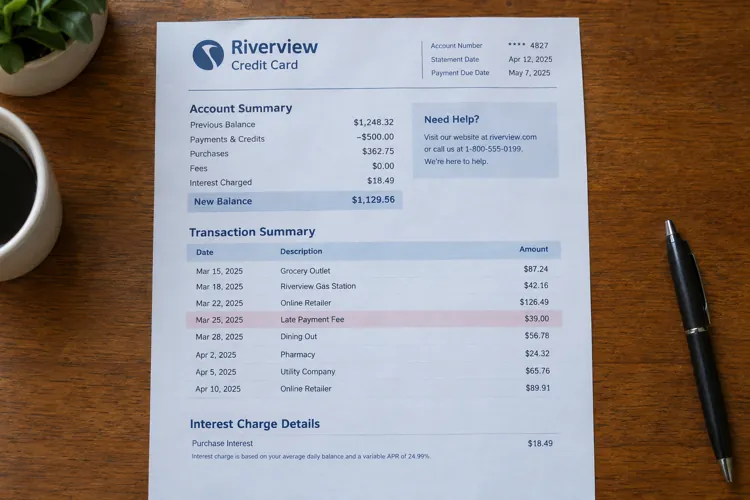

Late fees and higher borrowing costs associated with lower credit scores cost U.S. households an estimated $983 a year, according to a new doxoINSIGHTS report.
Credit cards and rent account for 77% of the $32.2 billion households pay annually in biller late fees.
The report says 35% of households paid at least one late fee in the past year.
Paying a bill late can cost considerably more than the fee on the next statement. A damaged credit score can also make borrowing more expensive, adding to household expenses long after the missed deadline.
The doxoINSIGHTS Hidden Cost of Bill Pay Report 2026 estimates that late fees and credit-related borrowing costs total $127 billion annually, or approximately $983 per U.S. household.
Those expenses account for 82% of what the bill payment company describes as hidden bill pay costs. Including fraud, identity theft, overdraft and insufficient funds fees, the estimated total reaches $155.3 billion annually, or $1,202 per household.
The figures are national estimates spread across all households. They do not mean that every family pays those amounts, and the largest component — the credit score impact — is based on a comparison of borrowing costs at different scores.
Credit cards and rent generate the most late fees
According to the report, households pay $32.2 billion annually in biller late fees, equivalent to about $249 per household.
Credit cards account for the largest share: $17 billion, or approximately $132 per household. The report lists an average credit card late fee of $32.
Rent comes next, generating an estimated $7.9 billion in annual late fees. The average fee is $85, considerably higher than the typical credit card charge. Together, credit cards and rent account for 77% of all late fees identified in the report.
Mortgage late fees total an estimated $2.7 billion annually, followed by auto loans at $1.6 billion and utilities at $1.4 billion. Mobile phone bills and cable and internet bills each generate approximately $775 million.
The report’s survey found that 35% of households paid at least one late fee during the previous year.
The larger expense is associated with credit scores
The report attributes $94.8 billion in annual costs — approximately $733 per household — to the difference in borrowing rates available to consumers with different credit scores.
To calculate that amount, doxo compared estimated mortgage, auto loan and credit card rates for borrowers with FICO scores of 714 and 814. It then applied those differences to average balances and weighted the results by the share of households holding each type of debt.
For a household carrying a mortgage, auto loan and credit card balance, the modeled annual difference reaches $1,528.
However, that calculation has an important limitation: It measures the estimated cost of a 100-point credit score gap, rather than directly measuring interest charges caused by late payments. It does not establish that late payments explain the entire difference between those scores.
The report cites FICO simulations showing that a payment 30 days late can reduce a strong credit score by as much as 83 points, while a payment 90 days late can cause a decline exceeding 100 points. Actual effects vary with a borrower’s credit history.
Other costs add to the burden
Beyond late payments, the report includes $15.9 billion in fraud and identity theft losses and $12.4 billion in overdraft and insufficient funds fees. Spread across U.S. households, those amounts equal approximately $123 and $96 a year, respectively.
Those categories also draw on broader national estimates. The fraud figure reflects FTC-reported consumer losses for 2025, while the overdraft figure comes from a National Consumer Law Center estimate. They should not be read as losses exclusively caused by paying household bills.
The report recommends tracking due dates, coordinating payments with incoming paychecks and using verified payment channels to help reduce avoidable costs.
Doxo, which sells bill payment services, compiled the report using aggregate data from more than 10 million paying consumers and 120,000 billers, a November 2026 consumer survey, and government and industry sources. Its per-household estimates use a base of 129.2 million U.S. households.