

Compare our top hearing aid picks for the elderly
| Company | Customer rating | Our pick for | Starting price | Hearing aid styles | Financing offered | Availability | |
|---|---|---|---|---|---|---|---|
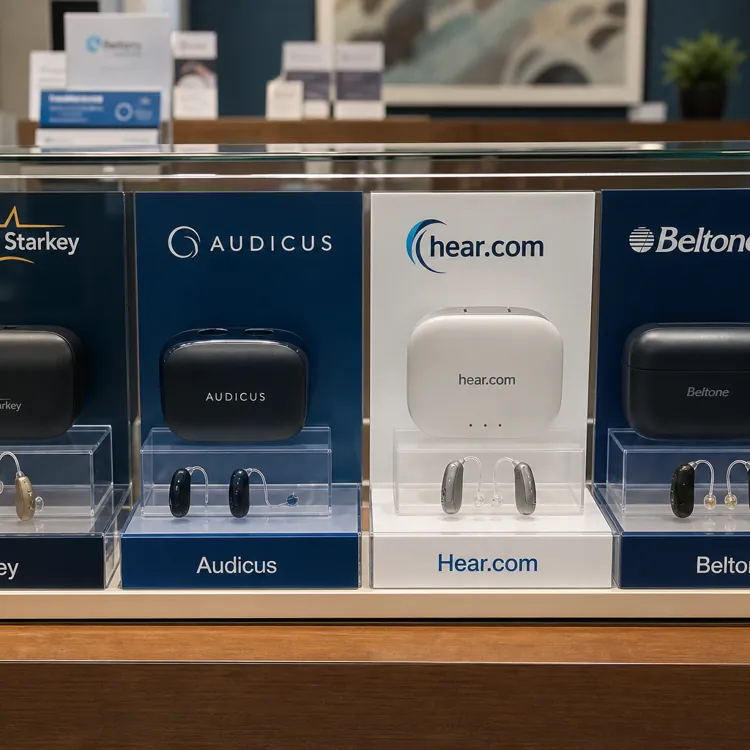
 Starkey Hearing Aids | Learn More | 4.2 | Best overall | $1,998 | Behind-the-ear, receiver-in-canal, in-the-ear, in-the-canal, completely-in-canal, invisible-in-canal |  | Through authorized hearing professionals |
 Audicus | Get Pricing | 4.5 | Best customer service | $1,498 | Receiver-in-canal, completely-in-canal | | Online with remote support |
 hear.com | Learn More | 4.6 | Best long warranty | $1,599 | Behind-the-ear, in-the-ear, completely-in-canal, invisible-in-canal, contralateral routing of signal | | Online, virtual care and 2,000+ partner providers |
 Beltone Hearing Aids | Learn More | 3.8 | Best for all levels of hearing loss | $2,000 | Receiver-in-ear, completely-in-canal, in-the-ear, in-the-canal, behind-the-ear | | Beltone hearing centers |
Starkey Hearing Aids

- Availability
- Through authorized hearing professionals
- Warranty
- Limited
- Trial period
- 45 days
- Types of hearing loss
- Mild to profound
Audicus

- Availability
- Online with remote support
- Warranty
- 2 years
- Trial period
- 100 days
- Types of hearing loss
- Moderate to severe
hear.com

- Availability
- Online, virtual care and 2,000+ partner providers
- Warranty
- 1 to 3 years
- Trial period
- 45 days
- Types of hearing loss
- Mild to profound
Beltone Hearing Aids
- Availability
- Beltone hearing centers
- Warranty
- 1 year
- Trial period
- 30 days
- Types of hearing loss
- Mild to profound
Methodology: How we chose the best hearing aids for seniors
The ConsumerAffairs Research Team evaluated hearing aid companies for seniors across four core areas: hearing care and service experience, cost and value, device selection and online reputation. Our analysis combined verified customer feedback with company-reported pricing and product details to identify the providers that offer the strongest hearing aid experience for older adults. Review data reflects verified feedback submitted to ConsumerAffairs between July 1, 2023, and June 30, 2026.
1. Hearing care and service experience (based on verified reviews): We measured satisfaction with:
- Staff
- Customer service
These factors help show how well companies support customers through the fitting process and after a purchase.
2. Cost and value: We reviewed company-reported pricing and purchase protections and evaluated:
- Price satisfaction
- Starting price for a pair of hearing aids
- Warranty length
- Trial period length
Companies offering lower starting prices, stronger price satisfaction and longer warranties and trial periods received higher scores.
3. Device selection: We reviewed company-reported product details to gauge how much choice each company offers, including:
- Whether the company offers hearing aids for all types of hearing loss
- Number of product lines
- Number of hearing aid styles and types
Companies with broader lineups and support for more types of hearing loss received higher scores.
4. Online reputation: We considered the volume of reviews submitted in the past six months and how quickly and consistently each company responded to customer reviews. Companies with more recent review activity and higher response rates received higher scores.
Which companies we included
We evaluated companies with an overall ConsumerAffairs star rating of at least 3.5, based on reviews submitted over the three-year period from July 1, 2023, to June 30, 2026.
How scoring works
Companies earned a 0 to 10 score for every factor:
- The top-performing company for a given factor earned a 10.
- Other companies were scored relative to that leader.
This standardized scoring system allowed us to compare customer satisfaction, pricing, device selection and online reputation on the same scale.
How we chose the winners
We evaluated every company using the same core factors but adjusted the weighting for each award to reflect what matters most in that category. The company with the highest weighted score earned the corresponding “Our pick for” designation:
- Best overall weighted most heavily toward staff satisfaction, customer service satisfaction and warranty length at 15% each, with moderate weight on price satisfaction, hearing loss coverage and hearing aid types.
- Best for customer service emphasized customer service satisfaction at 25% and staff satisfaction at 20%, which together made up nearly half of the category’s weighting.
- Best for all levels of hearing loss gave 25% of the weighting to the number of product lines and 15% to hearing aid types, with an additional 10% for whether the company covers all types of hearing loss.
- Best for a long warranty gave 25% of the weighting to warranty length and 10% to trial period length, with the remainder spread across service, value and device factors.
Hearing aids for seniors buyers guide
When buying hearing aids, start with your degree of hearing loss, then compare device style, features, upkeep and professional care. A hearing test can help narrow your options before you start shopping.
Key insights
Hearing aids commonly cost $1,000 to $4,000 per ear, with features, warranty coverage and bundled professional services affecting the price.
Jump to insightLarger devices and rechargeable batteries may be easier to handle if small batteries or controls are difficult to manage.
Jump to insightWhile it may take some time to adjust to hearing with the help of hearing aids, you’ll likely see an improvement in your ability to interact with others.
Jump to insightHearing aid cost
The cost of hearing aids is typically $1,000 to $4,000 per year, though pricing varies by style, features and included care. You can sometimes find OTC devices for even cheaper, at less than $100 per ear device, at a big-box store. Prescription prices often bundle your hearing test, fittings, adjustments and maintenance, while an OTC device costs much less because it doesn’t require professional fitting. Adding in features like Bluetooth and longer warranties will typically raise the price you’ll pay.
What to look for in hearing aids for the elderly
A hearing test can show the type and degree of your hearing loss, which helps you choose the right hearing aids for you, whether OTC or prescription hearing aids.
For easier daily handling, consider rechargeable batteries. That way you’re not fumbling around with tiny batteries you need to replace all the time. Larger controls and an insertable device style can also improve comfort and make removal easier. If you have a difficult time hearing in noisy environments, hearing aids with directional microphones can help you hear better. Need to make some phone calls or want to stream your fave show? Bluetooth can help.
» COMPARE: Top-rated hearing aids
Pros and cons of hearing aids
Hearing aids can improve access to speech and everyday sounds, but cost, upkeep and adjustment time can be a hindrance.
Pros
- Improves speech comprehension
- Multiple styles available
- OTC and prescription options
Cons
- Can be expensive
- Requires regular upkeep and they don’t last forever
- May take time to adjust
FAQ
Are hearing aids covered by Medicare?
Original Medicare doesn’t cover hearing aids or exams used to fit them. If you have a Medicare Advantage plan, check your Summary of Benefits to see if you have coverage.
How much do hearing aids cost for seniors?
Hearing aids usually run $1,000 to $4,000 per ear, though you can find OTC hearing aids for much cheaper.
Are hearing aids worth it for age-related hearing loss?
It’s worth getting hearing aids if you need them. The National Institutes of Health did a study that found hearing aids slow cognitive decline in people at high risk.
What type of hearing aid is best for severe hearing loss?
If you have severe hearing loss, you’ll want a prescription hearing aid fitted rather than an OTC device, as the FDA limits OTC devices for mild-to-moderate hearing loss.
Is Medicaid a way to help pay for hearing aids?
Medicaid might cover hearing aids. However, adult hearing aid benefits vary by state because states can choose which optional Medicaid benefits they cover.
Guide sources
ConsumerAffairs writers primarily rely on government data, industry experts and original research from other reputable publications to inform their work. Specific sources for this guide include:
- National Institutes of Health, “Hearing aids slow cognitive decline in people at high risk.” Accessed Aug. 16, 2026.
- Food and Drug Administration, “OTC Hearing Aids: What You Should Know.” Accessed Aug. 16, 2026.
- Medicaid.gov, “Mandatory & Optional Medicaid Benefits.” Accessed Aug. 17, 2026.
- Medicare.gov, “Hearing Aid Coverage.” Accessed Aug. 16, 2026.