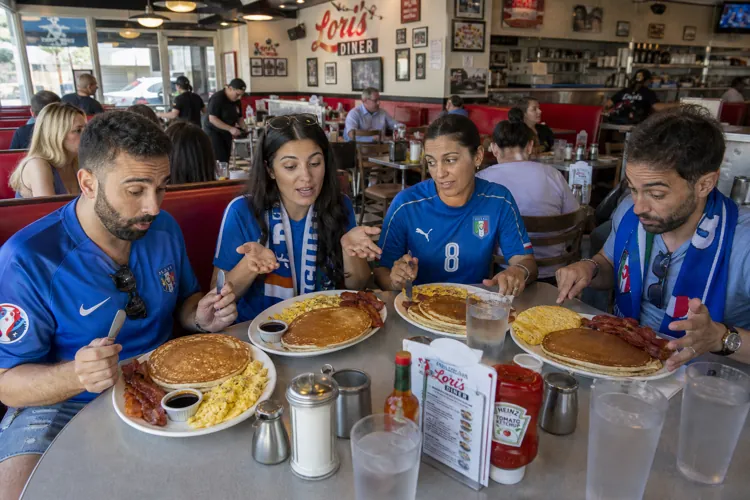

International soccer fans visiting the U.S. for the World Cup say Americans are friendlier and more curious than expected, often stopping to ask about their teams and countries.
Visitors are embracing distinctly American experiences — from oversized restaurant portions and tailgate parties to road trips between host cities.
While some fans praise the country's convenience and entertainment options, others cite concerns about transportation, healthcare costs, and the visible gap between wealth and poverty.
As hundreds of thousands of international soccer fans descend on the United States for the FIFA World Cup, many are finding that their biggest discoveries have little to do with what happens on the field.
Instead, conversations in bars, rideshares, restaurants, and stadium parking lots are giving visitors a firsthand look at American culture – especially American consumer culture – one that often differs from the image many carried with them before arriving.
For many fans, one of the biggest surprises has been the friendliness of ordinary Americans.
Visitors from Europe and South America frequently describe Americans as approachable and eager to talk, particularly when they notice national team jerseys or flags. Several fans said strangers struck up conversations in airports, restaurants, and public spaces, asking about soccer traditions in their home countries.
The tournament is also exposing international visitors to uniquely American sporting customs. Tailgate parties outside stadiums have become a major attraction for fans accustomed to pre-match gatherings in pubs or city centers.
American-size portions
Food has become another common topic of conversation among visitors. Many say they were unprepared for the size of restaurant portions, the prevalence of drive-through restaurants, and the variety of regional cuisines available across host cities, and have expressed their amazement on social media.
Fans traveling between matches have reported seeking out Texas barbecue, Southern comfort food, New York-style pizza, and Mexican cuisine, turning the tournament into a culinary tour as much as a sporting event.
“That is properly scrumptious!” one European fan said in a YouTube video after taking his first bite of Texas Barbecue.
In another YouTube video, a father and son from Europe are overwhelmed by their first visit to Waffle House, where they budgeted $100 for a meal but only could spend $35.
Getting around could be a challenge
The country's sheer scale has also left an impression.
For supporters accustomed to traveling between World Cup venues by train in relatively compact countries, the distances between American cities can be eye-opening. Some fans have incorporated domestic flights and cross-country road trips into their tournament itineraries.
Transportation remains one of the most frequently-cited challenges. While fans praise airport infrastructure and highway networks, many visitors from Europe note the relative lack of public transportation in some metropolitan areas.
Several supporters said renting a car became necessary in places where they expected trains or other transit options to be more readily available.
The World Cup has also exposed visitors to broader aspects of American society. Some international fans expressed surprise at the visible contrasts between affluent neighborhoods and areas struggling with homelessness and poverty.
Sticker shock
Others mentioned sticker shock when learning about healthcare costs or discussing insurance with local residents.
Yet many visitors say the country's diversity has become one of its most memorable features. In host cities, fans often encounter communities speaking dozens of languages and representing cultures from around the globe.
Business owners near World Cup venues say the cultural exchange is working both ways. Restaurant managers, hotel operators, and local residents are gaining exposure to soccer traditions from around the world, while visitors are learning about American customs and lifestyles.
Tourism officials hope those interactions will leave a lasting impression long after the tournament ends.