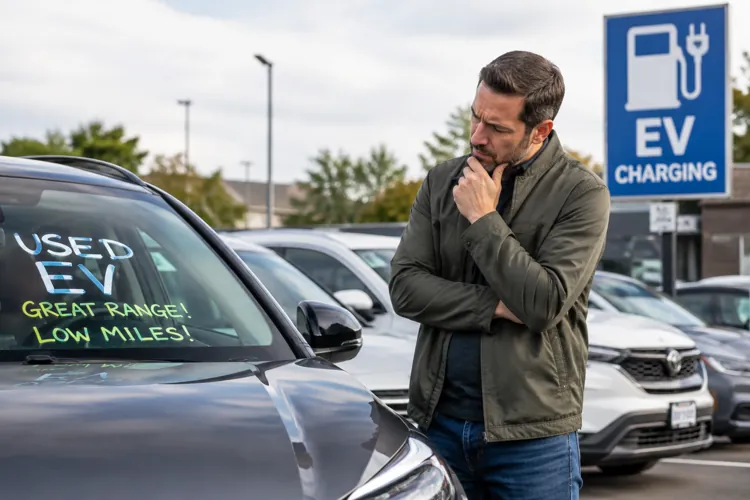

Check the battery first: Battery health, remaining warranty, and charging speed matter more than many first-time EV buyers realize.
Look beyond the sticker price: Factor in home charging, insurance, registration, and electricity costs before you buy.
Do your homework: Check recalls and service records, verify software updates, and consider an inspection by an EV-qualified mechanic.
Used electric vehicles have become far more affordable over the past few years, giving shoppers a chance to save thousands compared to buying new.
But unlike traditional gas guzzlers, used EVs come with some unique factors that many first-time buyers don't think about until after they've driven it home.
With that said, if you’re in the market for a used EV, here are seven mistakes you’d be wise to avoid when you go shopping.
1. Assuming battery health is fine
To no one’s surprise, the battery is the most expensive component in an electric vehicle, yet many shoppers never ask about its condition.
Similar to your smartphone, an EV battery gradually loses some capacity over time. That doesn't necessarily mean it's a bad purchase as many batteries still retain most of their original range after years of driving. But with that said, it's very important to know what you're buying.
If possible, ask for a battery health report or have the vehicle inspected by an independent mechanic familiar with electric vehicles.
Don't rely solely on the dashboard's estimated range. Ask about battery health, charging history, and whether the battery has ever been repaired or replaced.
Pro tip: Get an independent inspection. Just as you would with a used gas-powered vehicle, paying an EV-qualified mechanic to inspect the battery, charging system, and overall condition is money well spent.
2. Ignoring the remaining battery warranty
Many automakers provide battery warranties that last eight years or 100,000 miles, and some cover even longer periods.
A vehicle that's only a few years old may still have years of battery protection remaining, which can provide valuable peace of mind.
Before buying, verify:
How much warranty remains
Whether it transfers to a new owner
What's actually covered
On most EVs, including Tesla, Ford, Chevy, and Nissan, the battery warranty absolutely does transfer to the new owner.
Pro tip: A slightly newer used EV with several years of battery warranty left may be a smarter purchase than an older model selling for a little less.
3. Assuming every charging plug is the same
One of the biggest surprises for first-time EV owners is that not every charging connector works with every vehicle.
Most newer EVs are moving toward the North American Charging Standard (NACS), while many older models use CCS or J1772 connectors for charging.
Knowing which connector your vehicle uses can affect where, and how quickly, you'll be able to recharge.
Before buying, confirm which charging standard the vehicle uses and whether you'll need an adapter for the public charging networks in your area.
Pro tip: Test the charging speed and not just the vehicle’s range. Two used EVs with similar range can have very different “fast-charging” speeds. One may recharge from 20% to 80% in about 20 minutes, while another could take nearly an hour. If you plan to take road trips, charging speed can matter just as much as battery range.
4. Forgetting to budget for home charging
Many shoppers focus entirely on the vehicle's purchase price. But if you plan to charge at home, you may also need to budget for a Level 2 charger, and in some cases, electrical upgrades.
The good news is that home charging is often the biggest convenience of owning an EV and typically costs far less than buying gas.
If you have to add a charger to your home, it’s smart to get an estimate from an electrician before purchasing the vehicle so you know the true cost of ownership.
Pro tip: Check your electric utility before you buy. Many power companies offer rebates on home chargers, discounted overnight electricity rates, or special EV charging plans. Signing up before installing a charger could save hundreds of dollars during your first year of ownership.
5. Skipping software updates
Today's electric vehicles are as much computers as they are cars. Manufacturers regularly release software updates that improve charging performance, battery management, navigation, and even driving range.
It’s smart to ask up-front if the vehicle has received the latest available software updates. That way, what you see is what you get and you can make an informed decision.
Some updates happen automatically over the air, while others require you to visit a dealership to have it done.
Pro tip: Take a "real life" test drive. Don't just drive around the dealership. If possible, plug the car into a public charger, pair your phone, use the navigation system, and test the regenerative braking. Those everyday features are what you'll use most, and they're often more important than how quickly the car accelerates.
6. Overlooking recalls and service history
Just because an EV has fewer moving parts than a gas-powered vehicle doesn't mean it's maintenance-free.
Be sure to review service records for:
The last tire replacements
Brake maintenance
Suspension work
Charging system repairs
Battery-related service
A well-documented maintenance history can tell you a great deal about how the previous owner cared for the vehicle.
Also, be sure to check the vehicle's recall history and verify that any outstanding recalls have been completed.
7. Buying more range than you actually need
It's easy to assume the EV with the biggest battery is automatically the best choice. But larger batteries typically mean higher purchase prices.
For example, if your daily commute is only 30 to 40 miles, paying thousands more for an extra 150 miles of range may not make financial sense.
Instead, think honestly about your driving habits and what EV makes the most sense for you.
It’s smart to track your driving for a week before you go EV shopping. By knowing your typical daily mileage ahead of time, it can help you avoid paying for battery capacity that you'll rarely need.
In actuality, most drivers charge at home overnight and rarely use their vehicle's maximum range.
Pro tip: Be sure to calculate the total cost of ownership and not just the sticker price. Don’t forget about things like insurance, charging costs, home charger installation, maintenance, and registration fees before deciding which used EV offers the best value.