The Best and Worst States to Have a Baby (2026)

+1 more


There’s no two ways about it: Having a baby is one of the biggest and most life-changing decisions a family can make. And when it comes to starting or growing your family, it’s not just about the when or the how — it’s also a matter of where.
While not every family has the privilege of moving before having a baby, data indicates that it’s easier, safer and more affordable to start a family in some states than in others. Where you live can have a significant influence on a range of factors, from the cost of delivery to the length of guaranteed paid leave from work.
“Whether a place is ‘safe’ for having a baby isn’t only about hospitals and clinics,” said Jun Wu, a professor of environmental and occupational health at UC Irvine. “The surrounding environment shapes the conditions a pregnancy unfolds in, and with it the health of both the pregnant person and the infant.”
To further explore how the experience of having a baby varies state by state, ConsumerAffairs analyzed data on maternal healthcare access, affordability, postpartum and family support, and maternal and infant health outcomes for all 50 states and Washington, D.C. Read on for our full analysis of the best and worst states to have a baby.
Key insights
New Hampshire ranks as the best state to have a baby in, with strong maternal healthcare access and some of the nation’s best maternal and infant outcomes.
Jump to insightWest Virginia is the worst state to have a baby. In-network childbirth costs average about 35% of median household income — the highest share in the nation.
Jump to insightThe regional divide is striking: Eight of the 10 worst states for having a baby are in the South, while the top-performing states are in the Northeast.
Jump to insightMississippi shows that lower birth costs don’t guarantee better outcomes, ranking worst for maternal and infant outcomes despite low costs.
Jump to insightThe 10 best states to give birth in
Our analysis revealed some meaningful trends among the states that offer the most supportive environments to have a baby. Among the 10 highest-scoring states, health-related metrics are the top predictors of strong performance in the overall rankings. Nine states rank in the top 10 for maternal healthcare access, and seven rank in the top 10 for maternal and infant health outcomes.
Another commonality? Region. The Northeast is home to the top four states and six of the top 10. Family support is another common thread: All 10 states have good postpartum and family support, with at least six weeks of paid parental leave.
Does all this support and access come at a cost to families? Interestingly, these states tend to lag in affordability. Only two rank in the top 10 for this metric, while the rest fall in the middle of the pack or near the bottom. That's despite nine states having median household incomes above the national median, suggesting that higher incomes don't necessarily translate to greater affordability.
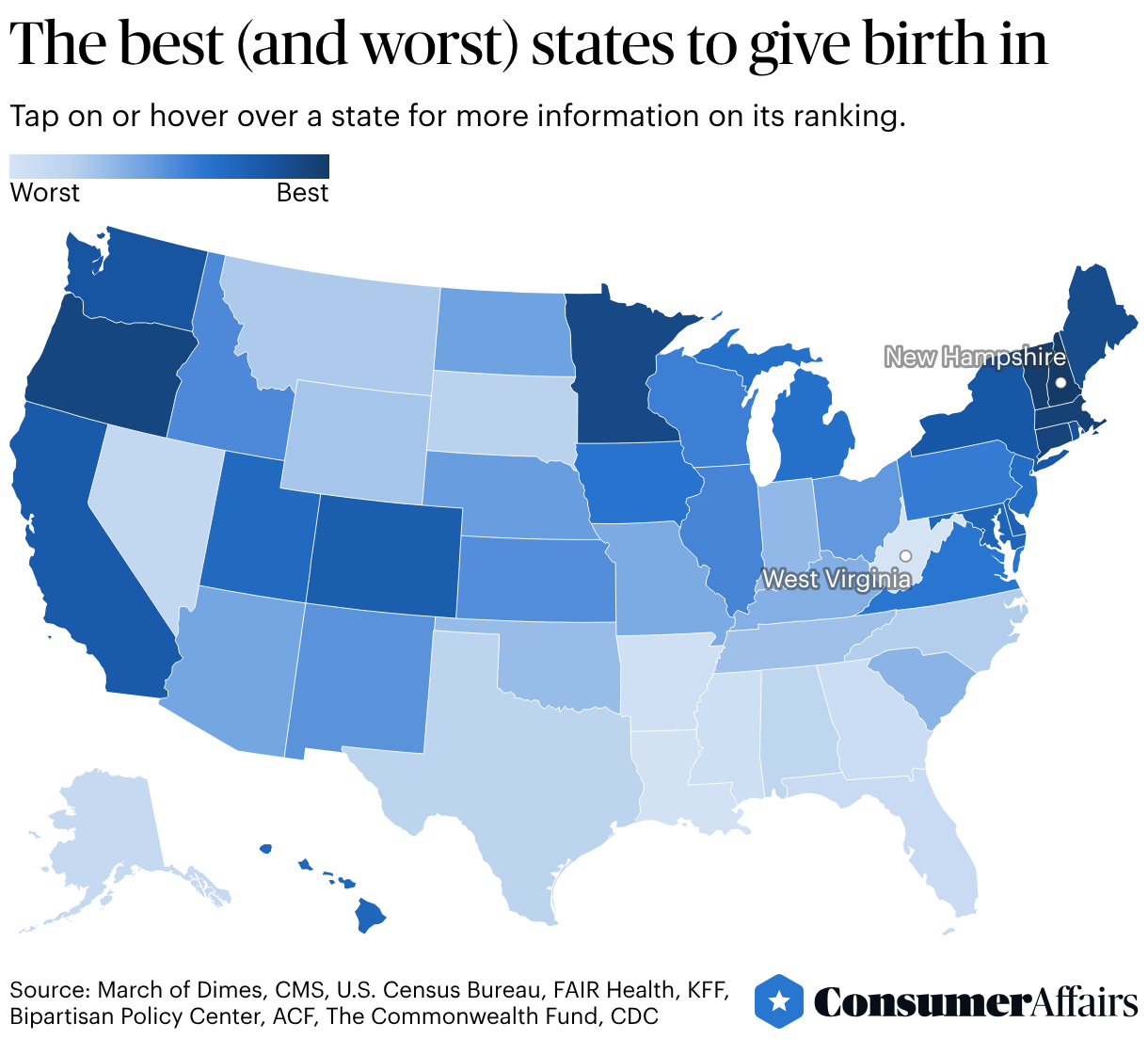
Check out the map below for an overview of the childbirth environment across the United States. Then, read on for a closer look at the 10 states that score the highest for overall maternal and infant support.
1. New Hampshire
New Hampshire’s top rank is driven by ample maternal healthcare access — the best in the nation — and some of the nation’s strongest maternal and infant outcomes. About 92% of women in the Granite State receive adequate or intermediate prenatal care, and zero counties are classified as maternity care deserts (a county where there are no hospitals or birth centers with obstetric care and no obstetric providers).
Even more impressive? Giving birth isn’t as expensive as you might think. New Hampshire ranks seventh best for childbirth affordability. While typical in-network childbirth costs in the state are moderate ($18,449 in-network, $29,481 out-of-network), they’re helped by strong household incomes ($99,782 median).
Folks who have a baby here could do well to stick around. New Hampshire isn’t just a supportive environment for giving birth; it’s also a good place to raise a family, ranking No. 1 in our latest analysis.
2. Vermont
Families in the Green Mountain State can expect an incredibly supportive environment to start or grow their families. Vermont earned its No. 2 rank with strong maternal healthcare access (second best in the U.S.), helpful postpartum support (fifth best) and outstanding maternal and infant health outcomes (best in the country).
The most notable stat? The state’s near-zero rate of pregnancy-related deaths for women. Unfortunately, this makes Vermont an outlier. Even among the top-ranked states for maternal health outcomes, no other state comes close to having a rate this low.
Vermont’s only drawback is related to the cost of delivery. The state ranks sixth worst in this category, with in-network childbirth costs taking up about 27% of the median household income in the state (fourth highest).
3. Massachusetts
The Bay State offers families a well-rounded, supportive environment to have a baby. Massachusetts has the third-best maternal and infant health outcomes in the country, including some of the lowest mortality rates for both mothers and infants. It’s the 10th-best state for postpartum and family support, and the sixth best for access to maternal healthcare.
Massachusetts also ranks in the top half of states for affordability (No. 18), proving that it’s possible for a state to offer families an abundance of quality healthcare while balancing costs. (The state benefits from having the second-highest median household income, trailing only Washington, D.C.)
4. Connecticut
Like some other top-ranked Northeastern states, Connecticut isn’t the cheapest place to have a child. It ranks 35th best for the affordability of childbirth. However, strong performance across the other categories we measured help it compensate.
In the Constitution State, more than nine out of 10 women (90.7%) receive intermediate or adequate prenatal care — the third-best rate in the country. Connecticut ranks third best overall for access to maternal care, with zero counties classified as maternity care deserts and a dense supply of maternal care providers (the fifth-highest ratio in the U.S.).
5. Oregon
Oregon ranks fifth best overall, including fifth best for maternal healthcare access. The state boasts a high ratio of maternal care providers (eighth highest in the country), and nearly 89% of women receive adequate or intermediate prenatal care (10th best).
The state lags slightly in affordability, ranking 30th in the category. In-network childbirth costs equate to more than a quarter (26.7%) of a typical household’s annual income, more than six points above the national figure.
However, the Beaver State shines for its postpartum and family support, ranking fourth best overall in that category. Families can expect up to 12 weeks of paid family leave, with a maximum weekly benefit that is higher than in most states.
6. Minnesota
Minnesota ranks sixth best overall, with strong performances in maternal healthcare access (eighth best), maternal and infant health outcomes (seventh best) and postpartum and family support (seventh best).
In particular, many families are excited to take advantage of the state’s new Paid Leave program, which took effect on Jan. 1, 2026. It offers working parents up to 12 weeks of paid bonding time during the first 12 months after childbirth.
Like several other states in the top 10, Minnesota’s weakest area is affordability — but for many families, it’s not an altogether unaffordable place to have a baby, still ranking in the top half of states in that category (20th best).
7. Maine
Maine offers families a rich environment for starting or growing a family, though it can come at a steeper cost for the typical household.
While the state ranks fourth best for maternal healthcare access and eighth best for maternal and infant health outcomes, Maine lands at fourth worst for affordability. In-network childbirth costs are relatively high and eat up the third-highest share of median household income in the U.S. (29.5%).
However, that shouldn’t discourage families from having a baby in the Pine Tree State. Our analysis ranks it the best state in the U.S. for postpartum and family support. Maine offers 12 weeks of paid parental leave and the nation’s second-most generous eligibility threshold for childcare assistance in the country. This means more families can qualify for access to reliable care.
8. Washington, D.C.
Washington, D.C., ranks as the eighth-best place to have a baby. However, its strong overall ranking doesn’t come without some unique tensions in the data.
On the bright side, affordability is high (fourth best) — in no small part because the typical household income tops six figures ($109,707, highest in the U.S.). But the affordability here isn’t driven by high incomes “keeping up with” high costs; both in-network and out-of-network costs are actually below the national medians. In fact, relative to income, in-network costs are the most affordable in the country (only 12.4% of household income).
And there’s no shortage of healthcare providers — the nation’s capital boasts the best ratio of maternal care providers to female residents, at 149 per 100,000 women.
However, it’s critical that families in Washington take advantage of this ample access and affordability. Just 77% of women actually receive adequate or intermediate prenatal care — one of the lowest rates in the nation. Worse — but perhaps unsurprisingly — D.C. has poor maternal and infant health outcomes (fifth worst overall).
9. Rhode Island
Continuing the trend of strong performances from Northeastern states, Rhode Island ranks ninth best overall.
The state stands out for both maternal healthcare access (seventh best) and maternal and infant health outcomes (fifth best), pointing yet again to a meaningful link between how access to quality care can help more mothers and babies thrive. The state has some of the lowest rates of infant mortality and preterm births in the country, and no counties are classified as maternity care deserts.
Unfortunately, Rhode Island ranks in the back half of all states for affordability (32nd best). In-network childbirth costs are the 16th most expensive as a share of median household income.
10. Washington
Washington rounds out the top 10 states for having a baby, with strong performances across several categories in our methodology.
The Evergreen State hovers around the middle of the pack for the metrics measuring maternal healthcare access, ranking 27th overall in this category. However, Washington makes up for it with outstanding postpartum and family support, scoring third best. Families can take advantage of the state’s paid leave program, which includes 12 weeks and a maximum weekly benefit of $1,647 in 2026.
Washington is also a high performer (sixth best overall) for maternal and infant outcomes. The state boasts an especially low rate of babies born with low birthweight, at just 7%. That’s the third-lowest rate nationally.
What are the worst states for childbirth?
Our analysis found that eight of the 10 worst states for having a baby are located in the South. This regional concentration is impossible to ignore, and is rooted in broader inequities.
“Geography alone is not the problem,” said Dr. Sonal Patel, a pediatrician and founder of NayaCare, which provides health services and coaching for mothers and infants. “The ‘why’ behind these access gaps is structural.”
It’s well-documented that the South is home to deep disparities in maternal and infant health, mortality rates and postpartum support systems, and “the underlying thread is healthcare access,” Patel explained. “Without access (to quality maternal and infant healthcare), safety, affordability and availability are directly impacted, leading to higher maternal and infant mortality rates,” she said.
Larger demographic shifts play a role in changing access to care, explained Becky Ofrane, a doula and assistant professor of public health at Montclair State University. “Maternity care is facing a crisis because hospitals are closing labor and delivery wards, in part because of declining birth rates.”
“You also need high-quality providers, and we have a huge gap in the number of midwives available and in training, and fewer and fewer physicians are becoming OBs (obstetricians),” she added.
Geography alone is not the problem. The ‘why’ behind these access gaps is structural.”
These challenges show up repeatedly in the data. While many families do have healthy pregnancies and births in every state, states that rank poorly tend to struggle with healthcare access, childbirth affordability, postpartum and family support, and maternal and infant health outcomes.
Our analysis found that the worst states to have a baby are:
- West Virginia
- Louisiana
- Arkansas
- Mississippi
- Georgia
- Florida
- Alaska
- Nevada
- Alabama
- Texas
West Virginia leads the list mainly because it has the most expensive childbirth costs, but it also ranks 44th in maternal and infant outcomes and 36th in maternal healthcare access.
How much does it cost to give birth in the U.S.?
When families are preparing to grow, budgeting for that new bundle of joy is likely already top of mind. But do you know exactly how much it costs to give birth?
At the national level, the average cost to deliver a baby ranges from $16,495 for in-network care to $35,378 for an out-of-network childbirth (see our methodology for an explanation of these weighted averages). Those figures are already eye-wateringly steep, especially when compared with the median household income ($81,604). In some places, though, costs are far higher — and take an even bigger bite out of a family’s finances.
Factoring in not just the delivery services (labor and delivery room, medical and surgical supplies) but also anesthesia, ultrasounds and lab work, the median cost of giving birth with in-network coverage is highest as a share of the median household income in West Virginia (35%), and lowest in Washington, D.C. (12.4%).
But it’s not just state-to-state variations that expecting families may want to consider. “The fee to deliver a baby can differ greatly even among hospitals in the same city,” said Janene Oleaga, a fertility lawyer and reproductive rights advocate based in New York and Maine. “Insurance providers and hospital market power are two factors that determine cost: The more competitive the market, the more negotiating power,” she said.
Explore the map below for more insights into the cost of giving birth across the United States. The darkest states are those where the costs of giving birth are the highest.
How the rest of the U.S. ranks for childbirth
Whether you’re considering relocating to have a baby or want to better understand the environment in your home state, check out the full data and rankings below.
Note that regional clusters appear at both extremes of the rankings. Six of the 10 top-scoring states are in the Northeast, while eight of the 10 states with the poorest scores are located in the South.
Methodology
The ConsumerAffairs Research Team ranked the best states to have a baby in using a weighted scoring system based on metrics in four categories: maternal healthcare access, childbirth affordability, postpartum and family support, and maternal and infant outcomes.
Each state received a score for every metric, with the top-performing state earning the maximum number of points and all other states scored relative to that benchmark. Category scores were combined for a final score out of 100 points.
Maternal healthcare access (35 points)
This category includes the percentage of women receiving adequate or intermediate prenatal care (13 points), the number of maternal healthcare providers (OB-GYNs and midwives) per 100,000 women ages 15 to 44 (12 points) and the percentage of counties classified as maternity care deserts (10 points). Data is from March of Dimes (2023 and 2024), the Centers for Medicare & Medicaid Services National Plan and Provider Enumeration System (2026) and the U.S. Census Bureau (2024).
- Adequate prenatal care is defined as care beginning within the first four months of pregnancy with at least 80% of recommended prenatal visits completed. Intermediate care consists of 50% to 79% of recommended visits attended.
- A maternity care desert is a county where there are no hospitals or birth centers with obstetric care and no obstetric providers.
Childbirth affordability (30 points)
This category includes the in-network weighted average childbirth cost as a percentage of median household income (14 points), the out-of-network weighted average childbirth cost as a percentage of median household income (6 points), the average annual family premium for employer-based health insurance (6 points) and the average annual family deductible for employer-based health insurance (4 points). Data is from FAIR Health (2025), KFF (2024) and the U.S. Census Bureau (2024).
- For each state, we calculated a weighted average of childbirth, using national rates for vaginal and C-section deliveries.
Postpartum and family support (20 points)
This category includes paid family leave (15 points total) and childcare assistance eligibility (5 points). Data is from the Bipartisan Policy Center (2026) and the Administration for Children & Families (2025 to 2027).
- Paid family leave generosity includes the maximum length of paid parental leave offered (both mandatory and voluntary programs) (7.5 points), the maximum weekly paid leave benefit available under a state program (5.5 points) and whether the state has a mandatory statewide paid leave program (2 points).
- Mandatory statewide paid leave programs automatically cover eligible workers, while voluntary programs typically depend on employer participation or optional enrollment.
- States with enacted but not yet effective mandatory paid leave laws, including Virginia and Maryland, were scored based on active policies at the time of publication.
- Childcare assistance eligibility is based on how much a family of three can earn as a percentage of the state median income and still qualify for childcare subsidies.
Maternal and infant outcomes (15 points)
This category includes pregnancy-related deaths per 100,000 births (5.5 points), infant deaths per 1,000 live births (4.5 points), the percentage of live births that were preterm (3 points) and the percentage of babies born with low birth weight (2 points). Data is from The Commonwealth Fund (2019 to 2023) and the U.S. Centers for Disease Control and Prevention (2024).
- A pregnancy-related death is defined as a death occurring during pregnancy or within one year after it ends that was from any cause related to or worsened by the pregnancy or its management.
- Infant mortality is defined as death within a year of birth.
- A preterm birth is a live birth occurring before 37 completed weeks of pregnancy.
- Low birthweight refers to a weight of less than 2,500 grams, or 5 pounds, 8 ounces.
Reference policy
We love it when people share our findings! If you do, please link back to our original article to credit our research.
Questions?
For questions about the data or if you'd like to set up an interview, please contact egomes@consumeraffairs.com.
Article sources
ConsumerAffairs writers primarily rely on government data, industry experts and original research from other reputable publications to inform their work. Specific sources for this article include:
- March of Dimes, “Prenatal Care.” Accessed June 1, 2026.
- Centers for Medicare & Medicaid Services, “NPI Files.” Accessed June 1, 2026.
- March of Dimes, “Nowhere to go: Maternity Care Deserts across the US 2024 Report for United States.” Accessed June 1, 2026.
- U.S. Census Bureau, “Explore Census Data.” Accessed June 1, 2026.
- FAIR Health, “Cost of Giving Birth Tracker.” Accessed June 1, 2026.
- KFF, “Average Annual Family Premium per Enrolled Employee For Employer-Based Health Insurance.” Accessed June 1, 2026.
- KFF, “Average Annual Deductible per Enrolled Employee in Employer-Based Health Insurance for Single and Family Coverage.” Accessed June 1, 2026.
- Bipartisan Policy Center, “State Paid Family Leave Laws Across the U.S.” Accessed June 1, 2026.
- Administration for Children & Families, “CCDF Family Income Eligibility Levels by State.” Accessed June 1, 2026.
- The Commonwealth Fund, “Maternal Mortality in the United States, 2025.” Accessed June 1, 2026.
- U.S. Centers for Disease Control and Prevention, “Infant Mortality.” Accessed June 1, 2026.
- U.S. Centers for Disease Control and Prevention, “Preterm Births.” Accessed June 1, 2026.
- U.S. Centers for Disease Control and Prevention, “Low Birthweight.” Accessed June 1, 2026.
- KFF, “Racial Disparities in Maternal and Infant Health: Current Status and Key Issues.” Accessed June 2, 2026.
- Minnesota Department of Employment and Economic Development, “Paid Leave for bonding.” Accessed June 2, 2026.
- Washington State’s Paid Family and Medical Leave, “Individuals and Families.” Accessed June 2, 2026.
- CSG South, “Reinforcing Our ‘Steel Magnolias’: How the South Is Combatting High Maternal Mortality Rates.” Accessed June 2, 2026.
Figures