States With the Highest Summer Cooling Cost Burden (2026)

+1 more

Summertime means relaxing in the sun, digging in the garden and socializing with friends outside. Or does it mean sweat dripping down your back, mosquitoes biting your ankles and the highest electricity bills you’ve seen all year?
Summer can mean a lot of things to different people. But no matter whether you’re a beach bum or prefer to hang indoors shielded from the sun, seasonal electricity costs can have you feeling the heat.
If you’re looking to lower home cooling costs, it’s important to know what you’re up against. To find out, the ConsumerAffairs Research Team analyzed electricity costs and household income data across all 50 states and Washington, D.C., to uncover where staying cool this summer puts the biggest strain on household budgets. Keep reading to see where cooling costs are stretching household finances the most.
Key insights
Alabama ranks No. 1 for highest summer cooling burden, with the average summer electricity bill consuming 4.4% of the median monthly household income.
Jump to insightArizona households face the nation’s highest average summer electricity bill, at over $265 per month — 33% above the national average.
Jump to insightWashington residents have the nation’s lowest summer cooling burden, with the average summer electricity bill equal to 1.2% of median monthly household income.
Jump to insightIllinois households saw the largest year-over-year increase in summer electricity bills as a percentage of income, spending 39.3% more.
Jump to insightHow summer electricity prices have changed over time
In 2020, the average summer electricity bill in the United States was about $152, but in 2025, Americans paid an average of $199 each month during summertime. What gives?
The increase in price isn’t just due to inflation. Alexis Abramson, dean of the Columbia Climate School in New York, told ConsumerAffairs that aging infrastructure is the No. 1 reason that some Americans are seeing electricity costs increase substantially.
“In an effort to keep electricity prices low for consumers, maintenance of and upgrades to our electricity grid have long been deferred,” Abramson said. “The country needs new transmission lines and significant upgrades to its distribution system. … Utilities are passing those modernization expenses directly to ratepayers.” And that’s not the only factor: Surging demand and the fluctuation of natural gas prices affect costs, too.
These extra expenses can leave some Americans in a dangerous position. According to the U.S. Energy Information Administration, 17.5 million households reported leaving the home at an “unhealthy temperature” in 2024, and 8.2 million households reported being unable to use air conditioning.
The 10 states with the highest summer cooling cost burden
You don’t have to break a sweat to figure out what the top states for cooling costs have in common: They’re all part of the U.S. regions that get the hottest during the summer. But none of them rank among the top 10 most expensive states for electricity rates, according to data from the EIA.
So why are people in these states paying so much for cool air? “Lower rates don't necessarily mean lower bills,” Abramson said. “The South's climate brings long, hot and humid summers that demand larger air conditioning systems running for months on end, driving up residential electricity bills dramatically despite the cheaper per-kilowatt-hour cost.”
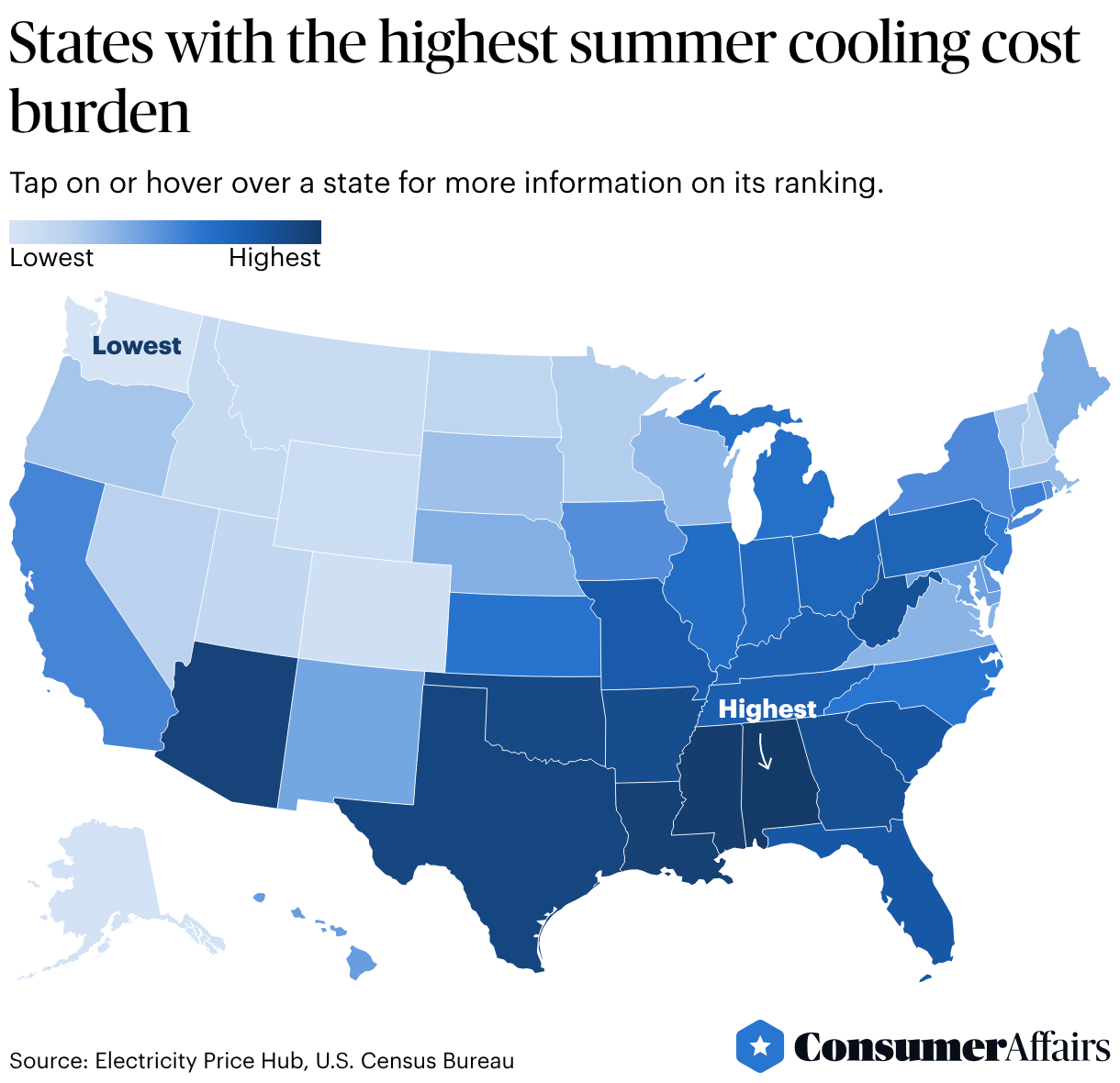
What exactly are households spending to cool their homes? Check out the map below to learn more about the states with the highest summer cooling costs — and keep scrolling for information on the highest-ranked states.
1. Alabama
It’s all “Sweet Home Alabama” until you read the number on that sweet home’s summer electric bill. It costs Alabama residents an average of $241 per month to keep cool when the weather is hot, or 4.4% of the median monthly income. Alabama also ranked No. 1 when we looked at the data from 2024 and 2020, and when we surveyed residents, 97%, a national high, told us their monthly electric bill is usually over $100.
2. Mississippi
In 2025, Mississippi households spent 4.2% of their monthly income on summer cooling costs. The state’s $201 average summer electric bill isn’t the highest on our list, but households in the state earn a median $4,835 per month, the lowest in the U.S. and 30% below the national median.
“Residents of Mississippi, Louisiana and Alabama are absorbing costs on significantly lower median incomes than their Northern counterparts,” said Abramson. That financial discrepancy makes rising summer cooling costs an even heavier burden.
3. Louisiana
We all know the world has changed since 2020, but Louisiana residents really feel it. The Pelican State recorded the largest increase in summer electricity costs as a share of income among the states on our top 10 list between 2020 and 2025, at 15.2%. Residents were also hit with the biggest year-over-year increase (22.1%).
One of the reasons for these big jumps? Median incomes in Louisiana are growing at the second-slowest pace in the country, so when electricity prices rise, they take up a bigger chunk of the average household budget.
4. Arizona
The average summer electricity bill in Arizona is $266, the most expensive on the map and 33% above the national average. But the median household income is slightly higher than across the U.S., while the three states above Arizona have some of the lowest incomes in the country. Still, Arizona has one of the highest heat wave risks in the U.S. according to the Federal Emergency Management Agency, so staying cool remains a major necessity.
One bright spot: Arizona’s average summer electricity bill dropped 3% from 2024 to 2025. While the exact cause is unclear, the state’s growing solar capacity may be helping ease some pressure on summer energy costs.
5. Texas
Texas residents spent less on summer electricity in 2025 than in 2024 — but the average bill is still the second highest nationwide, at about $252.
So why isn't Texas closer to the top of our rankings? The median monthly household income is in the top 50% of states, not far behind Arizona. As a result, the share of monthly income Texans spend on summer electricity is around 3.8%. That’s 10% lower than in 2024, the biggest year-over-year drop of any state on our top 10 list.
6. Oklahoma
Oklahoma sits directly above Texas on the map, but it ranks one spot below the Lone Star State in our report.
Oklahoma’s cooling bills as a percentage of the median household budget increased 12.5% between 2020 and 2025, including a 4.3% rise in the last year. The increase from 2024 to 2025 was second highest among the top 10 states, after Louisiana. Households in the Sooner State spend about 3.7% of their monthly income on electricity bills.
7. Arkansas
When the typical Arkansas household checks its electricity bill during June, July or August, the amount due is lower than the national average by about 10%. But cooling costs still account for 3.4% of the average household’s monthly income. That’s because the median household income in the Natural State is the fourth lowest in the U.S.
8. Georgia
Georgia may be known for peaches, but electricity bills there can leave a sour taste. The average bill during summertime is about $225, which is sixth highest in the U.S. In 2025, residents spent 3.4% of their monthly income to pay for summer electricity. That percentage has fallen slightly in recent years, but not by enough to keep Georgia out of the 10 most expensive states for cooling when the temperature rises.
9. West Virginia
West Virginia has the lowest average summer electricity bill among the states in our top 10, at about $168 per month. But with median monthly household income sitting just above $5,100 — second lowest in the country — even relatively modest cooling expenses can place a meaningful strain on household budgets.
And for some residents, the challenge isn't paying for air conditioning — it's not having it at all. According to the EIA, 11% of West Virginia homes lack air conditioning (the highest percentage of any state in the top 10), leaving many households vulnerable to high indoor temperatures during the hottest time of the year.
10. South Carolina
Since 2020, no state in the current top 10 has seen electricity costs as a percentage of income fall more than South Carolina. In 2020, they made up 3.8% of household income. In 2025, that number dropped to 3.2%. Residents still face a burden when it comes to summer cooling, but at least the Palmetto State is trending toward greater affordability.
States with the lowest summer cooling cost burden
Are there any states that don’t face major summer cooling costs? Here’s the short answer: Yes.
But remember — the grass isn’t always greener on the other side. “Summer cooling bills in the South are still generally lower than the heating bills Northern households face each winter,” Abramson, the Columbia Climate School dean, said. That’s because heating and cooling systems have to overcome the difference between outdoor temperature and the indoor temperature homeowners want inside, and in colder climates, that gap is usually larger and lasts longer.
If summer cooling costs are your biggest concern, you’ll find relief in these places, which have the lowest summer electricity bills compared with household incomes:
- Washington
- Alaska
- Colorado
- Washington, D.C.
- Wyoming
- Montana
- Idaho
- Utah
- North Dakota
- New Hampshire
How the rest of the U.S. ranks for summer cooling burden
Across the U.S., the average summer electricity bill takes up about 2.9% of the median household income. But the percentage varies state by state, from the state with the highest burden (Alabama) to the state with the lowest (Washington). Take the temperature of the full data below.
Tips to reduce summer electricity costs
“The connection between hotter summers and higher bills is direct and measurable,” said Abramson of the Columbia Climate School. “As summers grow hotter and heat waves more intense … air conditioners run longer, cycle more frequently and consume significantly more energy.”
That raises the question: Is it even possible to both beat the heat and save money? (Don’t worry — the answer is yes.)
Here are some tips to reduce summer cooling costs, from everyday swaps to major changes:
- Stay in the shade: Keep window shades, blinds and curtains closed to keep out the sun — and the heat.
- Keep it clean: Dirty air conditioner filters force your air conditioner to work harder, increasing energy use. Reduce strain by cleaning or replacing your filters monthly.
- Change the temp: Don’t set it and forget it when it comes to AC. According to the U.S. Department of Energy, you can save up to 10% on energy bills by turning the thermostat back 7 to 10 degrees for eight hours a day, so consider adjustments when you are away.
- Invest in efficiency: If you do have to replace your air conditioner, shop smart. AC units with a higher SEER2 (seasonal energy efficiency ratio) ratings use less energy to cool your home, reducing your bills. Look on the yellow EnergyGuide label for this rating, the Energy Star logo and estimated operating costs.
- Consider switching to solar: Solar panels aren’t in everyone’s budget, but there’s no denying that they can help lock in lower long-term energy costs.
Methodology
The ConsumerAffairs Research Team ranked states by summer cooling cost burden by comparing the average summer electricity bill with median monthly household income.
To calculate the average summer electricity bill, we used June, July and August 2025 electricity cost data from Electricity Price Hub, a joint project between the Massachusetts Institute of Technology and Heatmap News. Income data came from the U.S. Census Bureau (2020 to 2024).
Because 2025 income data was not available at the time of analysis, we estimated 2025 median household income by applying the same percentage increase from 2023 to 2024 in each state to the 2024 figure.
We then divided the average summer electricity bill by the estimated 2025 median monthly household income to calculate the percentage of monthly income spent on summer electricity bills (the “cooling cost burden”).
This percentage was the metric used to determine the final ranking. Supplemental data, including changes in cooling cost burden over time, the share of households spending more than $100 per month on electricity, air conditioning access and heat wave risk, was collected for additional context but was not factored into the ranking.
Reference policy
We love it when people share our findings! If you do, please link back to our original article to credit our research.
Questions?
For questions about the data or if you'd like to set up an interview, please contact jrodriguez@consumeraffairs.com.
Article sources
ConsumerAffairs writers primarily rely on government data, industry experts and original research from other reputable publications to inform their work. Specific sources for this article include:
- Heatmap News, “Electricity Price Hub.” Accessed June 2, 2026.
- U.S. Census Bureau, “Explore Census Data.” Accessed June 2, 2026.
- Federal Emergency Management Agency, “National Risk Index Data.” Accessed June 2, 2026.
- U.S. Energy Information Administration, “Highlights for Air Conditioning in U.S. Homes by State, 2020.” Accessed June 2, 2026.
- U.S. Energy Information Administration, “2024 RECS Survey Data.” Accessed June 1, 2026.
- Solar Energy Industries Association, “Arizona.” Accessed June 5, 2026.
- U.S. Department of Energy, “Spring and Summer Energy-Saving Tips.” Accessed June 8, 2026.
- U.S. Department of Energy, “Programmable Thermostats.” Accessed June 8, 2026.
- U.S. Department of Energy, “Purchasing Energy-Efficient Residential Central Air Conditioners.” Accessed June 8, 2026.
- Federal Trade Commission, “Energy Guide FAQs.” Accessed June 8, 2026.
Figures