
Over the last three years car dealers, both new and used, have used shortages as an opportunity to maximize prices. Now, the shoe appears to be on the other foot.
Multiple sources report both new and used car prices are falling. There are now plenty of new and used cars but, because of sharply higher interest rates, consumers are a lot more choosy.
The Manheim Used Vehicle Value Index (MUVVI), a measure of used car prices at the wholesale level, fell more than 4% from May to June. Compared to June 2022, used car prices were down more than 10%.
“The wholesale market story for the first half of 2023 can be summed up in one word: volatile,” said Cox Automotive Chief Economist Jonathan Smoke. “The result, however, is not unexpected. Larger upswings during the first quarter and a downward trajectory that began in the second half of March have brought us to roughly where we expected to be at this point in the year.”
The June Consumer Price Index (CPI) shows these price drops have already arrived on used car lots. Used vehicle prices dropped 0.5% from May to June and are down 5.2% year-over-year.
EV prices are ‘collapsing’
Price declines are even greater in the electric vehicle (EV) segment. A study by automotive marketplace iSeeCars.com found EV prices are “collapsing,” even as prices for some models have stabilized.
In June, used EV prices dropped 29.5% from a year earlier, after falling 28.9% in May. Prices were down 24% in April and nearly 17% in March.
“A year ago, used EV prices were on the upswing, rising faster than the average used car,” said iSeeCars Executive Analyst Karl Brauer. “Electric vehicle prices are now falling at nearly 10 times the rate of the average used vehicle, reflecting a clear shift in EV supply and demand.”
Brauer says three of the four EVs with the biggest price declines are Teslas, with the average price of the Model 3 at $37,023 last month, a 30% year-over-year decline.
New cars may be next
That same consumer-friendly trend may soon show up in new car showrooms. After years in which dealers marked up prices over the sticker price, analysts at UBS suggest consumers may benefit from growing competition.
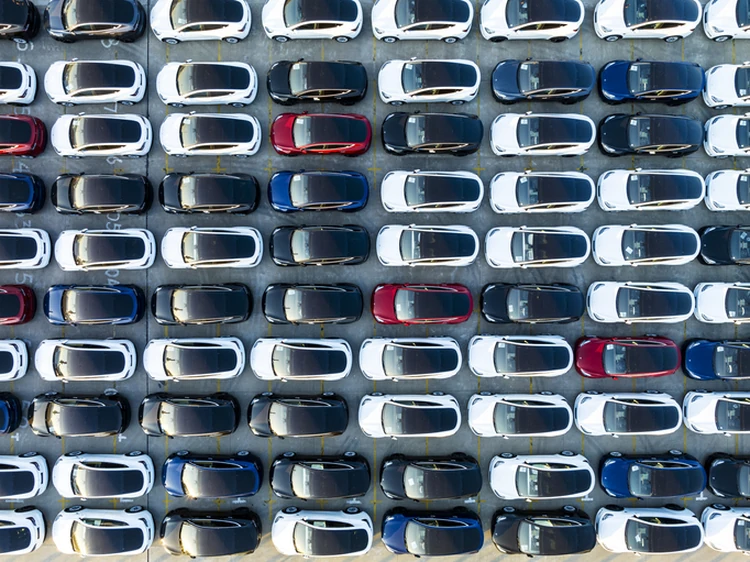
UBS estimates that worldwide automobile production will be 6% higher than sales in 2023, leaving a surplus of about 5 million vehicles by the end of the year.
“Given the bullish production schedules, we see a high risk of overproduction and growing pricing pressure as a result,” UBS said in a note to clients. “The price war has already started unfolding in the EV space, and we expect it to spread into the combustion engine segment.
UBS predicts new car prices will begin falling in the second half of this year. The June CPI shows new car prices showed no increase from May to June.