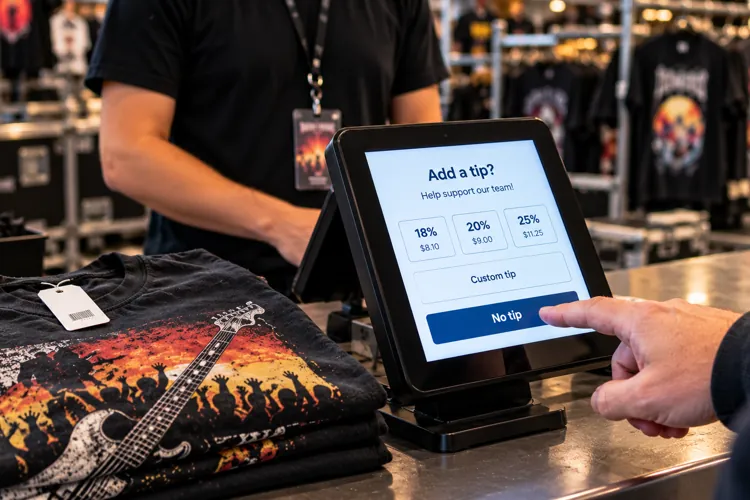

Tipping pressure is spreading: Customers are increasingly asked to tip at checkout, even for ordinary retail purchases.
Being a generous tipper doesn't mean tipping everywhere: There's a difference between rewarding good service and feeling obligated to pay extra simply because a screen asks.
You can push back without being rude: Seven practical strategies can help you avoid guilt tipping while still treating employees with respect.
I recently went to a Mumford & Sons concert, and on a whim, I decided to buy a T-shirt, as I’m a big fan of the band.
The employee quickly grabbed my size, rang it up and flipped the payment screen around. "Here's a tip option to help out my team," he said. Then he just stood there, waiting, and watching.
I remember thinking, Seriously? I'm being asked to tip for buying a $45 T-shirt? But you know what? I tipped.
Not because I thought the transaction deserved a tip. I tipped because I felt guilty. The employee was staring right through me, people were waiting behind me, and I didn't want to be that guy who looked cheap.
Walking away, I wasn't upset about the few extra dollars. I was annoyed that I'd let an awkward moment make a spending decision for me.
And here's the thing. I consider myself a fairly generous tipper. When someone provides great service at a restaurant, I'm happy to leave 25% or more. I appreciate people who work hard, especially in jobs where tips are an important part of their income.
But I have a problem with being asked to tip before someone has even made my sandwich. Think about it. I'm standing at the counter, placing my sandwich order, and the payment screen is already asking whether I'd like to leave 15%, 20%, or 25%.
For what? The sandwich hasn't even been made yet and I don’t even know if you’re going to leave mayo off like I requested.
I'm not against tipping. I'm against the growing expectation that nearly every transaction deserves one, regardless of the service involved.
And apparently, I'm not alone.
Americans are getting tired of tipping everywhere
According to Bankrate's 2025 tipping survey, 41% of Americans believe tipping culture has gotten out of control, while 38% say they're annoyed by preselected tipping screens.
Another survey, from restaurant technology company Popmenu, found that 66% of consumers feel pressured to tip when digital checkout screens suggest gratuities.
There's even a name for what's happening: tip creep.
It's the gradual expansion of tipping requests into places where gratuities weren't traditionally expected. Coffee shops. Takeout counters. Self-service kiosks. Retail stores. And, apparently, concert merchandise stands.
The good news is that you can push back without being rude, confrontational, or disrespectful.
Here are seven ways to do it.
1. Decide when you'll tip before you get to the register
The worst time to make a tipping decision is when an employee is staring at you and a line of customers is forming behind you. That's when guilt takes over.
Instead, create your own tipping guidelines. For example, you might decide to tip generously for sit-down meals, bartending, food delivery, and haircuts.
At a coffee shop or sandwich counter, you might leave a little extra when someone goes above and beyond. But for ordinary retail purchases, like buying a T-shirt, your default could simply be no tip.
The fix: Make your tipping decision based on the service, not the payment screen that you know is coming. Having a personal rule setup ahead of time takes the emotion out of the transaction.
2. Learn to press 'No tip' without apologizing
This is probably the simplest and most effective way to fight back against tip creep.
When the screen appears, select "No tip" or "Skip" if you don't think the transaction warrants a gratuity.
Then smile, thank the employee and move on.
That's it.
You don't need to explain that you're trying to save money. You don't need to apologize. And you certainly don't need to launch into a speech about how tipping culture has gotten ridiculous.
Remember, you're declining an optional charge, not insulting the employee.
The fix: Keep your response simple. "Thanks, I appreciate it." You can be friendly, respectful, and appreciative without adding money to the bill.
3. Stop tipping before you've received the service
This is one of my biggest frustrations with modern tipping.
You walk into a sandwich shop, place your order, and pay. Before anyone has even started making your food, the screen asks for a tip. How are you supposed to reward good service when you haven't received it yet?
Now, that doesn't mean counter-service employees don't work hard. They absolutely do.
And if someone handles a complicated order, accommodates your special requests, or provides exceptional service, you might decide a tip is absolutely appropriate.
But there's nothing wrong with waiting until you've actually received something before deciding whether it deserves a gratuity.
The fix: If the payment system asks for a tip before service, don't feel obligated to leave one simply because the option appears. You can always leave cash afterward if someone provides exceptional service.
4. Don't let suggested percentages determine what you owe
Here's a trick that makes digital tipping screens so effective.
They often present three suggested amounts, perhaps 18%, 22%, and 25%. Suddenly, 18% looks like the cheap option.
But those percentages aren't necessarily what you're expected to pay. They're simply suggestions. And they can become particularly unreasonable when applied to expensive merchandise.
Take my $45 concert T-shirt. A 20% tip adds another $9. That's $54 for a T-shirt, before any applicable sales tax. And all the employee did was grab my size and ring up the purchase.
The fix: Look for "Custom tip," "Other," or "No tip." If you genuinely want to reward someone for extra help, consider a flat dollar amount rather than automatically tipping a percentage of an expensive purchase.
5. Ask yourself: Would I tip if nobody were watching?
This is the question I wish I'd asked myself at the concert.
Would I have left a tip if the employee had simply handed me the payment device and walked away? Probably not.
The reason I tipped was because he was standing there, waiting for me to make a decision. That's social pressure, and it can be surprisingly effective.
But here's the thing, the employee may not even care whether you tip. They might simply be following the checkout procedure their employer requires.
The fix: Before selecting a tip, ask yourself one question: "Would I leave this tip if nobody could see my answer?" If the answer is no, take a second to reconsider. You don't need to rush through the screen or make a decision based on what a stranger might think.
6. Check for tips that are already included
Another way tipping can get expensive is when customers don't realize they've already paid a service charge or gratuity.
This is especially important at restaurants, entertainment venues, and when placing large food orders. Some businesses automatically add gratuities to certain bills. Others charge service fees that may or may not go directly to employees.
Those aren't necessarily the same thing. An automatic gratuity might already cover what you'd normally tip. A service fee, on the other hand, may be retained by the business or distributed differently.
The fix: Before adding another tip, review the receipt and ask what any service charge covers. A simple "Is gratuity already included?" can prevent you from tipping twice unintentionally. And if the fee isn't clear, there's nothing wrong with asking where the money goes.
7. Push back against the business, not the employee
This might be the most important point in the entire discussion. The cashier at a concert merchandise stand probably didn't design the payment system.
The sandwich shop employee likely didn't decide that customers should be prompted to leave 25% before their food is made.
Those decisions are typically made by management, not the employees standing behind the counter. And while tipping can help businesses keep labor costs down, it's the customer who's being asked to make up the difference.
So if you want to push back, direct your frustration toward the people who control the checkout experience.
The fix: Send a polite message to the business. Something like: "I appreciate your employees, but being asked to tip on a routine merchandise purchase made checkout uncomfortable. I'd prefer a payment process that doesn't put customers on the spot."
You can also use receipt surveys or customer feedback forms. If enough shoppers explain that aggressive tipping prompts make them uncomfortable, businesses may have a reason to rethink the experience.
So when should you actually tip?
There isn't one universal rule for every situation, but it helps to distinguish traditional tipped services from optional ones.
Sit-down restaurant: Tipping is customary, often around 15%–20%
Bartender: Tipping is customary
Food delivery: Tipping is customary
Haircut or personal service: Tipping is customary
Coffee shop counter: Tipping is optional
Sandwich or takeout pickup: Tipping is optional
Self-service checkout: Tipping is generally not expected
Retail or concert merchandise: Tipping is generally not expected
These are general U.S. customs, not some sort of legal requirement. Exceptional service, complicated orders, and local practices can change what's appropriate.
And there's nothing wrong with leaving an extra couple of dollars at a coffee shop or sandwich counter if you want to. The important distinction is that you're choosing to tip, not feeling pressured into it.