


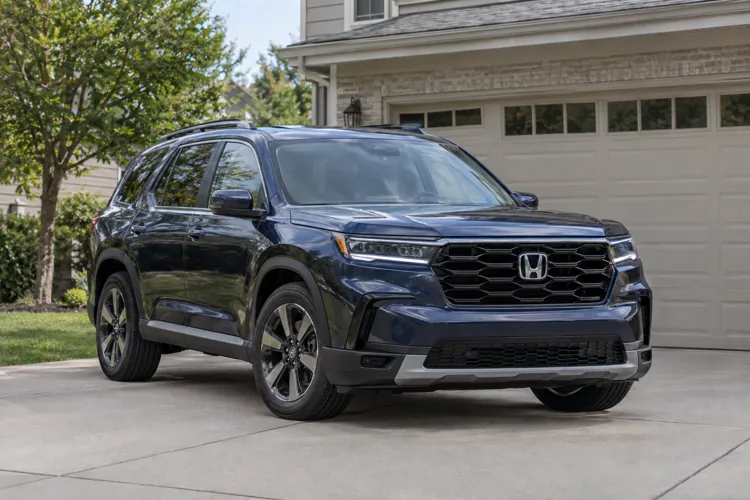

Honda is recalling 635,808 Honda and Acura vehicles because a software defect could disable power steering assistance, increasing the risk of a crash.
The recall covers certain 2023–2025 Honda Pilots, 2022–2024 Acura MDXs and 2021–2025 Acura TLXs.
Dealers will update the steering software free of charge, with owner notification letters scheduled for December 14. static.nhtsa.gov
Honda is recalling more than 635,000 vehicles in the United States after determining that a software problem could unexpectedly disable power steering assistance, making the vehicles harder to control.
The recall affects Honda’s Pilot SUV and two models sold under its Acura brand: the MDX SUV and TLX sedan. Honda disclosed the recall in a recall announcement.
The problem involves the vehicles’ electronic power steering software. Under certain operating conditions, an error can cause the system to enter a failsafe mode that turns off steering assistance.
Drivers would face increased steering effort, and warning indicators would illuminate on the instrument panel. Honda said the change could reduce vehicle controllability and increase the risk of a crash or injury.
Source of the problem
Honda traced the defect to an incorrect calculation in software associated with the Driver Attention Monitor. Under specific circumstances, the software can attempt to divide by zero, triggering an internal error. Its programmed response to that error improperly disables power steering assistance.
Honda’s filing with the National Highway Traffic Safety Administration lists 383,110 Pilots, 177,100 MDXs and 75,598 TLXs as potentially affected.
As of October 22, the automaker had received 146 warranty claims and one injury report related to the issue. No deaths had been reported.
Lengthy investigation
The investigation stretched over several years. Honda received its first report in November 2021, and subsequent investigations were complicated by the deletion of diagnostic error codes from returned components. The supplier identified the failure in August 2025, and Honda later reproduced the problem using dashcam footage and analysis. The company decided to conduct a safety recall on October 22, 2026.
Owners will be asked to take affected vehicles to an authorized Honda or Acura dealer, where technicians will reprogram the electronic power steering control unit with corrected software. The repair is free, and notification letters are expected to be mailed December 14.
Consumers can check their vehicle identification number at NHTSA’s recall website. Owners with questions can call Honda at 866-784-1870 and reference recall codes KQB or TQA. NHTSA’s campaign number is 26V721.