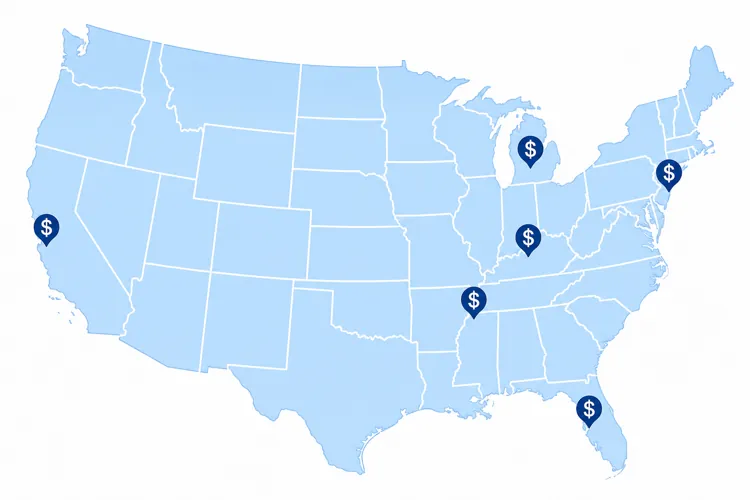

Americans spend a national median of $25,266 a year on essential household bills, but costs vary dramatically from city to city.
San Jose, California, tops the list of the most expensive cities, with annual bills totaling $44,947, while Detroit is the least expensive at $20,125.
When household income is taken into account, the affordability picture changes significantly, with Detroit residents facing the greatest financial burden.
Americans struggling to pay their monthly bills might find that where they live makes an enormous difference. A new report from bill payment service doxo finds that households in the nation's most expensive cities can spend more than twice as much on essential bills as those in the least expensive cities.
The company's 2026 Top 50 U.S. Cities Household Bill Pay Report examines spending on 13 common household expenses, including mortgages, rent, utilities, auto loans, insurance, and mobile phone service.
The national median is $25,266 annually, or about $2,106 a month. But in San Jose, California, the median household pays approximately $3,746 a month, or 78% above the national figure.
In Detroit, the median annual cost is just $20,125, or about $1,677 a month.
That means households in San Jose spend $24,822 more each year on essential bills than households in Detroit.
The most and least expensive cities
California accounts for three of the five most expensive cities, reflecting the substantial costs associated with living in some of the nation's largest coastal housing markets.But the report also reveals that lower household bills don't necessarily mean residents are better off financially.
One of the report's most revealing findings emerges when household expenses are compared with local incomes.
In San Jose, where annual bills are highest, those expenses represent 31% of median household income. In San Francisco, the figure is just 28%.
Detroit, despite having the lowest annual bills of the 50 cities, has the highest burden relative to income. Essential bills consume an estimated 51% of median household income.
Other cities where bills consume a particularly large share of income include Los Angeles at 45%, Miami and Memphis at 44%, and Baltimore at 42%.
A household earning substantially more money may be better positioned to handle higher bills than a lower-income household living in a less expensive city.
For consumers considering a move to reduce living expenses, the findings suggest that looking at housing prices or utility costs alone may not provide a complete picture of affordability.
Even without housing, some cities are expensive
Housing is generally the largest household expense, but doxo also examined what consumers pay when mortgage and rent payments are excluded. That analysis produced some surprising results.
San Jose remained the most expensive city, with non-housing bills averaging $16,329 annually. New York ranked second at $15,865.
However, Tampa, Florida, moved into third place at $15,303, followed by Birmingham, Alabama, at $14,923, and Louisville, Kentucky, at $14,758.
Meanwhile, San Francisco, the third-most-expensive city when housing is included, fell to 30th place when housing was excluded.
The findings suggest that consumers moving to a city with lower housing costs may still encounter substantial expenses for transportation, insurance, utilities, and other services.