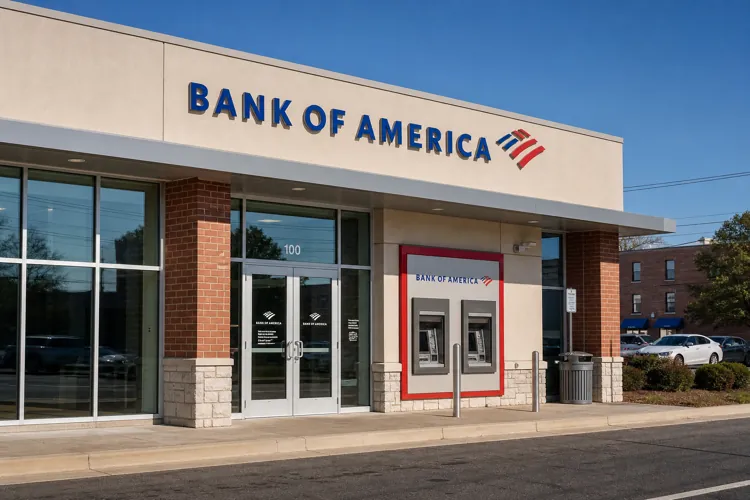

Bank of America faces more than $1.2 billion in federal penalties for failing to detect and report suspicious financial transactions, including activity potentially linked to drug trafficking and international money laundering.
Federal regulators say the bank ignored warning signs for years, even after being ordered in 2024 to improve its anti-money laundering procedures.
Consumers won't receive settlement checks, and ordinary banking services are expected to continue, although customers could face additional identity verification and scrutiny of certain transactions.
Bank of America is facing one of the largest financial penalties in U.S. banking history after federal regulators concluded that the institution failed to adequately monitor suspicious transactions and comply with laws designed to prevent money laundering.
The U.S. Treasury Department announced Tuesday that it had imposed more than $1.21 billion in penalties against the nation's second-largest bank, including a $1.2 billion penalty assessed by the Financial Crimes Enforcement Network (FinCEN).
The action represents the third-largest penalty in Treasury Department history.
Regulators said Bank of America failed to properly monitor trillions of dollars in transactions, allowing more than $5 billion in potentially suspicious activity to go unreported or be reported too late to be useful to investigators.
More than $1 billion of that activity involved potential national security threats and other high-priority risks, including Chinese money laundering networks, suspected narcotics trafficking, and financial transactions connected to the southwestern U.S. border.
What regulators found
According to Treasury officials, Bank of America's problems extended beyond occasional mistakes or technical failures.
The bank admitted to willfully violating provisions of the Bank Secrecy Act, which requires financial institutions to maintain systems for identifying suspicious transactions and reporting them to federal authorities.
Regulators said the bank sometimes relied on law enforcement agencies and other financial institutions to identify questionable activity rather than detecting it through its own monitoring systems.
The Office of the Comptroller of the Currency (OCC) also found that the bank's compliance employees lacked adequate training and that management had failed to address longstanding weaknesses.
The OCC imposed a record $750 million penalty, which will be credited against FinCEN's $1.2 billion assessment rather than added to it.
Separately, Bank of America agreed to an $11.6 million settlement involving 475 apparent violations of U.S. sanctions programs covering countries including Russia and Iran.
Treasury Secretary Scott Bessent said the violations exposed the U.S. financial system to significant risks and demonstrated that large financial institutions are not exempt from enforcement actions.
What does this mean for Bank of America customers?
For millions of Americans who have checking accounts, savings accounts, credit cards, or mortgages with Bank of America, the immediate consequences are likely to be limited.
The penalties do not require the bank to close branches, suspend ordinary banking operations, or restrict customer access to deposits.
There is also no indication that customers will receive compensation from the settlement.
Unlike some consumer protection settlements, in which money is distributed to people harmed by illegal practices, these penalties address violations of federal financial reporting and anti-money laundering requirements. The money will go to the federal government — not individual account holders.
Customers should also understand that the enforcement action does not mean their deposits have been stolen or that their accounts are unsafe. Bank deposits remain eligible for Federal Deposit Insurance Corporation (FDIC) protection, generally up to $250,000 per depositor, per insured bank, for each account ownership category.
Could banking become more complicated?
There could be some indirect consequences. Bank of America has been ordered to improve its monitoring of financial transactions, including conducting a retrospective review to identify suspicious activity that its systems previously missed.
As those improvements are implemented, some customers could encounter additional requests for identification, documentation, or explanations of unusual transactions.
Large international transfers, substantial cash transactions, and certain business payments could receive greater scrutiny. However, these are potential consequences of enhanced compliance procedures, not specific new restrictions announced for ordinary customers.
There is also the question of whether the financial penalties could eventually affect what consumers pay for banking services.
Banks sometimes seek to offset higher operating costs through fees or other pricing decisions. But there is no evidence that Bank of America plans to raise consumer fees or reduce deposit interest rates specifically because of this settlement.
Bank of America responds
Bank of America acknowledged the seriousness of the regulatory findings while emphasizing its efforts to improve compliance.
In a statement, the bank said it had invested billions of dollars in technology and assigned thousands of employees to combating financial crime.
The company said it had worked with regulators to resolve issues stemming from a 2024 regulatory order and a subsequent FinCEN investigation.
The bank also said it was making substantial progress toward completing the required improvements.