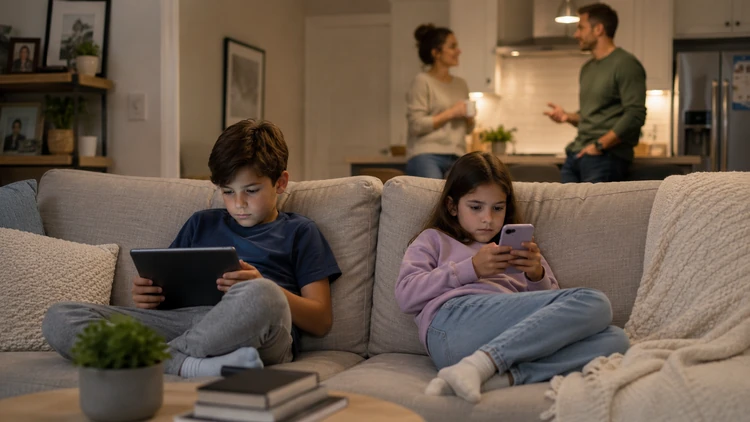

A new federal advisory warns that excessive screen use among children and teens is becoming a growing public health concern tied to sleep disruption, mental health challenges, and academic struggles.
Experts say the issue extends beyond social media to include smartphones, video games, streaming platforms, recommendation algorithms, and AI chatbots shaping childhood development.
Child development experts are calling for stronger safety protections from tech companies and encouraging parents to create more screen-free time at home, especially during meals and before bed.
A major new federal advisory is putting a spotlight on something many parents already worry about every day: how much screen time is too much for kids?
The report warns that excessive screen use among children and teens is becoming a growing public health concern, citing research linking heavy digital media use to sleep problems, mental health struggles, academic difficulties, and reduced face-to-face social connection.
But experts say the conversation is no longer just about social media. Today’s digital world also includes smartphones, gaming platforms, recommendation algorithms, and even AI chatbots that are increasingly influencing how young people learn, communicate, and spend their time.
ConsumerAffaris spoke with Kris Perry, Executive Director of Children and Screens: Institute of Digital Media and Child Development, who explained what this new warning means for families, why experts are paying closer attention to the broader “digital ecosystem,” and where the conversation around kids and technology may be headed next.
How screen time is negatively impacting kids
The report explains that screen time can be particularly detrimental to kids’ sleep. Perry broke down the impact this can have long-term.
“One of the most concerning findings is the extent to which excessive screen use is displacing basic human needs for healthy development,” Perry said.
“The advisory cites research showing that teenagers are spending more time on screens than they do sleeping or attending school, averaging over eight hours a day online on average. When devices consume that much time in a child’s day, regardless of what they are doing online, there are developmental impacts.”
Beyond social media
Additionally, parents and caregivers need to be mindful of more than just social media. Video games, AI chatbots, and other streaming services all work together for kids’ mental health.
“Public conversation has been focused on social media platforms, but children engage in a vast, interconnected digital ecosystem across devices and platforms including video streaming, gaming, and increasingly artificial intelligence,” Perry said.
“The expanded scope addressed by the new advisory helps shift the focus to the full scope of the digital environment that surrounds our children from their first year of life, acknowledging the pervasive, unregulated designs and settings that may interfere with healthy child development.”
Increasing protections for kids on devices
Perry said that privacy and safety protections should be the default for all young people – rather than something families are expected to figure out on their own.
She shared some of the best ways for tech companies to increase protections for kids on any devices:
Default youth accounts with the strongest available privacy and safety protections.
Limiting or disabling certain engagement-maximizing features for minors, such as endless personalized feeds, autoplay, nighttime notifications, and Excessive algorithmic recommendations.
Providing clear, easy-to-use settings that allow families and young people to make informed choices about their digital experiences.
Following data minimization principles by collecting only the information that’s necessary for the platform to function.
Increasing transparency in platform design, data collection practices, recommendation systems, and safety measures.
Advice for parents
Managing kids’ screen time is difficult for parents from several different angles. However, Perry suggests there are ways parents can feel more in control of their kids’ screen use.
“We encourage parents to focus first on their values and what they want to protect. The federal advisory makes it clear that the greatest damage occurs when screen use displaces vital pillars of healthy child development – restorative sleep, physical activity, and face-to-face connection.”
Here are some tips for parents to consider:
Prioritize and protect screen-free space in your home and daily routines.
Keep devices out of the bedroom at night.
Protect meal times as spaces for conversation.
Put handheld devices away during moments of interaction and connection.