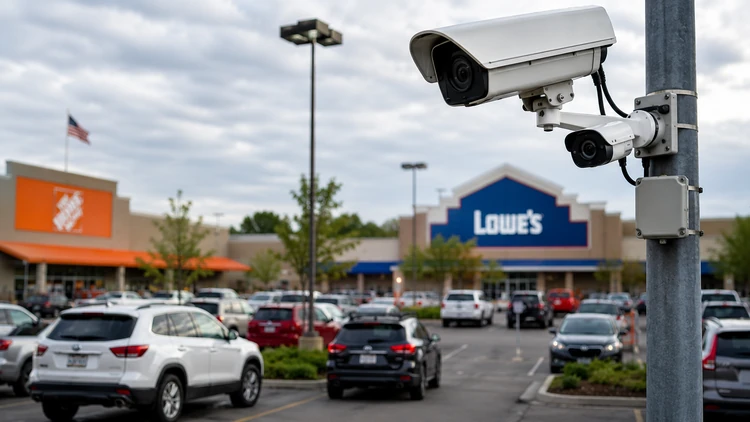

Some Home Depot and Lowe’s stores are using cameras that scan and log license plates in parking lots.
Retailers say the systems help fight theft, but privacy advocates worry shoppers may not realize their vehicle data could be stored or shared with police.
Experts recommend watching for parking lot camera signs, reading store privacy policies, and limiting location tracking through store apps.
A growing number of shoppers are realizing that security cameras in retail parking lots are doing more than just recording video.
According to a recent report from Fox News, some Home Depot and Lowe’s locations in Connecticut are using automated license plate reader cameras, also known as ALPRs, to scan vehicles entering and leaving store parking lots.
Retailers say the systems help fight theft and improve safety, which are both needed right now. But privacy advocates worry shoppers may not fully realize their vehicle information could be stored, searched, or potentially shared with law enforcement.
Here’s what you should know along with some tips to better protect your privacy.
What exactly are license plate reader cameras?
Automated license plate readers use cameras and software to capture:
- Your license plate number
- Vehicle make and model
- Vehicle color
- Time and location data
These aren’t just your standard security cameras that only record video footage that we’ve grown accustomed to seeing. These systems actually create a searchable record tied to the details of your vehicle.
The cameras mentioned in the report were linked to Flock Safety, a company that says its technology does not use facial recognition.
Still, privacy concerns remain because the systems can create a digital log showing when a vehicle visited a store.
Why stores are using them
Retail theft is definitely a big problem right now. This is especially the case at home improvement stores that sell expensive tools, power equipment, and gadgets.
Both Home Depot and Lowe’s say the cameras are used for:
- Theft prevention
- Parking lot security
- Public safety
- Fraud prevention
Police departments also make the argument that the cameras can help them locate stolen vehicles or investigate other crimes nearby. But critics say the problem is that many shoppers have no idea their vehicle information may be captured simply by pulling into a parking space.
Pro tip: Look near parking lot entrances for small camera poles or signage mentioning “security cameras,” “vehicle monitoring,” or “license plate readers.” Many shoppers never notice them, but once you start looking, they’re hard to miss.
The bigger concern is who can access the data
This is where the privacy debate gets a little more complicated.
According to the report, some police departments in Connecticut can access certain retailer camera systems through agreements with individual businesses.
That doesn’t necessarily mean police have unlimited access everywhere. Flock Safety says businesses control whether data sharing is enabled and that searches are logged.
Still, privacy advocates worry about transparency as shoppers often do not know how long the data is stored, which agencies may access it, and whether out-of-state police can actively search it.
In many states, private retailers face fewer transparency requirements than government agencies.
Pro tip: The report suggests searching the retailer’s privacy policy online using terms like “ALPR,” “license plate reader,” or “vehicle information.” Many shoppers never realize this information is publicly disclosed in company policies.
You can’t fully avoid plate scanners — but you can stay informed
The reality is that your license plate is already visible anytime you drive in public.
But automated scanning changes things because it creates searchable digital records instead of just visual observation and eye witness accounts.
With that said, the Fox News report points to a few practical steps shoppers can take:
- Read store privacy policies
- Watch for posted notices
- Ask customer service questions
- Stay informed about state privacy laws
Pro tip: Try not combining multiple forms of tracking at once. For example, if you use a store app with location permissions turned ON, while your vehicle is also being scanned in the parking lot, you create an even larger data trail tied to you and your shopping habits. Consider turning OFF location tracking in the app, or delete it all together and just use the retailer’s website through your web browser instead.
Why this issue will likely grow
Experts expect license plate readers to spread to more retail parking lots over the next several years because the technology is relatively cheap and effective for security monitoring.
And unlike some forms of surveillance technology, ALPR systems often operate in the background without most shoppers noticing them.
For consumers, the biggest issue may not be the cameras themselves, it’s the transparency, or lack thereof.
Shoppers deserve to know the following:
- What data is being collected
- Who can access it
- How long the information is stored
- If the data is ever shared outside of the company
Right now, the answers to these questions can vary heavily depending on the retailer, the technology provider, and the state where you live.