


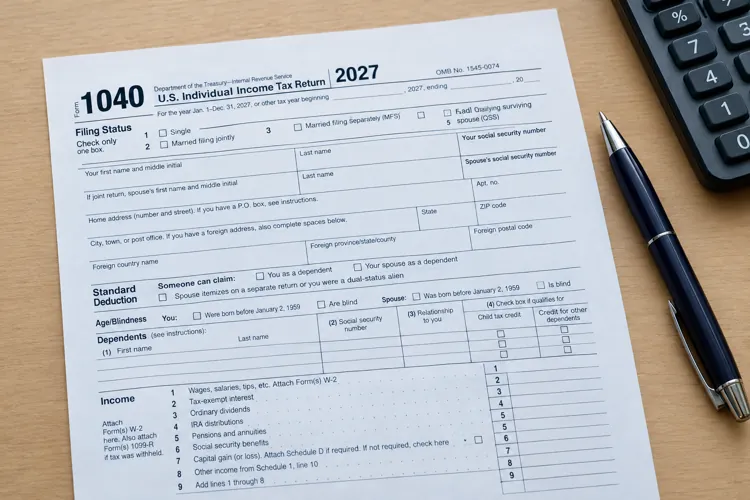

The IRS has raised federal income tax bracket thresholds for 2027, allowing taxpayers to earn more before moving into a higher bracket.
The standard deduction will increase to $16,600 for single filers and $33,200 for married couples filing jointly.
The seven federal income tax rates remain unchanged, ranging from 10% to 37%. The new amounts generally apply to returns filed in 2028.
The IRS has announced new federal income tax brackets for 2027, increasing the income thresholds at which higher tax rates take effect and raising the standard deduction.
The changes are part of annual inflation adjustments affecting nearly 70 tax provisions. They generally apply to income earned during 2027, reported on tax returns filed in 2028.
For consumers, higher thresholds mean more taxable income can fall within lower brackets. The adjustments help limit “bracket creep,” which occurs when inflation pushes earnings higher without a corresponding increase in purchasing power.
The new brackets
For single taxpayers, the 2027 brackets apply as follows: The first $12,800 of taxable income is taxed at 10%; income above $12,800 through $52,025 at 12%; and income above $52,025 through $109,125 at 22%.
The 24% rate applies to income above $109,125 through $208,325, followed by 32% above $208,325 through $264,550. The 35% bracket covers income above $264,550 through $661,375, with the top 37% rate applying above that amount.
For married couples filing jointly, the thresholds are $25,600 for the top of the 10% bracket; $104,050 for 12%; $218,250 for 22%; $416,650 for 24%; $529,100 for 32%; and $793,650 for 35%. Taxable income above $793,650 falls into the 37% bracket.
Tax brackets apply to taxable income after deductions. Also, moving into a higher bracket does not mean all income is taxed at that higher rate. Only the portion within each bracket is subject to its rate.
For example, a single filer with $60,000 in taxable income would pay 10% on the first portion, 12% on the next portion and 22% only on the amount exceeding $52,025.
Larger standard deduction
The standard deduction will rise by $500 to $16,600 for single taxpayers and married people filing separately. Joint filers will receive a $33,200 deduction, up $1,000, while heads of household will receive $24,925.
Those increases reduce the income subject to tax for eligible taxpayers who take the standard deduction. A $500 increase in the deduction does not translate into a $500 reduction in taxes; the savings depend on the taxpayer’s applicable rate.
Families could also benefit from a higher child tax credit. The maximum credit increases by $100 to $2,300 for 2027, while the maximum potentially refundable portion rises to $1,800, subject to eligibility requirements.