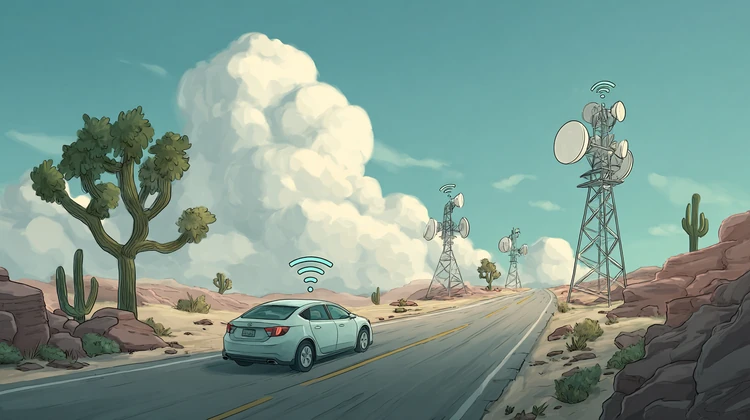

- Cars increasingly depend on the same fragile cell networks as smartphones
- Coverage gaps can cripple navigation, safety features, and remote apps
- Automakers are scrambling for solutions, from multi-carrier modems to satellites
Automakers have spent the past decade selling the promise of the “always-connected” car—a vehicle that can download new features on the fly, report maintenance problems before drivers notice them and automatically call for help after a crash. But that promise runs into a hard limit: the same cell phone dead spots that frustrate everyday smartphone users.
Modern vehicles depend heavily on 4G and 5G cellular networks to power telematics, navigation, over-the-air updates, and remote-vehicle control apps. When coverage disappears, so do many of the features consumers increasingly take for granted. As more car systems rely on cloud connectivity, the impact of these gaps grows larger.
Dead spots create problems drivers can feel
Dead zones appear in all the familiar places—mountain passes, rural stretches of interstate, tunnels, bridges and remote coastal or desert regions where carriers simply don’t have enough towers. While a phone losing service is an inconvenience, a connected car losing service can quickly present a more serious problem.
Navigation systems may stop receiving real-time traffic data, leaving drivers with outdated or incomplete routing. Electric vehicles can lose access to live charger availability, forcing drivers to rely on old information. Remote functions like lock/unlock or remote start often fail because the car briefly goes “offline.” Even streaming services built into the dashboard may freeze or buffer endlessly.
These interruptions don’t always last long, but they happen frequently enough that consumers routinely complain about the mismatch between what automakers advertise and what their cars actually deliver.
Some outages carry safety implications
Beyond convenience, certain dead-zone failures can matter in an emergency. Automatic crash notification systems may not be able to send data to call centers if the vehicle is out of range. Stolen-vehicle tracking systems lose the ability to ping the car’s location. Some advanced driver-assistance features that depend on cloud-fed hazard or road-data updates won’t refresh until coverage returns.
Most vehicles can still make a traditional voice 911 call if any carrier signal is present, but in true dead zones even that backup may fail. As automakers lean harder on telematics for safety and diagnostics, coverage gaps become a more critical point of failure.
Automakers try workarounds, but none are perfect
Manufacturers are experimenting with ways to smooth out the gaps. Some vehicles now use multi-carrier SIMs that can hop between wireless networks, although switching isn’t instantaneous. Others cache limited map or hazard data so the vehicle can function briefly without a connection. Still, anything requiring live information—traffic, weather, remote commands—suffers.
Over-the-air software updates may stall or restart if connectivity drops mid-download. Infotainment features that depend on real-time data simply shut down until the signal returns.
A satellite-assisted future may be on the way
Long term, the industry sees satellites as the escape hatch. Low-Earth orbit constellations could provide a backup layer of coverage for emergency services and essential telematics, eliminating the most dangerous dead zones. Several major automakers have announced partnerships aimed at integrating satellite capability into upcoming models, though most consumers won’t see it before the late 2020s.
Until then, the connected car is only as connected as the nearest cell tower—and for many drivers, that remains a shaky link.