


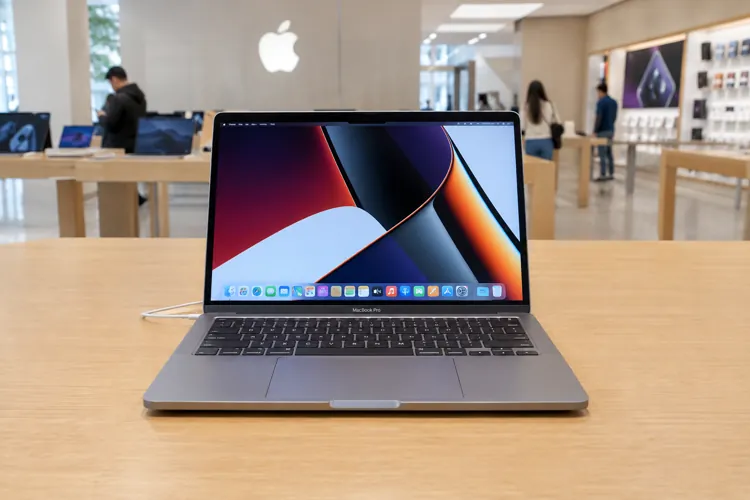

Apple has introduced its first touchscreen MacBook Pro, ending years of resistance to adding touch capabilities to its laptop computers.
The new models feature 14-inch and 16-inch OLED displays, M5 Pro and M5 Max processors, and up to 24 hours of battery life.
Prices start at $2,899 for the 14-inch model and $3,399 for the 16-inch version, with availability beginning November 6.
For years, Apple insisted that touchscreen technology belonged on iPhones and iPads, not laptop computers. Now the company has apparently changed its mind.
Apple has unveiled its first touchscreen MacBook Pro, a major redesign that allows users to interact directly with the laptop's display instead of relying exclusively on a keyboard, mouse or trackpad.
The new MacBook Pro, introduced at the end of October, represents one of the biggest changes to Apple's laptop lineup in years. It also brings the company into a market where competing Windows-based computers have offered touchscreens for more than a decade.
The redesigned laptops are available in 14-inch and 16-inch versions, with prices beginning at $2,899 and $3,399, respectively. Preorders are underway, and the computers are scheduled to become available November 6.
The announcement marks a significant shift in Apple's approach to laptop design. Apple co-founder Steve Jobs famously opposed touchscreen laptops, arguing that reaching across a keyboard to touch a vertical display was uncomfortable and impractical.
But changing consumer habits, particularly among younger users accustomed to smartphones and tablets, appear to have persuaded Apple to reconsider.
What the touchscreen can do
The new MacBook Pro allows users to scroll through websites, enlarge photographs with a pinch gesture, move files and rearrange windows by touching the screen.
Apple says the touch sensor is integrated directly into the display panel rather than placed on top of it, reducing the delay between a finger movement and the computer's response.
The technology is also designed for professional applications. Graphic designers can manipulate images directly on the screen, musicians can play virtual instruments, and software developers can test touch-based applications without switching to another device.
However, Apple isn't abandoning the traditional laptop experience. The new MacBook Pro retains its keyboard and trackpad, allowing users to choose whichever method works best for a particular task.
The company has also redesigned the screen hinge to prevent excessive movement when users press against the display.
Unlike some Windows laptops, the MacBook Pro does not convert into a tablet.
More than just a touchscreen
The touchscreen isn't the only significant change.
Apple has introduced a new display technology it calls PROLED XDR, using tandem OLED panels to produce brighter images, deeper blacks and improved color accuracy. The display supports a refresh rate of up to 120Hz and brightness levels reaching 2,000 nits, according to Apple.
Other improvements include M5 Pro and M5 Max processors, up to 128GB of unified memory, and storage configurations reaching 16TB.
Apple also promises up to 24 hours of battery life, although actual performance will depend on how the computer is used.
The redesigned laptops are thinner and lighter than their predecessors. They also feature an interactive Dynamic Island display area, similar to the feature introduced on Apple's iPhones.
For consumers who use their laptops for video editing, photography or other demanding applications, the improvements could make the new MacBook Pro especially appealing.
A steep price for new technology
The biggest obstacle for many consumers may be the price.
At $2,899, the least expensive touchscreen MacBook Pro costs considerably more than Apple's standard laptops. The 16-inch touchscreen version starts at $3,399, and upgraded configurations can cost thousands more.
Apple is positioning the new computers primarily for creative professionals and other users who need high-performance hardware.
Consumers who mainly browse the internet, send emails, stream video and work with documents may find it difficult to justify the added expense.
Early reviews also suggest that the touchscreen, while convenient, may not fundamentally change how most people use their laptops.
A review published November 5 by The Verge praised the new display and lighter design but found that touch controls were most useful for occasional tasks rather than as a replacement for the trackpad.
Is it worth upgrading?
For consumers considering a new MacBook, the decision may come down to how much they value touchscreen controls and the improved OLED display.
People who already own a recent MacBook Pro may find that their existing computers perform nearly as well for everyday activities.
But owners of older laptops, particularly those who regularly edit photographs, produce videos or work with graphics, could benefit from the combination of a brighter display, faster processing and more flexible controls.
The new MacBook Pro also raises an interesting question about Apple's future product lineup: If touchscreens prove popular on its most expensive laptops, will the company eventually introduce the technology on more affordable MacBooks? Apple hasn't announced such plans.
For now, the company's first touchscreen MacBook represents a major departure from its longstanding philosophy — and a potentially expensive new option for consumers who want the convenience of a tablet without giving up a traditional laptop.