

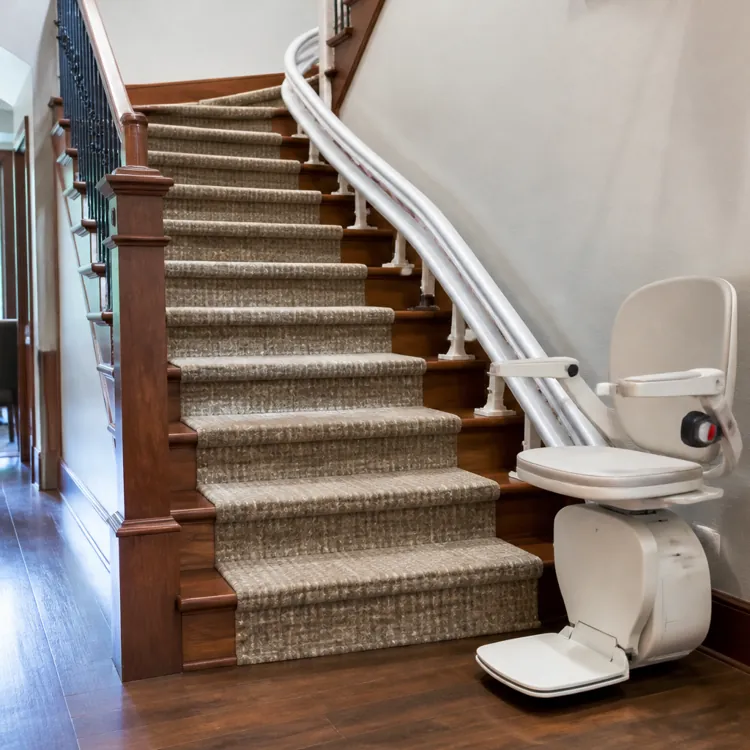
Stair lift weight capacity ranges
Most stair lifts support up to 300 pounds, though heavy-duty models can reach 350 to 400 pounds or higher. Capacity depends on the lift design, rail construction, staircase layout and model.
| Stair lift type | Typical weight capacity |
|---|---|
| Standard straight | 300 to 400 pounds |
| Standard curved | Varies by model, often under 400 pounds |
| Heavy-duty straight | 400 to 600 pounds |
| Heavy-duty curved | 350 to 600 pounds |
| Outdoor stair lift | Varies by model, generally similar to indoor versions |
» RELATED: How do stair lifts work?
Understanding stair lift weight limits
A stair lift’s capacity depends on the model, rail design and intended user. Too much weight on the stair lift can affect safe operation and may damage the equipment.
Standard vs. heavy-duty stair lift limits
Most standard stair lifts support about 300 to 350 pounds, though some support up to 400 pounds.
If you need more capacity, heavy-duty stair lifts are built for higher loads and can support up to 600 pounds, though this depends on the manufacturer, model and construction.
The weight limit on a stair lift depends on several factors, including:
- Staircase structure
- Materials it's made of
- Type of track and rail system
- Drive mechanism type
- Seat width and cushioning
- Angle and steepness of your stairs
What does the load limit include?
The load limit applies to everything going on the stair lift at once. If you’ve got an oxygen tank, other medical equipment or groceries piled on your lap, include these items in the total weight calculation. Then compare that number with the capacity listed in the product specs, owner’s manual or on the lift itself.
» LEARN MORE: Stair lift pros and cons
Stair lift weight limits and safety
A stair lift’s rated capacity is a safety limit and shouldn’t be treated as a suggestion. Exceeding a stair lift’s weight limit runs the risk of your lift breaking, wearing down or creating unsafe operation. If you’re close to the stated limit, a higher-capacity model may be a better fit.
Overloading may also impact your warranty coverage. For example, Harmar Mobility’s SL600 warranty says your warranty can be voided if your lift has been over-stressed, misused or neglected.
Watch for signs that your lift needs professional attention, including:
- Slower travel
- Jerky movement
- Frequent stops
- Error lights or codes
- New or unusual noises
These symptoms can have several causes, so stop using the lift and call your manufacturer. Regular maintenance, such as cleaning, battery checks and professional inspection, can also help you catch any problems early.
» COMPARE: Best stair lifts
Heavy-duty stair lifts by staircase type
Heavy-duty stair lifts are available for both straight and curved staircases, with the latter often having limited options. Straight models usually have the highest weight capacity, while curved lifts trade capacity for a rail built to follow turns, landings and changes in direction.
Straight stair lifts for higher weights
If you need the highest capacity, straight stair lifts usually offer the most options.
For example, Harmar’s SL600HD supports up to 600 pounds and adds a wider padded seat, larger backrest, stationary armrests and a reinforced footrest. It’s 18.5 inches across the seat and 16.5 inches from the wall when folded, so you still need to pay attention to stair width when comparing models.
Curved stair lifts for higher weights
Curved heavy-duty stair lifts exist, though their weight capacity tends to be lower than the highest-capacity straight models.
Bruno’s Elite curved stair lift supports up to 400 pounds and uses a rail built specifically for the staircase, including its angles and turns. You can often upgrade to extra-large seats and footrests.
Space and seat width requirements
Larger-capacity stair lifts usually need more room for a bigger seat, backrest or footrest. Before buying a stair lift, compare the seat dimensions and folded width with your staircase so there’s enough usable space for the lift and anyone walking past it. Depending on the model, you may also need extra room at landings or in hallways.
FAQ
Is there a weight limit for stair lifts?
Yes, stair lifts have weight limits. Standard stair lifts support between 300 and 400 pounds, while some higher-capacity models can support up to 600 pounds.
Does Medicare pay for stair lifts for seniors?
No, Original Medicare doesn’t pay for stair lifts because it treats them as home modifications rather than covered durable medical equipment. Some Medicare Advantage plans may offer some coverage, so check your Summary Plan Description to see if you have stair lift benefits.
What's the average cost of a stair lift?
Stair lifts usually cost about $3,000 to $15,000, depending on the staircase, model and features. Straight lifts usually cost less than curved models, since curved models require custom rails.
What is the weight capacity of heavy-duty stair lifts?
Heavy-duty stair lifts can support about 400 to 600 pounds, depending on the model.
Article sources
ConsumerAffairs writers primarily rely on government data, industry experts and original research from other reputable publications to inform their work. Specific sources for this article include:
- Harmar, "SL600HD Pinnacle Heavy-Duty Stairlift." Accessed Aug. 26, 2026.
- Harmar, "SL600HD Pinnacle Stairlift: Owner’s Manual." Accessed Aug. 26, 2026.
- Harmar Mobility, "SL600 Pinnacle Stairlift: Owner’s Manual." Accessed Aug. 26, 2026.
- Bruno Independent Living Aids, Inc., "Elite Curved Indoor Stair Lift." Accessed Aug. 26, 2026.
- Bruno Independent Living Aids, Inc., "Elite Curved Outdoor Stair Lift." Accessed Aug. 26, 2026.
- U.S. Centers for Medicare and Medicaid Services, "Durable medical equipment (DME) coverage." Accessed Aug. 26, 2026.