

Compare our top home alarm and security systems picks
| Company | Customer rating | Our pick for | Monitoring type | Smart home integration | Availability | |
|---|---|---|---|---|---|---|
 Vivint | Get a Quote | 4.5 | Best overall | Professional |  | Nationwide |
 ADT | Get a Quote | 4.1 | Best value | Professional or DIY | | Nationwide |
 Vector Security | Learn More | 3.7 | Best customer experience | Professional | | 17 states |
Vivint

- Monitoring costs
- Starting at $24.99
- Contract terms
- 1 to 60 months
- Installation
- Professional
- Mobile app monitoring
- Yes
ADT

- Monitoring costs
- Starting at $9.99
- Contract terms
- 1 to 36 months
- Installation
- Professional or DIY
- Mobile app monitoring
- Yes
Partner Disclosure
ADT disclosure
Theft Protection Guarantee: Customer may receive reimbursement of up to five hundred dollars ($500) of Customer’s homeowner’s insurance deductible (if any) if, and only if, ALL requirements for Theft Protection Guarantee are met to ADT’s reasonable satisfaction. Requires purchase and continual monthly payment of professional monitoring from the time of original activation to be eligible. Customer must request reimbursement within 60 days of property loss. Request must be mailed to ADT and include: Theft Protection Guarantee certificate signed by Customer, a letter from Customer requesting reimbursement, a copy of the police report, and a copy of the accepted insurance claim. ADT reserves the right to reject any application for reimbursement that does not comply with all of the requirements.
ADT Money-Back Guarantee: Money-back guarantee only applies after ADT has made attempts to resolve a system-related issue and has not been able to resolve that issue within the first six (6) months of your original activation. Requires purchase and continual monthly payment of both QSP (Quality Service Plan, ADT’s extended limited warranty) and professional monitoring from the time of original activation. ADT Money-Back Guarantee is not transferable. Equipment must be returned before a refund will be processed. Conditions preventing normal system operation cannot be caused by the customer.
Vector Security

- Monitoring costs
- Starting at $44.95
- Contract terms
- 36 months
- Installation
- Professional
- Mobile app monitoring
- Yes
Methodology: How we chose the best home alarm and security systems for seniors
The ConsumerAffairs Research Team evaluated home security companies across four core areas: installation and service experience, cost and value, app and technology features, and online reputation. Our analysis combined verified customer feedback with company-reported service details to identify the providers that offer the strongest home security experience.
1. Installation and service experience (based on verified reviews): Review data reflects verified feedback submitted to ConsumerAffairs between June 1, 2023, and May 31, 2026. In addition to evaluating recent review activity, we measured satisfaction with:
- Installation
- Customer service
- Technicians
- Staff
- Punctuality and speed of service
These factors help show how well companies deliver on their promises after customers sign up for monitoring.
2. Cost and value: We reviewed company-reported pricing details and evaluated:
- Price satisfaction
- Starting monthly monitoring cost
- Equipment return policy window
Companies offering lower costs, stronger price satisfaction and more flexible equipment return policies received higher scores.
3. App and technology features: We evaluated customer ratings of each company’s mobile app, including ease of use. Companies with higher-rated apps received higher scores.
4. Online reputation: We considered the volume of reviews submitted in the past six months and how quickly and consistently each company responded to customer reviews. Companies with more recent review activity and higher response rates received higher scores.
How scoring works
Companies earned a 0 to 10 score for every factor:
- The top-performing company for a given factor earned a 10.
- Other companies were scored relative to that leader.
This standardized scoring system allowed us to compare customer satisfaction, pricing and technology features on the same scale.
How we chose the winners
Every company was evaluated using the same core factors, but we adjusted the weighting based on what mattered most in each category. The company with the highest overall score in each category earned the corresponding “Our pick for” designation.
Home alarm and security systems for the elderly buyers guide
Choosing a home alarm and security system for yourself or an elderly family member means balancing costs and monitoring reliability with ease of use and emergency response capability. It’s also important to watch out for pitfalls such as long-term contracts and overseas monitoring centers when shopping for senior-friendly home security.
Key insights
Look for accessibility features for aging adults with hearing or eyesight issues and limited mobility.
Jump to insightThe lowest monthly costs often require long-term contracts, and medical monitoring may cost extra.
Jump to insightHome security options include professionally monitored, DIY monitoring, and fall and medical alert only.
Jump to insightWhat to look for in a home alarm and security system for seniors
Shopping for a home security system for seniors often means a careful balancing act between costs, independence, privacy and the remote access families need.
Features and coverage
Senior home security systems are often very similar to normal home security systems with small adjustments to fit reduced hearing and eyesight, limited mobility, remote access needs and medical monitoring.
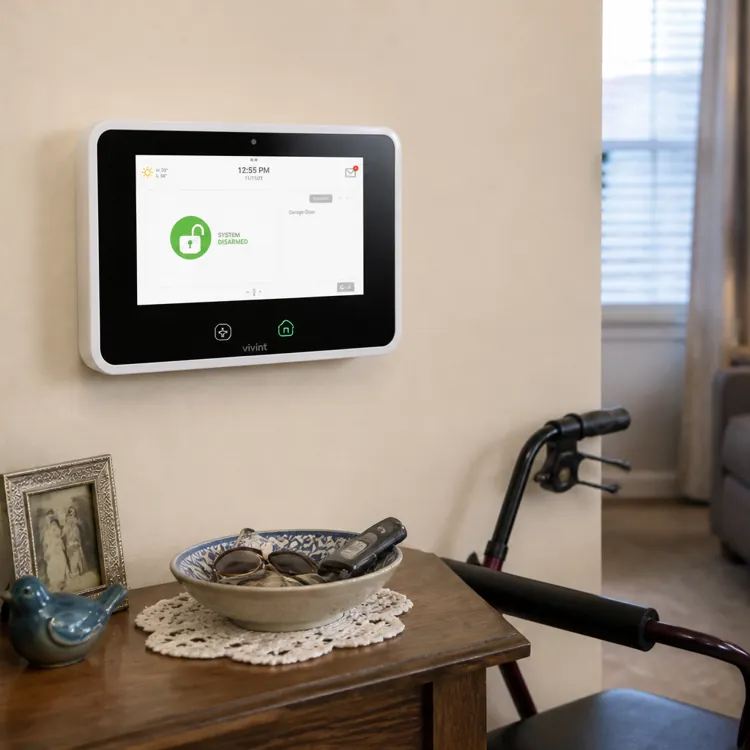
For example, special care should be taken to ensure controls are easily accessible for people with limited mobility, such as placing the control panel lower on the wall for access from a walker or wheelchair.
Top features include:
- Remote access for caregivers
- Medical alert wearable
- Professional monitoring
- Two-way communication with monitoring service
- Environmental monitors such as leak detection, temperature alerts, CO2 monitoring and smoke detectors
- Easy-to-use control panel
- Maintenance reminders
- Battery backups
- U.S.-based monitoring and customer service
Ease of use
Wired systems may be easier for seniors due to less maintenance, but wireless systems offer portability in case of a move to assisted living. However, by far the biggest concern with ease of use is the control panel or app itself.
Laura Finson, Director of Product and Strategy at Brinks Home, noted that “When selecting a home security system for seniors, it’s important to focus on features that enhance safety and ease of use. Key features may include emergency response capabilities that can be paired with select security systems and allow for immediate assistance in case of an emergency. Additionally, fall detection sensors, monitored smoke and carbon monoxide detectors, and smart home automation that includes voice-activated controls can be highly beneficial.”
Look for control panels with intuitive controls, brighter lighting and large icons for limited vision and dexterity, louder warning and confirmation tones and a company with strong customer support available by phone to make using the system simpler for seniors.
Home alarm and security system cost
For many families, the cost of home security is worth it to help aging family members stay in their homes longer as well as avoid costs from burglaries, which the FBI estimates at over $2,000 per occurrence. Costs can vary widely, from under $100 for a doorbell camera to thousands for fully wired whole home systems. Monthly monitoring tends to average between $25 and $50 a month but can go higher depending on the complexity of your system and the type of monitoring.
Those monthly costs can be problematic on a fixed income for many seniors, leading family members to often pitch in on costs both for the equipment and monitoring. Hidden costs to watch for include activation costs, early cancellation costs and long-term contract requirements.
Senior discounts, such as from brand partnerships with AARP, and limited-time special offers on security company websites often help lower costs.
Types of home alarm and security systems
Not all home security systems are the same. Four main types of home security systems that apply to seniors are:
- Traditional professionally monitored: Home security systems with professional monitoring for break-ins, motion and glass breakages. Sometimes include fire and CO2 monitoring.
- Self-monitored: Traditional home security for motion, glass breakage and home break-ins, but monitoring is managed by the homeowner.
- Smart home systems: Smart locks, environmental monitors such as fire and CO2, temperature controls, lighting controls and appliance management. May be monitored or self-managed.
- Medical and fall alert: Wearable emergency buttons with professional monitoring to help seniors stay in their homes longer. May be bundled with traditional professionally monitored systems or offered as stand-alone services.
Pros and cons of home alarm and security systems for seniors
Home alarm systems for seniors have pros and cons, with most revolving around safety, cost and independence. Choosing the best alarm for the elderly is about balancing the tradeoffs to best fit your family’s needs and budget.
Pros
- Optional fall and medical alerts assist in getting help quickly in case of a fall or other medical emergency
- Mobile apps help adult children and caregivers remotely manage the system
- Smart lock integration allows controlled access for emergency crews, tradespeople and caregivers
- Home security systems help offset break-in risks that rise with age
- Security systems with medical alerts and environmental monitoring often help seniors avoid moving to a group home
Cons
- Seniors may feel like monitored systems or internal cameras are invasions of privacy
- Systems may be confusing for seniors to operate
- Professionally monitored systems can be expensive on fixed incomes
- Alarm companies may require multi-year contracts for monitoring
- Seniors may not keep system maintenance up to date, such as software updates, battery swaps and system tests
FAQ
Are there free home alarms for the elderly?
No, complete home alarm systems aren’t available for free. However, some government programs aimed at helping seniors age in place, such as Program of All-inclusive Care for the Elderly (PACE), or some Medicare Advantage plans, may cover emergency alert wearables.
Is there a personal alarm for the elderly without a monthly fee?
Professional monitoring for personal alarms requires a monthly fee unless the button is provided by an aide program. However, some home security systems offer personal alarms at no additional cost when bundled with your security system.
How do fall detection alarms work for seniors?
There are two main types of fall alert devices. Most fall alert devices rely on the senior to push a button to contact the monitoring station after a fall. However, some advanced sensors automatically alert the monitoring center if accelerometers or gyroscopes inside the device detect sudden movement.
Why do seniors need a home security system with emergency monitoring?
Emergency monitoring is typically suggested for seniors because of fall and other medical emergency risks. There are over 1 million falls by seniors yearly according to the CDC. Environmental monitoring and alarms are also important in case of fire.
Can a home alarm help if my senior wanders from home?
Yes, alarm systems with door and window open sensors can help alert you quickly if your senior tries to leave the house.
Article sources
ConsumerAffairs writers primarily rely on government data, industry experts and original research from other reputable publications to inform their work. Specific sources for this guide include:
- The FBI, “2019 Crime in the United States.” Accessed July 21, 2026.
- U.S. Department of Justice, “Crime and the Elderly.” Accessed July 24, 2026.
- Medicare, “PACE.” Accessed July 28, 2026.
- The CDC, “Facts About Falls.” Accessed July 28, 2026.