


Compare our top RIC hearing aid picks
| Company | Customer rating | Best for | Rechargeable Battery | Bluetooth | Financing | |
|---|---|---|---|---|---|---|
 Audicus | Get Pricing | 4.3 | Best overall |  | | |
 hear.com | Learn More | 4.5 | Best for hearing aid selection | | | |
 Starkey Hearing Aids | Learn More | 4.2 | Best for AI features | | | |

- Financing
- True
- Who programs
- Licensed professional
- Trial period
- 100 days
- Warranty
- 2 years

- Financing
- True
- Who programs
- Licensed professional
- Trial period
- 45 days
- Warranty
- 1 to 3 years

- Financing
- True
- Who programs
- Licensed professional
- Trial period
- 45 days
- Warranty
- Limited, with optional add-on coverage
Methodology: How we chose the best RIC hearing aids
The ConsumerAffairs Research Team compared receiver-in-canal (RIC) hearing aid brands using verified customer reviews, product details and company policies. To qualify, companies needed verified reviews submitted between Sept. 1, 2023, and Aug. 31, 2026. We scored each brand in four areas:
- Customer experience: Satisfaction with staff, customer service and price
- Hearing aid selection: Product lines and options for all types of hearing loss
- Price and policies: Starting price for a pair, warranty coverage and trial period
- Recent engagement: Review volume and company response rate over the past six months
Each company received a score from zero to 10 for every metric. The top performer earned a 10, and the other companies were scored relative to it. We used different weightings for each award. For example, the best overall award focused more on customer satisfaction ratings, while the warranty coverage award emphasized warranty length and trial period.
Receiver-in-canal hearing aid buyers guide
Before you choose a receiver-in-canal (RIC) hearing aid, consider your hearing test results and lifestyle. These factors, along with your budget and desired features, can help you choose the best hearing aids for you.
Key insights
Getting your hearing tested is an important first step before choosing hearing aids.
Jump to insightRIC aids cost from $1,000 to over $5,000 per pair.
Jump to insightRIC aids tend to offer a more natural, realistic sound experience than BTE aids.
Jump to insightHow to choose receiver-in-canal hearing aids
When choosing hearing aids, consider your lifestyle — your activity level and the complexity of your sound environments. Based on your hearing test results and budget, consider each RIC provider’s features and fit to find the option that best matches your needs.
Requirements and hearing test results
While no hearing aids require a doctor’s prescription, many providers and models have different requirements and processes for getting started. Some over-the-counter (OTC) hearing aids don’t require a hearing test, while most higher-end OTC aids and prescription-grade hearing aids do.
Getting tested is a valuable first step before choosing your hearing aids. These results show the severity and nuances of your hearing loss, helping specialists recommend a style and model, then program your device.
All the providers on our list require a hearing test. Audicus’ hearing test is self-administered online, while hear.com and Starkey require an in-person clinic visit.
Features
RIC hearing aids vary significantly in features, which drives price differences between models. Many models pack medical-grade features like tinnitus support, advanced noise-blocking and speech articulation, rechargeable batteries and AI tools. However, depending on your budget and the severity of your hearing loss, you may not need all these features.
Key features to compare when researching the right RIC aids for you:
- Unwanted noise reduction: RIC aids usually include background-noise-reduction technology that eliminates unwanted sounds like feedback or wind noise.
- Rechargeable batteries: Many RIC devices, including all those on our list, use rechargeable batteries, so you can charge your device overnight and always have a powered aid.
- Bluetooth streaming: RIC devices usually let you connect to multiple devices via Bluetooth so that you can stream from your phone, TV, computer or other apps.
- Directional microphones: RIC aids often use multiple microphones and AI that analyzes incoming sounds and their direction. This helps reduce unwanted noise and improves your awareness of your surroundings.
- Tinnitus reduction: Higher-end RIC aids include built-in tinnitus-masking capabilities that help reduce ringing in your ears, supporting peace of mind and focus.
- Smartphone control: Today’s RIC aids typically connect to your smartphone through your provider’s app. This lets you adjust settings and access data or AI tools without fiddling with your hearing device.
Ease of use
Clean your RIC hearing aids daily to help prevent wax buildup and keep sound clear.
RIC aids offer a middle ground between the bulkiness of behind-the-ear (BTE) aids and the complete snug fit of in-the-ear (ITE) aids. RIC aids are lighter than BTE aids, so they feel more comfortable, and having the receiver in your ear delivers more natural sound.
Smartphone apps make it easy to switch between settings on your device, so you don’t have to worry about small buttons.
On the other hand, like ITE aids, RIC receivers are susceptible to moisture and wax buildup, which can clog your device or block your ears. However, the receiver is generally easy to replace if it malfunctions, saving you the headache and cost of more expensive in-person repairs.
Lifestyle and aesthetic preferences
RIC hearing aids are smaller and fit more snugly than BTE aids, making them more discreet. Some models, like the Audicus Ray, feature a sleeker body for a more inconspicuous look.
RIC aids’ lightness makes them better for active lifestyles than BTE aids, which are more likely to fall out. And although ITE aids may be even snugger and lighter than RIC, RIC aids like the hear.com Horizon 5IX typically offer a good balance of a snug fit and immersive audio, making them ideal for active lifestyles and everyday situations.
RIC hearing aid cost
RIC hearing aids typically cost $1,000 to over $5,000 per pair, depending mostly on features. Starter-level prescription or medical-grade hearing aids and mid-level OTC aids usually start around $ 1,500 per pair and include solid features like Bluetooth, rechargeable batteries and noise-reduction and speech-articulation features.
Higher-level models, which approach $5,000 per pair, are usually more form-fitted and include more advanced hearing support and AI features. These models may have tinnitus blocking, AI translation or sophisticated algorithms to block out background noise.
Pros and cons of RIC hearing aids
Compared with BTE and ITE aids, RIC hearing aids offer a better balance of audio amplification and lightweight comfort. Suitable for mild-to-severe hearing loss and available at a wide range of price points, RIC aids can work for most people.
However, form-fitted RIC aids typically require a hearing test, and their in-ear receiver can be susceptible to earwax buildup.
Here are some additional pros and cons to weigh when deciding whether RIC hearing aids are right for you.
Pros
- More natural sound, compared to BTE aids
- Great wireless and Bluetooth features
- Long battery life
- Works for active lifestyles
- Lightweight and comfortable
Cons
- In-person testing can feel tedious
- Susceptible to earwax buildup
- Not as discreet as ITE aids
- Feature-rich models can be costly
- Some providers may have limited choice
FAQ
What are RIC hearing aids?
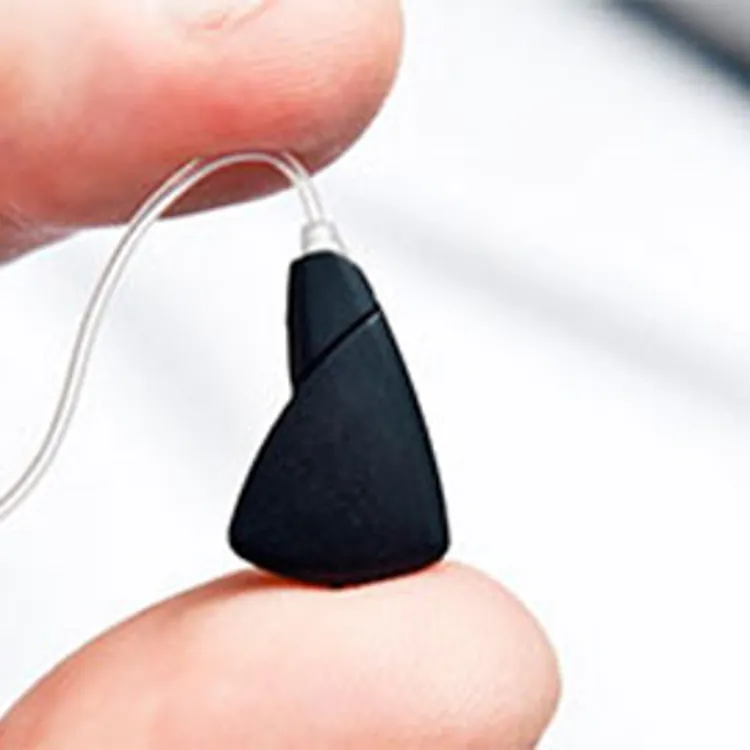
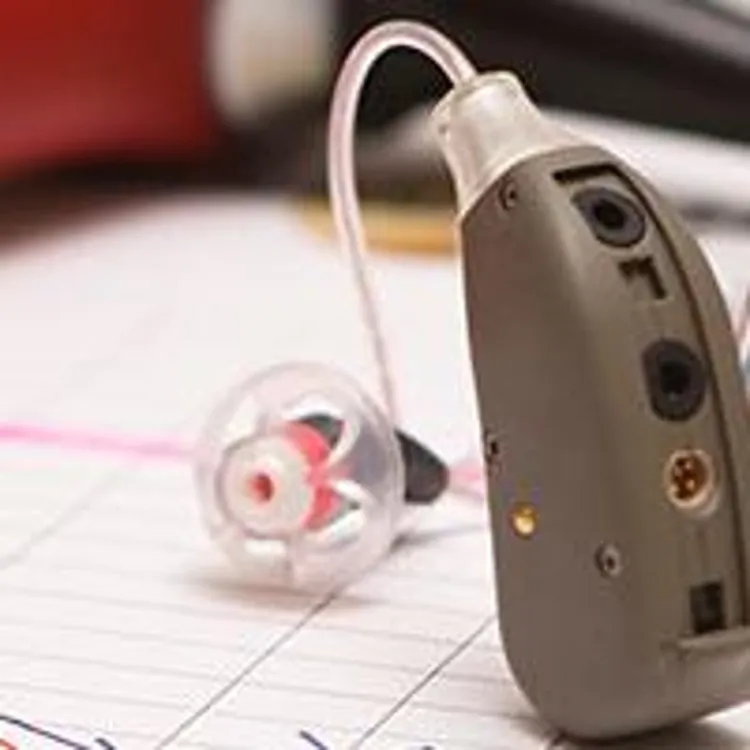
RIC hearing aids place the device body behind your ear, with the receiver (speaker) in your ear canal, connected to the body by a thin tube.
How do RIC hearing aids differ from BTE hearing aids?
Because RIC aids place the receiver inside your ear, they have a smaller, less bulky body behind your ear than BTE aids. RIC aids tend to feel lighter and more natural because the receiver’s location sits inside your ear.
Are RIC hearing aids good for first-time users?
Yes, RIC aids can be good for first-time users because they are comfortable, easy to put on and simple to control through a mobile app.
How much do RIC hearing aids cost?
RIC aids generally cost between $1,000 and $5,000 per pair, with more feature-rich, custom-fitted models pushing toward the higher end.
Why do RIC hearing aids pick up more wind noise than other styles?
RIC aids tend to pick up more wind noise than in-the-ear (ITE) models because, like BTE aids, RIC devices place the microphones outside your ear, where they are more exposed to the elements and wind.
Article sources
ConsumerAffairs writers primarily rely on government data, industry experts and original research from other reputable publications to inform their work. Specific sources for this guide include:
- Alleghany Hearing and Balance Center, "Receiver-in-Canal." Accessed Nov. 25, 2026.
- Amplifon Hearing Health Care, "RIC vs. BTE Hearing Aids." Accessed Nov. 25, 2026.
- Audicus, "Ray." Accessed Nov. 25, 2026.
- Audience Hearing, "Receiver-In-Canal Hearing Aids: What You Should Know." Accessed Nov. 25, 2026.
- CornerStone Ear, Nose & Throat, "Why You Should Consult An Audiologist Before Purchasing OTC Hearing Aids." Accessed Nov. 25, 2026.
- hear.com, "Hearing Aid Prices." Accessed Nov. 25, 2026.
- LINNER, "How Much Do RIC Hearing Aids Cost." Accessed Nov. 25, 2026.
- Sioux Falls Audiology Associates, "Understanding the Differences Between RIC, BTE, and CIC Hearing Aid Styles." Accessed Nov. 25, 2026.
- Windsor Park Hearing Centre, "Receiver in Canal Hearing Aids Review: What to Know." Accessed Nov. 25, 2026.