

Compare our top ITC hearing aid picks
| Company | Customer rating | Best for | Financing offered | Types of hearing loss | Warranty | |
|---|---|---|---|---|---|---|
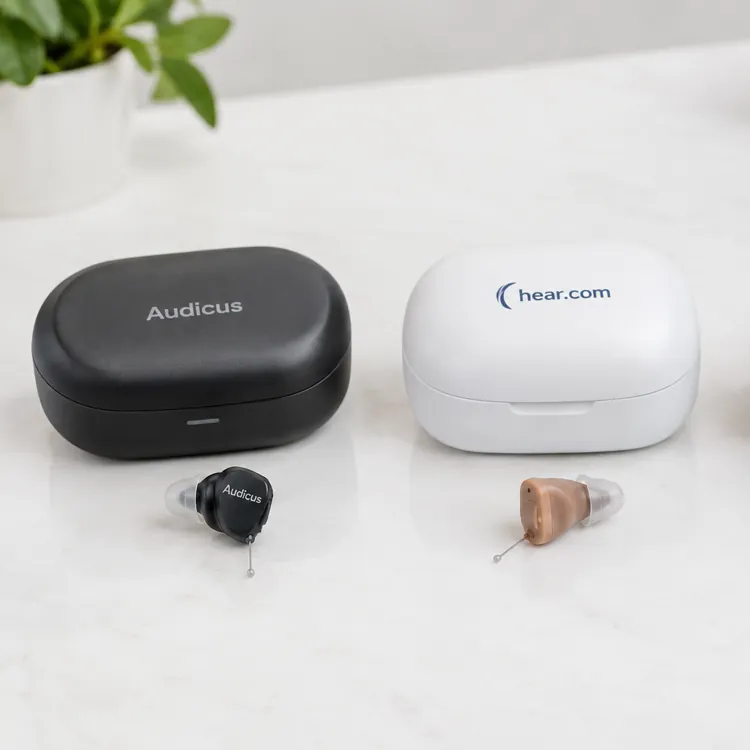
 Audicus | Get Pricing | 4.3 | Best overall |  | Moderate to severe | 2 years |
 hear.com | Learn More | 4.5 | Best warranty coverage | | Mild to profound | 1 to 3 years |
 Starkey Hearing Aids | Learn More | 4.2 | Best for ITC selection | | Mild to profound | Limited, with optional add-on coverage |
Audicus

- Starting price
- $1,498
- Trial period
- 100 days
- Hearing test required
- Yes
- Who programs
- Licensed professional
hear.com

- Starting price
- $1,599 per pair
- Trial period
- 45 days
- Hearing test required
- Yes
- Who programs
- Licensed professional
Starkey Hearing Aids

- Starting price
- $1,998 per pair
- Trial period
- 45 days
- Hearing test required
- Yes
- Who programs
- Licensed professional
Methodology: How we chose the best ITC hearing aids
The ConsumerAffairs Research Team compared ITC hearing aid brands using verified customer reviews, product details and company policies. To qualify, companies needed verified reviews submitted between Sept. 1, 2023, and Aug. 31, 2026. We scored each brand in four areas:
- Customer experience: Satisfaction with staff, customer service and price
- Hearing aid selection: Product lines and options for all types of hearing loss
- Price and policies: Starting price for a pair, warranty coverage and trial period
- Recent engagement: Recent review volume and company response rate
Each company received a score from zero to 10 for every metric. The top performer earned a 10, and the other companies were scored relative to it. We used different weightings for each award. For example, the ITC selection award focused more on product lines, while the warranty coverage award emphasized warranty length and trial period.
In-the-canal hearing aids buyers guide
If you’re comparing hearing aid options and prefer an in-the-canal model, consider your budget, degree of hearing loss, how discreet you want the device to be and which audio features matter most to you.
Below, we’ll walk through each of these factors.
Key insights
Consider key differences between ITC aid design types: in-the-canal, in-the-ear, completely-in-canal, invisible-in-canal.
Jump to insightITC aids are more discreet than behind-the-ear aids, but also vulnerable to earwax buildup.
Jump to insightThe price can easily exceed $1,000 for a custom-fitted device, based on a hearing test.
Jump to insightHow to choose ITC hearing aids
Before deciding on a hearing aid, consider factors like the design you want, the features, the free trial length and the degree of support you’ll receive.
Overall design
When choosing a hearing aid, you have several options that fit entirely in your ear, including completely-in-canal (CIC), in-the-canal, invisible and in-the-ear (ITE) models. While all these varieties of ITC aids reside completely in your ear, they vary in size, fit, external visibility and user experience.
Here’s a quick breakdown of the types of ITC hearing aids, from largest to smallest:
- In-the-ear: ITE aids are the largest type of hearing aids that sit inside your ear. They tend to fill all or most of your ear concha — the bowl-like part of your outer ear — and may extend outside of it. These aids tend to offer strong amplification technology, making a good option for those with moderate-to-severe hearing loss.
- In-the-canal: While generally smaller than ITE aids and far more discreet than BTE aids, ITC aids are still on the larger side, filling most of your ear canal. These offer a good balance of deep placement and a somewhat substantial size, still allowing relatively easy control and button-pushing when needed.
- Completely-in-canal: CIC aids, one of the smallest sizes, fit entirely in your ear canal. They are discreet and difficult for others to spot, but the reduced size often comes with a compromise in amplification, making CIC a suitable option only for those with mild-to-moderate hearing loss.
- Invisible-in-canal (IIC): IIC aids are the smallest custom hearing aids on the market today. They sit deep in your ear, making them very discreet and difficult for anyone to see. However, their small size can make them easy to misplace and difficult to manage, with tiny buttons. These are only a good option for those with mild-to-moderate loss.
Features
Although ITC aids are smaller than BTE options, modern ITC aids offer a great variety of features, with more feature-rich hearing aids typically costing more. However, features can also feel overwhelming and frustrating to adjust, so more isn’t always better.
Consider your lifestyle and the types of environments where you spend the most time, prioritizing the features that will allow you the most seamless day-to-day experience:
- Battery life: Most ITC hearing aids include rechargeable batteries, but you don’t necessarily need to recharge them daily. Depending on the battery your hearing aid uses, you can typically expect to get anywhere from three to seven days of lifespan from one battery charge, with some models providing 51 hours of use.
- Noise cancellation features: Many ITC aids, such as the Starkey Signature Series, include noise-cancellation features that block out transient noise and feedback, with some options even working to help process and normalize the sound of your own voice.
- Bluetooth connectivity: Nearly all of the hearing aids on our list, and elsewhere, include Bluetooth technology that connects to your smartphone or other devices, enabling streaming and convenience.
- Spatial awareness and omnidirectional microphones: Many of the hearing aids on our list include omnidirectional microphones, which pick up sound from multiple directions to improve your spatial orientation. This technology is quickly improving, even in ITE aids.
- Wind noise: Many ITC hearing aids include active features that use noise cancellation to block out wind noise, helping you focus more on the sounds you want.
- Amplification capabilities: Depending on the size and model, ITC hearing aids can vary considerably in their amplification capabilities. Individuals with more severe hearing loss may require larger ITC aids, such as ITE designs, to ensure proper amplification.
Setup process and requirements
All the ITC hearing aids on our list require a hearing test, which enables licensed professionals to customize your aids’ fit and sound settings to meet the nuances of your hearing loss. This customization leads to safer and more effective performance, and a better day-to-day experience for you.
Most of the preliminary hearing tests are free, including some online options, such as from Audicus. However, you can choose other OTC hearing aids that don’t require a hearing test. The main drawback is that these aids will likely not provide the same personalized frequency and noise response as the custom-fitted options we’ve suggested above.
Ease of use
Compared to behind-the-ear aids, ITC hearing aids offer advantages and disadvantages regarding daily user experience. On the plus side, ITC aids tend to be comfortable, especially custom-fitted models, which fit snugly in your ear. This snug fit also makes ITC aids a good option for active users, since they stay in your ear when your head moves.
On the other hand, some ITC aids—especially the smaller designs—are vulnerable to wax buildup, due to their smaller size and snug fit. This requires more frequent cleaning and can put you at a higher risk of ear infections.
Hearing aid cost
In-the-canal hearing aid costs typically range from $1,000 to $3,700 per device. You can find OTC in-the-canal hearing aids even cheaper, sometimes as low as $100, in stores like Target, but these are usually one-size-fits-all and lack sophisticated features or personalized support.
In most cases, users will benefit from ordering a hearing test, going over results with a licensed professional and choosing a custom-fitted option. These ITC hearing aids rival prescription options, with the same personalization, and all of them include some degree of ongoing customer support. Many of the providers on our list also offer financing options.
Pros and cons of in-the-canal hearing aids
Compared with BTE hearing aids, ITC aids offer a major cosmetic advantage because they are less conspicuous. Modern ITC aids match BTE aids in features, with the advantage of less wind noise and a more personalized fit.
However, the personalized fitting and testing process can feel tedious, and some ITC hearing aid models can be costly — especially those with more features.
Pros
- More discreet
- Great selection of features
- Less wind noise
- Bluetooth connectivity
- Custom fit
Cons
- Custom fit requires a hearing test
- Can be costly
- Requires more frequent cleaning
- May not provide enough amplification for all hearing loss severity levels
- Risk of earwax buildup and ear infection
FAQ
Are in-the-canal hearing aids any good?
Yes, in-the-canal hearing aids offer effective, custom frequency amplification through personally fitted ear molds. They offer modern features that improve the listening experience for a wide variety of levels of hearing loss.
What are the disadvantages of an in-the-canal hearing aid?
The main disadvantages of using ITC hearing aids are the fact that many of them require custom molding and testing, which takes time, and the fact that ITC aids can accumulate earwax.
Are receiver-in-canal hearing aids better than in-the-canal hearing aids?
Neither receiver-in-canal nor in-the-canal hearing aids are universally better. Receiver-in-canal aids go around the back of your ear and often include stronger sound amplification, while ITC aids fit inside your ear and are more discreet.
How much does a completely-in-canal hearing aid cost?
The cost of a completely-in-canal hearing aid typically ranges from $1,000 to $3,700 per device, with more feature-rich models reaching the higher end of the spectrum.
What does ITC hearing aid mean?
ITC hearing aid stands for in-the-canal hearing aid. It refers to a hearing aid style where the device’s entire body fits in your outer ear canal, mostly hiding it from external view.
How do in-the-canal hearing aids differ from completely-in-canal hearing aids?
Completely-in-canal aids are a type of in-the-canal hearing aid. CIC aids tend to be slightly smaller and fit further down into your ear, so they’re hidden a little more from view.
Guide sources
ConsumerAffairs writers primarily rely on government data, industry experts and original research from other reputable publications to inform their work. Specific sources for this guide include:
- Absolute Hearing Solutions, "IIC vs. CIC: What’s the Difference in Appearance?" Accessed Nov. 25, 2026.
- Amplisound Hearing Care Centers, "Completely-in-Canal Hearing Aids: Weighing the Pros and Cons." Accessed Nov. 25, 2026.
- Audibel, "How to Maximize Hearing Aid Battery Life." Accessed Nov. 25, 2026.
- Audiological Services of Lufkin, Texas, "Exploring the Pros and Cons of ITC, CIC, and IIC Hearing Aids." Accessed Nov. 25, 2026.
- Cleveland Clinic, "Types of Hearing Aids: Which Is Right for You?" Accessed Nov. 25, 2026.
- Hearing Aid UK, "In the Ear (ITE) Hearing Aids." Accessed Nov. 25, 2026.
- HearUSA, "In-the-Canal (ITC) Hearing Aids." Accessed Nov. 25, 2026.
- Hill Country Audiology Service, "Taking a Look at ITC Hearing Aids." Accessed Nov. 25, 2026.
- Triangle Sinus Center, "Which Type of Hearing Aid Will Suit My Hearing Loss." Accessed Nov. 25, 2026.