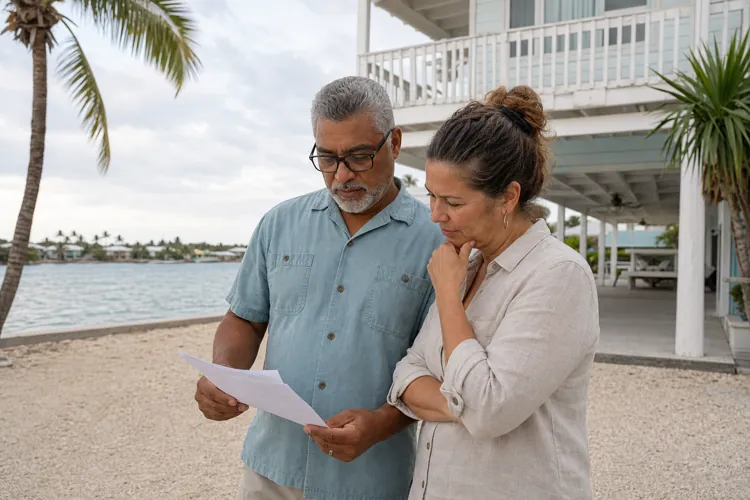

A new Insurify analysis found that Florida, Louisiana, and North Carolina are home to many of the nation's least insurable counties, where homeowners face the highest insurance costs and risks.
The rankings are based on factors including natural disaster risk, home age, property values, and local insurance premiums, all of which influence how expensive and difficult it is to insure a home.
Experts say homeowners can help lower their insurance costs by weather-proofing their homes, shopping around for coverage regularly, and asking insurers about available discounts.
Home insurance has become more expensive — and in some parts of the country, it's also becoming much harder to get.
As extreme weather events grow more frequent and costly, insurers are raising rates, limiting coverage, or pulling out of high-risk areas altogether. A new home insurance risk index from Insurify highlights the counties where homeowners are facing the greatest insurance burden, with many of the hardest-hit areas concentrated in Florida, Louisiana, and North Carolina.
To better understand what's driving these trends and what they could mean for homeowners, ConsumerAffairs spoke with Insurify Senior Economic Analyst Matt Brannon about why some counties are becoming increasingly difficult to insure and how climate risk is reshaping the home insurance market.
Identifying risk
Insurify's Home Insurance Risk Index scored more than 3,100 U.S. counties based on factors that influence how difficult and expensive it is to insure a home.
“First we look at natural-hazard and extreme-weather risk,” Brannon said. “Counties with more vulnerability to natural disasters (e.g., wildfires, earthquakes, flooding, hail, etc.) are more prone to frequent and costly insurance claims.
“The second factor assessed is the age of a county's housing stock. Because of outdated building codes, worn-down materials, and a lack of regular upkeep, older properties are more susceptible to damage from severe weather. We also look at the number of residential structures in a county and the ratio of residential to commercial structures.
“Additionally, we examine the county’s median home value, as insurers generally charge higher premiums for more expensive homes, since they are more costly for the insurer to afford to replace. Finally, we incorporated average annual home insurance premiums by county, which capture risk factors that physical hazard models don’t fully reflect. Factors like local litigation and claims environments, crime rates, rebuilding cost inflation, and insurance market dynamics all play a part in determining how risky it is to insure a home.”
Which areas have the greatest risk?
Monroe County, Florida, home to the Florida Keys, ranked as the least insurable county in the country with a score of 99.5 out of 100. Homeowners there pay an average of $22,436 per year for insurance — nearly eight times the national average.
Overall, 19 of the 20 least insurable counties are located along the Gulf and Atlantic coasts, where hurricanes, storm surge, and high winds create significant risks. Jackson County, Oklahoma, was the only non-coastal county to make the top 20, largely because of its exposure to tornadoes and hail.
The report also found that Louisiana is home to three of the five least insurable counties, while California stands out on the West Coast because of wildfire risk, with Los Angeles and Santa Cruz counties both receiving scores above 95.
More broadly, the analysis found that densely-populated counties tend to have higher insurance risk scores than more rural areas, highlighting how a combination of climate threats, home values, and rebuilding costs is making insurance more expensive — and in some cases, harder to obtain — for millions of homeowners.
Can you lower your risk?
Because the highest risks are found in areas with extreme weather, Brannon recommends homeowners take the necessary precautions to weather-proof their homes as much as possible.
“Upgrade to impact-rated windows and doors, install hurricane shutters, and consider a more wind-resistant roof,” he suggested. “While home hardening measures can be costly, several coastal states provide assistance programs. For example, Louisiana contains four of the nation's ten least insurable counties. Homeowners in these areas can apply for the Fortify Homes grant, which offers grants of up to $10,000 for roofing improvements.
“Some insurers will even give discounts to homeowners who make these improvements. In Florida, state law requires insurers to give discounts to homeowners in risky areas who make certain weather-resistant improvements.”
Do your homework
While homeowners living in these high-risk areas are likely to going to bear the brunt of higher insurance premiums, Brannon says that taking the time to do your homework and see what offers exist can potentially help you save.
“The very best way to save money on home insurance is to compare rates,” he said. “Many people think insurance is a set it and forget it situation, but it shouldn’t be. Rates can be volatile, and business strategies vary by insurer. So the company that gave you the best rate five years ago may not be the company offering the best rates for your property today.
“We recommend reviewing every six months to make sure you have an affordable and adequate policy. You can also look into bundling coverage. Finally, ask your insurance agent about ways to save. They are the experts who are there to help you.”