


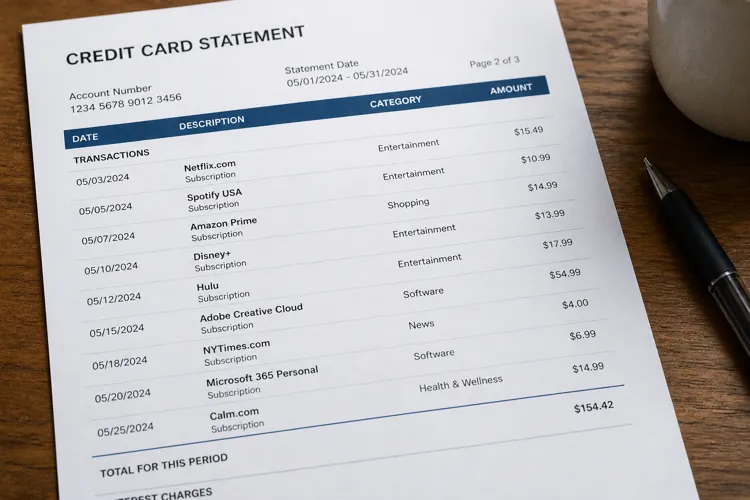

More than a third of subscribers (36%) have had a subscription payment overdraft their bank account, while 41% say subscriptions have forced them to cut back on other expenses or savings.
Forgotten subscriptions, rising prices, and unused services are adding up, with 81% of subscribers paying for a forgotten, unused, or duplicate subscription in the past year.
DealSeek co-founder Trey Donovan shares practical tips for auditing subscriptions, avoiding free-trial charges, and deciding which recurring expenses are worth keeping.
Signing up for a streaming service, a monthly subscription box, or a new app might not seem like a big expense on its own. But when those recurring charges start piling up, they can take a bigger bite out of household budgets than consumers realize.
And for some people, the consequences go beyond simply spending more than they intended. A new survey from DealSeek found that more than a third of subscribers (36%) have had a subscription payment overdraft their bank account, while 41% say subscription costs have forced them to cut back on other spending or made it harder to save money and cover essential expenses.
The problem may be that many consumers aren't keeping track of just how many services they're paying for — or how much those small monthly charges add up to over time.
ConsumerAffairs spoke with Trey Donovan, co-founder of DealSeek, about the growing problem of subscription creep, why recurring payments are catching consumers off guard, and what people can do to regain control of their budgets.
Methodology
To better understand how subscription services are affecting household finances, DealSeek surveyed 1,000 U.S. adults who currently pay for at least one recurring subscription.
The survey examined how many subscriptions consumers maintain, how much they spend, and whether they've paid for services they've forgotten about or no longer use. Researchers also looked at cancellation experiences, price increases, and the financial and emotional stress associated with recurring charges.
The results were broken down by generation (Gen Z, millennials, Gen X, and baby boomers) and household income. Income groups were defined as low-income (under $50,000 annually), middle-income (50,000 to $100,000), and high-income (over $100,000). All findings were based on self-reported survey responses.
Key Findings
The survey uncovered several ways subscription services are putting pressure on consumers' wallets:
Consumers are losing track of subscription spending: Nearly seven in 10 subscribers (69%) said they've been surprised by how much they spend on subscriptions each month. Meanwhile, 29% are juggling six or more active subscriptions.
Forgotten subscriptions are costing people money: More than eight in 10 subscribers (81%) have paid for a forgotten, unused, or duplicate subscription in the past year. Nearly half (46%) are currently paying for something they rarely or never use.
Recurring charges are causing overdrafts: More than one-third of subscribers (36%) have had a subscription payment overdraft their bank account. Another 63% worry that a service will renew before they have a chance to cancel.
Canceling isn't always easy: Although 95% of subscribers tried to cancel at least one subscription in the past year, 75% encountered some kind of obstacle. Only 39% of those who attempted to cancel were successful on their first try.
Rising prices are pushing consumers to reconsider subscriptions: Two-thirds (67%) canceled at least one subscription in the past year. Price increases were the biggest frustration, cited by 34% of respondents, compared with 17% who pointed to cancellation difficulties.
Subscriptions are forcing consumers to make financial sacrifices: Four in 10 subscribers (41%) said subscription costs have forced them to cut other spending or made it harder to save, pay down debt, or cover essential expenses. Dining out (29%) and entertainment and social plans (24%) were among the most common areas where people cut back.
Do a subscription audit
So, how do you make subscriptions an affordable part of your budget? Donovan recommends conducting a subscription audit.
“You’ll want to look at a full year’s worth of bank statements, not just the last month or two,” he said. “Otherwise, you’re going to miss those annual charges that pop up once a year.
“I’d also take a look at your Apple and Google accounts since a lot of app subscriptions are billed through them. Once you have a list, add up what you’re spending over the year. It’s one thing to notice a $15 fee every month, but realizing that’s $180 for something you might rarely use, that can really change your mind about keeping it.”
Don’t strain your budget
On the other hand, one of the tell-tale signs that your subscriptions are straining your budget is if you put off other expenses to keep up with them.
“Our research found that basically two in five subscribers have had to make financial trade-offs because of these costs,” Donovan said. “That’s not a small minority.
“Another thing to keep an eye on is if you’re depending on your credit cards to cover the recurring payments. If you’re unable to comfortably afford a subscription with the money you have coming in, then staying subscribed is basically doing more harm than good.”
Cutting back on non-essential subscriptions
If you’re thinking about making changes to your subscriptions, Donovan said that you don’t need to cancel every single one. Instead, think about the value you get from everything you’re subscribed to.
“If you’re paying for several streaming platforms, but typically only watch one, it’s clear you can cut out the rest and you won’t actually miss them,” he said. “Plus, it’s not like you cannot subscribe again later.
“I’d also check out if you’re paying for any features you don't end up using, because maybe a basic cheaper plan will still cut it, and you’re not paying extra for the bells and whistles you’re not taking advantage of.”
This is something Donovan recommends reviewing on a regular basis, especially because some subscriptions are valuable for a few months or even a year, but they may not be worth renewing again.
“I think people have gotten so normalized to paying monthly fees for everything that they don’t take a second to question if it’s still worth it,” he said. “A subscription might have been a good idea when you first signed up, but habits change and evolve, prices go up, and before you know it, you’re paying for something that you might not have even actually signed up for before.
“That’s probably the question I’d ask when reviewing subscriptions: if I wasn’t already signed up for this, would I actually want to pay for it?”
The free trial trap
Another thing that consumers should keep in mind: free trials.
“Free trials are a big one because people sign up with every intention of canceling, then forget about them,” Donovan said. “We actually found that a quarter of subscribers had been charged after forgetting to cancel a trial.
“It seems to often slip past people that a free trial doesn’t exactly mean it’s free if you forget when the promotion ends. I’d set a reminder a few days before the renewal date, and check whether you’re being billed on a monthly or annual basis once the trial ends.”
Donovan also recommends having an exit strategy in place before you actually need it.
“It’s also important to figure out how to cancel before you even put in your payment details. If you have to jump through a bunch of pages just to find a cancellation option, that’s worth knowing before you pull the trigger and sign up.”