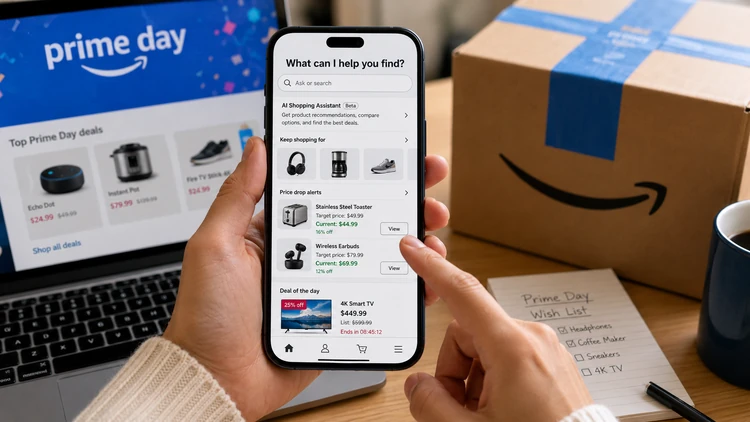

Let AI do the research: Ask specific questions to compare products, find cheaper alternatives, and avoid paying for features you don't need.
Track prices before Prime Day: Build a wish list now and let AI alert you when prices drop so you can spot real bargains.
Compare deals everywhere: Use Amazon Lens and AI to check prices at Walmart, Target, Costco, and Best Buy before you buy.
Prime Day is almost here (June 23-26), and millions of shoppers are already building wish lists, tracking deals, and trying to figure out the best time to buy. This year, Amazon wants artificial intelligence to do much of that work for you.
Last month, the retail giant rolled out a collection of AI-powered ‘Alexa+ for shopping’ tools designed to help customers compare products, track prices, answer questions, and even alert shoppers when items hit a target price.
For consumers preparing for Prime Day, these tools could help separate genuine bargains from all the noise.
Let AI do the product research
Thousands of products will go on sale during Prime Day, making it difficult to figure out which deals are actually worth your attention and which are just flashy marketing.
Amazon's AI shopping assistant can help you cut through the noise and summarize product features, compare similar products, and answer questions about specific items.
To find it, all you have to do is tap the Alexa icon in the bottom navigation bar in the Amazon app, or you’ll find it in the top left corner of your screen when on a laptop or desktop.
At the prompt window, the key is to NOT ask generic questions like, "Which laptop is best?" Instead, be very specific in your questions.
Try prompts like the following:
- "Compare the top three air fryers under $100."
- "Which cordless drill offers the best value for occasional DIY projects?"
- "What's the biggest difference between these two TVs?"
- "Which baby monitor has the best features for under $75?"
If you remember only one thing from this article, let it be this: the more specific your questions, the better the AI recommendations will be.
Pro tip: Start building your Prime Day wish list now. By watching prices for a couple weeks leading up to the event, you'll have a baseline price so you can quickly determine if a Prime Day deal is truly a bargain or simply the same price the item was last month.
Use AI to track Prime Day prices
One of the most useful features for deal hunters is Amazon's ability to track prices.
In other words, Amazon's AI tools can actually identify price drops and alert you when deals become available.
To make it happen, try these under-the-radar prompts:
- "Notify me if this item drops below $75 during Prime Day."
- "Has this product been discounted recently, or should I wait for Prime Day?"
- "Which items on my wish list are most likely to receive larger Prime Day discounts?"
- "Show me similar products that are already on sale."
- "Alert me when this item reaches its lowest price during Prime Day week."
- "Compare the current price to the price from the past 30 days."
Pro tip: Keep your Prime Day spending in check and create a personal spending ceiling beforehand. Decide how much you're willing to spend then ask AI to show you the best options within that budget. This prevents you from starting out looking for a $100 item and somehow ending up buying a $145 version because it was "only a little more."
Use Amazon Lens while shopping elsewhere
Prime Day isn't the only game in town. Retailers like Walmart, Target, Best Buy, and Costco frequently launch competing sales during Prime Day week.
Amazon Lens allows shoppers to scan products with their phone's camera via the Amazon app and quickly find similar items sold on Amazon.
So, if you spot a deal at another retailer during Prime Day week, use Amazon Lens to compare pricing and features before you buy. What you’ll often discover is that sometimes the best Prime Day deal isn't actually at Amazon.
Let AI find the hidden dupes as well
Big-name brands often dominate the Prime Day headlines, but lesser-known alternatives can offer similar performance at a much lower price.
It’s smart to ask Amazon AI about comparable products with similar ratings and features. Sometimes the biggest savings aren't on the most popular brands, but on the product sitting right next to them.
Here are a few smart prompts shoppers can use to uncover dupes:
- "What's the closest lower-priced alternative to this product?"
- "Which lesser-known brand offers similar features and ratings?"
- "Can you recommend a product that performs similarly for at least 25% less?"
- "What are shoppers buying instead of this name-brand item?"
Example: If you're eyeing a Dyson vacuum, AI may point you toward a Shark model with similar suction, attachments, and customer ratings for $100-$200 less. The same strategy works for everything from earbuds and coffee makers to coolers and robot vacuums.
Ask AI what not to buy
Most shoppers ask AI which product is best. Instead, ask which features you can safely skip. You'll often discover that a $79 gadget delivers nearly the same experience as the $149 version.
Prime Day is full of upsells, and knowing which features you don't need can be just as valuable as finding a discount.
Here are five actionable prompts worth using:
- "Which features on this product are mostly marketing gimmicks?"
- "What am I paying extra for with the premium model?"
- "Which version offers the best value for the average shopper?"
- "What features could I skip and still be happy with this purchase?"
- "Is there a cheaper model that delivers 90% of the same performance?"
Pro tip: Use AI to spot those sneaky upgrade traps. Many Prime Day listings encourage shoppers to spend a little more for upgraded models. Ask Amazon's AI assistant which features matter most for typical users and which ones are mostly marketing fluff. You may find that the mid-tier model offers the best value and saves you significant money.