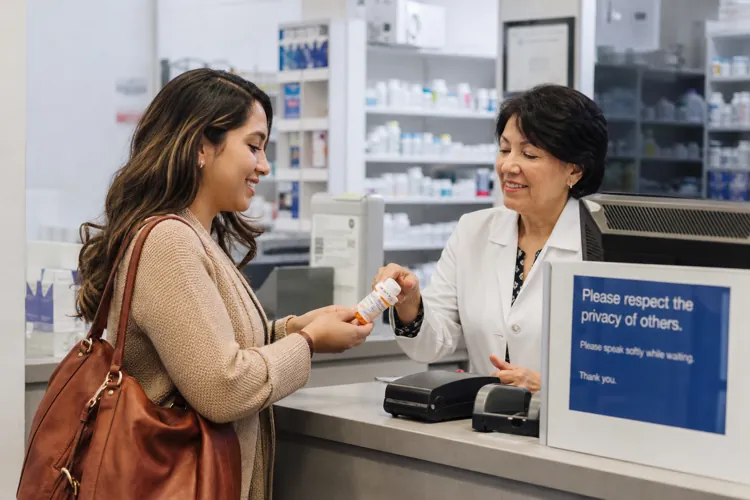

More Americans are searching for online prescription refills as pharmacy access becomes more limited, with searches up 440% since 2022.
A new Tebra analysis found millions of households live in pharmacy deserts, where getting to a local pharmacy can be difficult.
Experts say online prescription services can help fill access gaps, but consumers should use licensed, reputable providers and not view them as a replacement for quality healthcare.
Picking up a prescription has long been a routine part of healthcare, but for many Americans, it's becoming less convenient than it used to be.
As pharmacies close or become harder to reach, some communities are finding themselves in what's known as a "pharmacy desert" — areas where access to prescription medications is limited. That shift is prompting more consumers to look for digital alternatives, from online prescription refills to virtual pharmacy services.
A new analysis from Tebra examines where pharmacy access is most limited across the country and how those challenges are changing the way people manage their medications. ConsumerAffairs spoke with Kyle Ryan, Chief Product & Technology Officer at Tebra, who explained how digital healthcare tools are helping fill some of the gaps, while also highlighting why they aren't a complete replacement for in-person pharmacy care.
Key findings
To better understand where pharmacy access is most limited and how consumers are responding, Tebra analyzed data from all 50 states to create a Pharmacy Desert and Digital Demand Index.
The ranking combined three factors: the share of census tracts classified as pharmacy deserts (40%), the number of federally designated medically underserved areas per 100,000 residents (40%), and online healthcare search activity (20%). The search analysis included five prescription-related terms, such as "online pharmacy" and "prescription refill online," using search data from 2025 through 2026 and U.S. Census population estimates.
Some key findings from the survey include:
Searches for "prescription refill online" have increased 440% since 2022, making it the fastest-growing search term in the category.
Alaska had the highest share of pharmacy deserts, with more than half (51.41%) of its census tracts lacking adequate pharmacy access.
Texas had the largest number of affected households at more than 2.8 million.
Washington ranked first in overall online pharmacy search demand, suggesting residents are increasingly seeking digital healthcare options.
Wyoming led the nation in searches for "prescription refill online," highlighting how limited local pharmacy access may be driving consumers to look for online alternatives.
“A 440% rise in searches for ‘prescription refill online’ shows that people are looking for backup options when the nearest pharmacy is too far away, too busy, or no longer available,” Ryan said. “The findings illustrate that access problems and online behavior do not always reflect each other.”
The risks
While many consumers are turning to digital pharmacies out of necessity, Ryan warns that there are some risks involved with doing so.
“One significant risk is assuming that an online prescription tool works like any other online checkout,” he said. “Medication is different because a safe refill depends on prescription verification, dosage accuracy, drug-interaction checks, privacy protections, and access to a licensed clinician or pharmacist when consumer questions arise.
“Consumers should be careful with websites that promise unusually cheap medication, skip medical review, or make it difficult to identify who is dispensing the prescription. Online refills can be incredibly useful, but they should still feel like healthcare and not a shortcut around healthcare.”
What are the long-term solutions?
Ultimately, Ryan says that the long-term goal should be to increase access to pharmacy services to areas that need it most.
“The long-term answer cannot be just telling consumers to ‘go online,’ because online access still depends on broadband, delivery reliability, insurance coverage, and comfort using digital health tools,” Ryan said.
“Instead, a better solution is redundancy: safe mail-order pharmacy options, telehealth-enabled refills, mobile pharmacy services, local clinic partnerships, and better support for rural and independent pharmacies. For consumers in pharmacy deserts, the goal should be having more than one reliable path to essential medication before a refill becomes urgent. That is especially important in large states like Texas, where the study found 2.8 million households in pharmacy deserts, making this a scale problem as much as an access problem.”