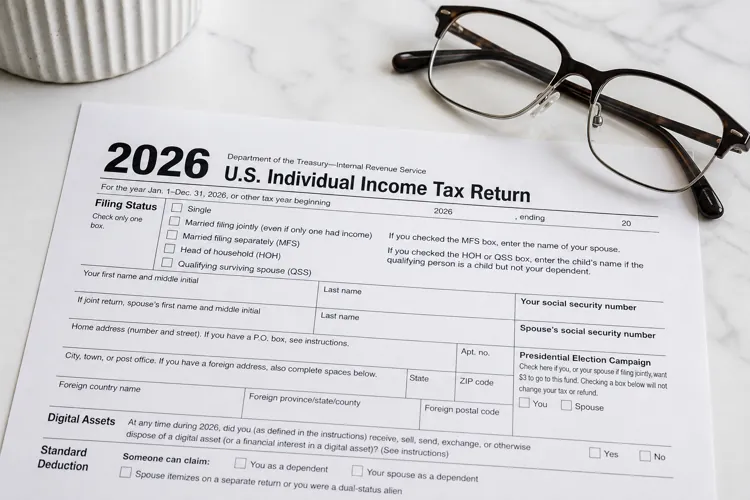

A new federal tax provision will allow non-itemizers to deduct up to $1,000 in qualifying cash donations, or $2,000 for married couples filing jointly, beginning in 2026.
Donors must keep a bank record or written receipt for every cash gift, while contributions of $250 or more require a detailed acknowledgment from the charity.
Taxpayers — not charitable organizations — are responsible for ensuring donation records satisfy IRS requirements before filing.
A federal tax break for charitable giving will return in 2026, allowing millions of Americans who claim the standard deduction to receive a tax benefit for qualifying cash donations — but only if they keep the proper records.
Single filers will be permitted to deduct up to $1,000 in eligible cash contributions, while married couples filing jointly may deduct as much as $2,000, according to Samuel Handwerger, an accounting lecturer at the University of Maryland’s Robert H. Smith School of Business.
The above-the-line deduction could apply to roughly 90% of taxpayers, many of whom have had little reason to retain charitable receipts since the standard deduction was substantially increased under the 2017 tax law.
Although the deduction is changing, the documentation rules are not. Handwerger said the restored benefit remains subject to the substantiation requirements of Section 170 of the Internal Revenue Code.
You’ll need these records
Every cash donation requires either a bank record — such as a canceled check or credit card statement — or a written record from the charity identifying the organization, donation date, and amount.
For individual contributions of $250 or more, taxpayers must obtain a written acknowledgment from the charity by the time they file their return. The document must also state whether the donor received any goods or services in exchange, such as a meal, event ticket, or merchandise, and give their value when applicable.
That language can be decisive even when there is no dispute that a donation was genuine.
In the 2012 case Durden v. Commissioner, David and Veronica Durden claimed more than $25,000 in donations to their church. Although they retained canceled checks and received a letter listing their gifts, the IRS disallowed more than $22,000 because the acknowledgment failed to say whether the church had provided anything in return.
The church later issued a corrected letter, but the Tax Court rejected it because the document was obtained after the relevant filing deadline and was therefore not contemporaneous.
The donor bears the responsibility
The case illustrates an often-overlooked aspect of charitable deductions: the donor bears responsibility for obtaining a compliant acknowledgment. If a receipt is incomplete, taxpayers should ask the charity for a corrected version before submitting their return.
Handwerger advised donors to rebuild the record-keeping habits that may have faded during the years when most households received no tax benefit from charitable contributions.