
• One in five UTI cases may stem from E. coli found in retail meats
• Chicken and turkey show the highest contamination rates
• Researchers call it a food safety issue, not just a personal hygiene problem
For decades, urinary tract infections (UTIs) have been seen as a matter of personal hygiene. But new research suggests that many cases may actually begin with what Americans bring home from the grocery store.
A new study published in the American Society for Microbiology journal reports that roughly one in five UTIs could be linked to E. coli bacteria found in contaminated meat products sold in U.S. supermarkets — reframing what has long been considered a private health issue as a food safety concern.
Study connects infections to bacteria in store-bought meat
Between 2017 and 2021, scientists from George Washington University and Kaiser Permanente Southern California analyzed more than 5,700 urine samples from patients with E. coli UTIs. They also collected meat samples — chicken, turkey, beef, and pork — from grocery stores in the same communities.
By comparing genetic sequences from both sources, researchers found that about 20% of UTI infections could be traced to E. coli strains originating in meat.
“Urinary tract infections have long been considered a personal health issue, but our findings suggest that they are also a food safety problem,” said Lance Price, senior author of the study and professor of environmental and occupational health at George Washington University.
Chicken and turkey show the highest contamination rates
Among the meats tested, E. coli contamination was found in:
38% of chicken samples
36% of turkey samples
14% of beef samples
12% of pork samples
Researchers said poor storage, handling, and packaging practices likely contributed to the spread of bacteria. Some chicken packages were “bloated with saline,” which could leak and contaminate grocery belts or other foods.
Low-income areas disproportionately affected
The study also revealed that food-borne UTIs more often affect women and people in lower-income neighborhoods.
Women’s anatomy makes them more prone to infection because bacteria have a shorter path to the bladder. However, researchers also found E. coli contamination more frequently in “value packs” — larger, lower-cost meat packages often sold in lower-income areas.
“My own experience of actually going to grocery stores in more affluent communities versus low-income neighborhoods is that the quality of the products are lower in the latter,” Price said.
Food-handling practices can lower your risk
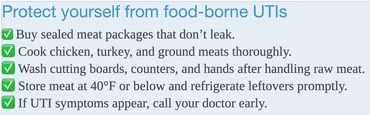
Researchers urged changes in meat processing and packaging to reduce contamination but said consumers can take steps to protect themselves at home:
Buy meat and poultry sealed securely to prevent leakage.
Cook meat to safe internal temperatures.
Keep raw and cooked foods separate to avoid cross-contamination.
Wash hands, utensils, and cutting boards thoroughly after handling raw meat.
CDC guidance may need an update
While the CDC acknowledges that E. coli causes UTIs, its guidance mainly focuses on diarrheal strains. Experts say this study highlights the need to recognize food-borne E. coli as a widespread source of urinary tract infections — especially among women and communities with limited access to higher-quality food.
“The food supply chain can and should do more to keep this dangerous bacterium out of our kitchens — and out of people’s bodies,” Price said.
What to do if you get a UTI
Know the symptoms
Common signs include a burning sensation while urinating, frequent urges to urinate, cloudy or foul-smelling urine, and pelvic discomfort.
When to see a doctor
If symptoms persist for more than a day or two, or if you experience fever, back pain, or blood in your urine, seek medical care. Untreated UTIs can spread to the kidneys and cause serious illness.
Treatment
Most UTIs are treated effectively with antibiotics prescribed by a healthcare provider. Drink plenty of water and avoid caffeine and alcohol while recovering.
Prevent recurrence
Urinate shortly after sexual activity.
Wipe front to back after using the bathroom.
Stay hydrated to flush bacteria from the urinary tract.
Avoid tight clothing that traps moisture.
Follow food safety practices to prevent E. coli exposure.