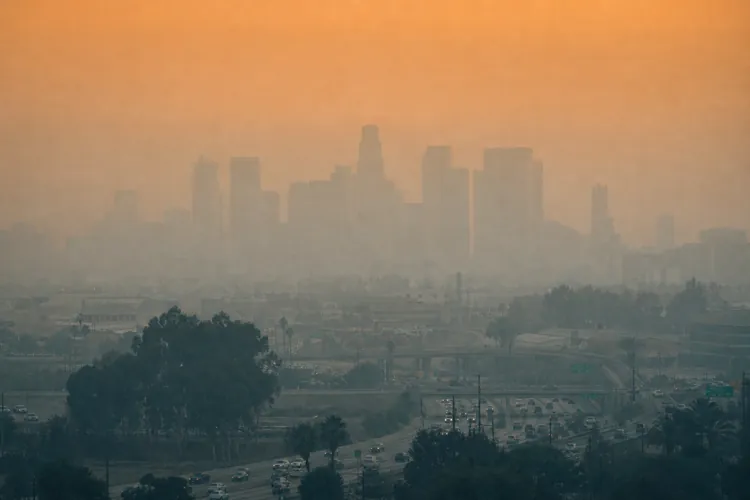

Canadian wildfire smoke is affecting the Great Lakes, Midwest, Northeast, and Mid-Atlantic, while separate fires are contributing to poor air quality in the Pacific Northwest.
Conditions should improve in parts of the Northeast, but another wave of smoke is expected to linger over the Great Lakes and Midwest into early this week.
Fine particles in wildfire smoke can aggravate heart and lung conditions and may cause coughing, wheezing, headaches, and chest pain.
Smoke from Canadian wildfires continues to spread across a large portion of the United States, prompting air-quality alerts and raising health concerns from Minnesota to the East Coast.
NOAA satellite observations showed a band of moderate to heavy smoke stretching across the Great Lakes and Mid-Atlantic before moving over the Atlantic Ocean. Lighter smoke covered much of the country, although smoke high in the atmosphere may create hazy skies without significantly affecting air quality at ground level.
Some of the most significant surface-level effects have been reported in the Upper Midwest and Great Lakes. The National Weather Service said air-quality alerts were in effect at the start of the week from Minneapolis to Cleveland as smoke from fires in western Ontario moved south.
That puts parts of Minnesota, Wisconsin, Illinois, Michigan, Indiana, and Ohio among the areas most likely to experience unhealthy conditions. Smoke has also reached portions of New York, Pennsylvania, New Jersey, New England, and the Washington, D.C., region.
Conditions in the Northeast were expected to improve Sunday after storms and a change in wind direction helped disperse some of the smoke. However, the outlook is less encouraging farther west.
“The latest batch of smoke over the Great Lakes and Midwest is expected to linger into early next week,” the National Weather Service’s Weather Prediction Center said Sunday.
The forecast remains subject to change because smoke movement depends heavily on wind direction, rainfall, and fire activity. Even after one plume clears, another can arrive if winds continue carrying smoke south from Canada. Residents should therefore check local conditions instead of relying solely on whether the sky looks hazy or smells smoky.
The AirNow Fire and Smoke Map, operated by the Environmental Protection Agency and U.S. Forest Service, provides current readings for fine-particle pollution and shows where smoke plumes are moving.
Why wildfire smoke is dangerous
The primary health threat is PM2.5, microscopic particles measuring 2.5 micrometers or smaller. Because the particles are so small, they can travel deep into the lungs and potentially enter the bloodstream.
Wildfire smoke can affect anyone when concentrations become high enough. Immediate symptoms may include coughing, wheezing, shortness of breath, stinging eyes, a scratchy throat, irritated sinuses, headaches, fatigue, chest pain, and a rapid heartbeat, according to the Centers for Disease Control and Prevention (CDC).
People at greater risk include older adults, children, pregnant women, and people with asthma, chronic obstructive pulmonary disease, heart disease, diabetes, or kidney disease. Outdoor workers and people who exercise outside may also inhale larger amounts of smoke because they breathe more deeply.
People with heart or lung disease should pay particular attention to new or worsening symptoms. Severe shortness of breath or chest pain may require immediate medical attention.
How to reduce smoke exposure
When the Air Quality Index reaches unhealthy levels, health officials recommend reducing strenuous outdoor activity and spending more time inside. Keeping doors and windows closed and running an air conditioner on the recirculate setting can help keep smoke outside.
A portable air cleaner equipped with a HEPA filter may reduce particle levels in a frequently used room. People who must spend extended periods outdoors can get added protection from a properly fitted N95 or KN95 respirator. Cloth and surgical masks are generally not designed to filter the smallest smoke particles effectively.
Drivers can also reduce exposure by closing vehicle windows and setting the ventilation system to recirculate.
Because air quality can vary significantly from one community to another — and can change within hours — residents in affected areas should monitor AirNow and local health advisories through at least the beginning of the week.