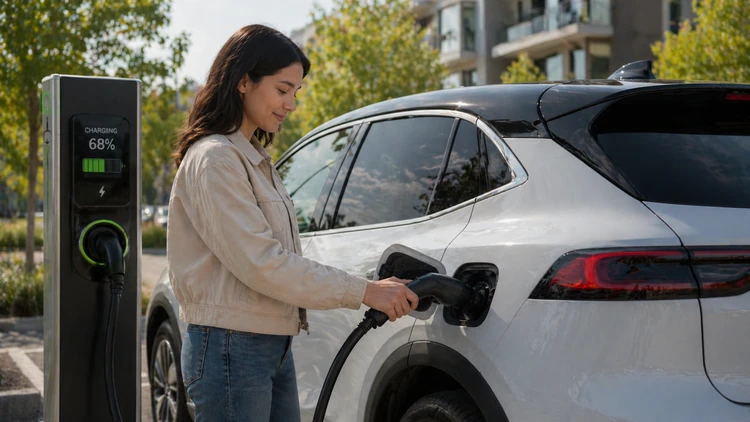

Widespread EV adoption could cut U.S. household energy costs by more than 6% by 2035.
Reduced gasoline demand may lower prices at the pump — even for non-EV drivers.
The shift could also reduce oil imports and boost U.S. energy exports.
Electric vehicles (EVs) are often framed as a personal choice — one that benefits drivers willing to invest in newer technology. But new research suggests the ripple effects could extend far beyond individual car owners.
According to a study from Georgia Tech, putting more EVs on the road could actually lower energy costs across the board, including for people who still drive gas-powered cars.
The reasoning is fairly straightforward: when more drivers switch to electricity, demand for gasoline drops. That reduced demand can push down fuel prices, meaning even households without EVs may see savings. At the same time, the study points to broader national impacts, including improved energy security and shifts in how the U.S. participates in global energy markets.
“Proponents of eliminating fuel efficiency standards and other EV-boosting policies often frame regulatory approaches as consumer-unfriendly, but our analysis shows that such policies have many long-term benefits, both for consumers and for the nation’s energy security,” researcher Niraj K. Palsule said in a news release.
How researchers modeled the impact
To understand these potential effects, researchers used a version of the National Energy Modeling System — a tool designed to simulate how energy is produced, consumed, and priced over time. Their version was tailored to better capture how different parts of the energy system interact with each other.
The study compared multiple policy scenarios between 2022 and 2035. One scenario assumed fewer incentives for EV adoption and weaker fuel efficiency standards. Another modeled a more moderate path forward, incorporating a mix of federal and state-level policies aimed at increasing EV use.
By running these side-by-side simulations, researchers were able to estimate how changes in vehicle technology and policy could influence fuel demand, electricity prices, and overall household energy spending over time.
What the study found
The results point to measurable, if gradual, economic benefits. By 2035, widespread EV adoption could reduce overall household energy bills by more than 6%, including over 4% savings on gasoline alone.
Lower demand for oil plays a key role here. The study estimates oil imports could fall by about 7%, while exports could increase by nearly 4%, shifting the U.S. further toward being a net energy exporter.
Interestingly, the savings aren’t limited to higher-income households or EV owners. Lower-income households — many of whom may still rely on gas-powered cars — could see slightly larger percentage savings on energy costs.
There are also secondary effects. As EV adoption grows, advances in battery technology could make energy storage cheaper and more efficient. That, in turn, may help stabilize or even slightly reduce electricity prices, offsetting concerns about increased demand on the grid.
Overall, the study suggests that the economic impact of EVs isn’t just about what happens in your driveway — it’s about how shifts in demand reshape the entire energy system.