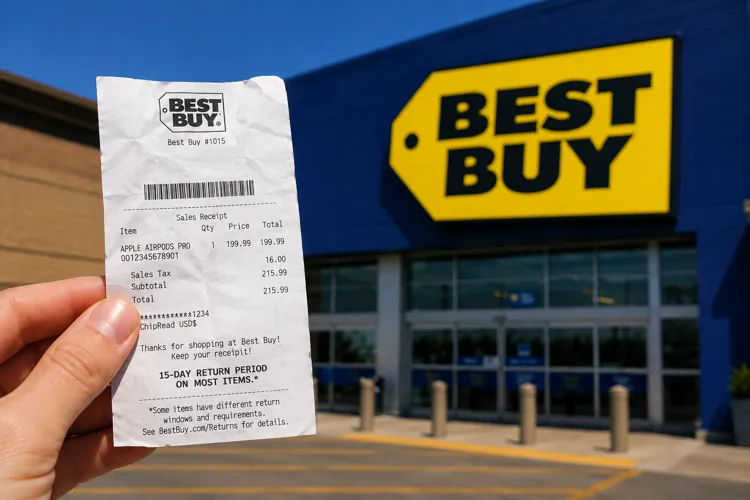

Best Buy gives a short 15-day return window on most items, but My Best Buy Plus and Total members get 60 days on eligible purchases.
If you open the box, that doesn't necessarily kill your return, but missing accessories can reduce your refund, and beware the 15% restocking fees on some items.
A few insider tricks can help you save, including checking for price drops post-purchase, inspecting open-box items before leaving, and asking for certain exceptions.
You bought a $1,200 laptop at Best Buy, opened it, used it for a week, and decided you hate it.
Can you return it? Probably.
Lost the box? Possibly still returnable.
Bought an open-box model? That's returnable too.
Waited 16 days? Now things get considerably more complicated.
Best Buy's return policy looks straightforward until you start looking into the exceptions. After digging through Best Buy's policy and experiences shared by current and former employees and shoppers on Reddit, I found quite a few things worth knowing before you walk up to the customer service counter.
Here's your cheat sheet.
1. The 15-day return window starts when you receive it
Yes, Best Buy only gives you 15 days to make a return on most items.
This is especially important information for online shoppers. Best Buy says the return period begins the day you receive the product (the delivery date), not necessarily the day you placed the order online.
The standard return window for most products is 15 days. But My Best Buy Plus members ($29.99/year) get 60 days to make a return.
There's one big exception: activate-able devices — including cell phones, cellular tablets, mobile hotspots, and cellular wearables — have a 14-day window for everyone. Verizon activate-able devices get 30 days.
Pro tip: Don't try to guess your deadline. Check your receipt or Best Buy account immediately after buying something expensive and put the return deadline in your phone.
2. The $29.99 membership can buy you 45 extra days
Here's where the math gets interesting.
My Best Buy Plus currently costs $29.99 per year and includes a 60-day return window on most products, compared with 15 days for a standard customer. My Best Buy Total also gets the 60-day window.
If you're buying a $1,500 laptop, TV, or other expensive piece of technology that you're unsure about, that extra 45 days could potentially be more valuable than the membership itself.
But don't assume you can wait until day 16 and then buy Plus to retroactively rescue your purchase. Recent discussions among purported Best Buy employees on Reddit indicate the extended window is supposed to be tied to membership status when the purchase is made. Some employees report managers occasionally making exceptions, but that's discretion, not something shoppers should count on.
Pro tip: If the extended return window matters, join before or when you make the purchase, not when you decide you don't like it.
3. Yes, you can usually open the box
A surprisingly common misconception is that opening electronics automatically makes them nonreturnable. For most Best Buy products, that's not true.
The official policy requires returned merchandise to be in "like-new condition." Items that are damaged, scratched, dented, unsanitary, or missing major contents can be refused.
So opening and trying a laptop, monitor, headphones, or TV doesn't automatically kill your return rights.
There are exceptions, however. Certain consumables and products that interact with bodily fluids become nonreturnable once opened, while opened physical software, movies, music, and video games purchased directly from Best Buy generally can only be exchanged for an identical item.
4. Don't panic if you threw away the box
Keep the box if you can. It makes everything easier.
But losing packaging doesn't necessarily mean you're stuck with the product.
Best Buy's policy asks customers to return the original packaging and accessories, but says that when something is missing it may deny the return or make a nonrefundable deduction from your refund.
In other words, returning something sans box doesn't automatically mean "no return," but you're giving the store another reason to complicate things.
Pro tip: For expensive electronics, put the box in the garage for at least as long as the return period. Don't recycle it the morning after you buy the product.
5. The charger may be more important than the box
If something came in the box, bring it back. That includes chargers, power adapters, remotes, cables, stands, and any other accessories.
Best Buy explicitly warns that missing accessories or packaging can result in the return being denied or your refund being reduced.
In other words, don't return a $1,000 laptop and discover at the counter that its charger is sitting underneath your desk.
Pro tip: When opening an expensive product, put every accessory you're not using back inside the original box. Then you don't have to hunt for it later.
6. Watch out for the restocking-fee categories
This is probably Best Buy's biggest return-policy landmine. Opened, activate-able devices generally carry a $45 restocking fee.
A much longer list — including drones, digital cameras, lenses, camcorders, action cameras, projectors, projector screens, and certain premium mobility and wellness products — can carry a whopping 15% restocking fee. Special-order products are also included.
What does this look like? If you return a $2,000 camera, that15% restocking fee comes out to $300.
But there's an important loophole, and it's worth noting. Best Buy says there's no restocking fee if the product is unopened. The fee also doesn't apply to purchases made in Alabama, Colorado, Hawaii, Iowa, Mississippi, Ohio, Oklahoma and South Carolina, as well as where prohibited by law.
So if you change your mind before opening an expensive camera or projector, don't break the seal just to look at it.
7. Laptops don't have the dreaded 15% restocking fee
This one comes up repeatedly among Best Buy shoppers. The company's current restocking-fee list does not include laptops.
That matches what purported Best Buy employees repeatedly tell shoppers on Reddit: laptops can generally be opened and returned during the applicable return window without a restocking charge, assuming they're returned in acceptable condition with their components.
That's useful if you're trying to decide between two laptops and won't really know whether the keyboard, screen, or battery life works for you until you've actually used one.
But don't treat Best Buy like a free electronics rental service. The product still needs to meet the company's return-condition requirements.
Pro tip: If Best Buy screwed up your online order, don't pay return shipping. If a return is necessary because of a Best Buy error, Best Buy is responsible for the return shipping. So, always check your refund carefully and make sure a shipping charge hasn't been deducted.
8. Open-box doesn't mean final sale
Here's another misconception worth killing: Open-box products generally get the same return window as new products.
Best Buy specifically says its return periods apply to new, clearance, open-box, refurbished, and pre-owned merchandise. That can make open-box purchases considerably less risky.
But Reddit reveals a different problem: inspect the item carefully.
Shoppers have reported supposedly excellent-condition open-box merchandise arriving with missing accessories, cosmetic damage, or other problems. One 2026 Reddit user reported buying an "excellent" open-box TV that was missing its remote and manual and repeatedly crashed.
Another shopper reported opening an "excellent" laptop box only to find paper inside instead of the computer.
Those are anecdotes, not evidence of a widespread problem, but they lead to a smart precaution.
Insider tip: If you're buying an expensive open-box item in-store, ask to inspect it before leaving the store. For a shipped high-dollar open-box purchase, consider documenting the condition as you open it.
9. Don't automatically return something because the price dropped
Suppose you buy a $900 TV and Best Buy puts it on sale for $799 eight days later. You may not need to return and rebuy it.
Best Buy says that if its own price drops during your applicable return-and-exchange period, it will match the lower price upon request. That's one of my favorite Best Buy tricks because it gives you a reason to keep checking the price after you've bought something.
It’s a smart idea to set yourself a reminder to check the price again a week after any expensive Best Buy purchase. A five-second search could potentially put $50 or $100 back in your pocket.
Pro tip: Returning a price-matched purchase? Do it in-store. A Best Buy manager told me that an item that received a competitor price match can indeed be refunded to the original payment method, but only when returned in-store. So, if you've received a price match, always make the return at a store rather than online.
10. A day or two late? Asking nicely may actually matter
Officially, when your return window ends, your return window ends. But here's where employee discretion enters the picture.
Best Buy employees on Reddit have repeatedly described situations in which managers may approve an out-of-policy return or exchange, particularly when the customer is only slightly late.
One employee put it rather plainly in a discussion about late returns: Sometimes a shopper's demeanor can influence whether an associate is willing to ask a supervisor for an exception.
That is not Best Buy policy, and a manager is completely within their rights to say no. But if you're on day 16 of a 15-day return period, it costs nothing to politely explain the situation.
Don't march in demanding an exception you're not entitled to. Politely ask for one.
11. Don't lose your receipt — but all may not be lost
Best Buy says returns without proof of purchase may be denied or limited. If accepted, reimbursement may be store credit, and certain taxes and fees may not be reimbursed.
So keep the receipt.
Better yet, attach purchases to your Best Buy account so the transaction is easier to retrieve.
For a faster in-store return, Best Buy recommends bringing your receipt or packing slip and the credit card used for the purchase. That little bit of preparation can save a lot of time standing at the counter.
12. Gifts have a return-policy trap worth knowing
Returning a gift in-store can be the smarter move.
If a Best Buy-purchased gift is returned in a store, Best Buy says the recipient receives store credit for the purchase price.
Mail it back, however, and Best Buy says it will credit the original purchaser and notify that person by email.
So if Aunt Linda bought you headphones and you'd rather quietly exchange them for something else, mailing them back could ruin the stealth operation.
Take the gift to the store.
One more big 2026 change: Watch for Marketplace sellers
Best Buy now has Marketplace products sold by third-party sellers on BestBuy.com.
Most Marketplace products generally follow Best Buy's standard return timeframe, but here's the catch: The 60-day return benefit for My Best Buy Plus and Total members doesn't apply to Marketplace purchases.
That makes checking the seller increasingly important before clicking Buy.
And if something purchased from a Marketplace seller arrives damaged or defective, Best Buy instructs shoppers to contact that seller through their Best Buy account.