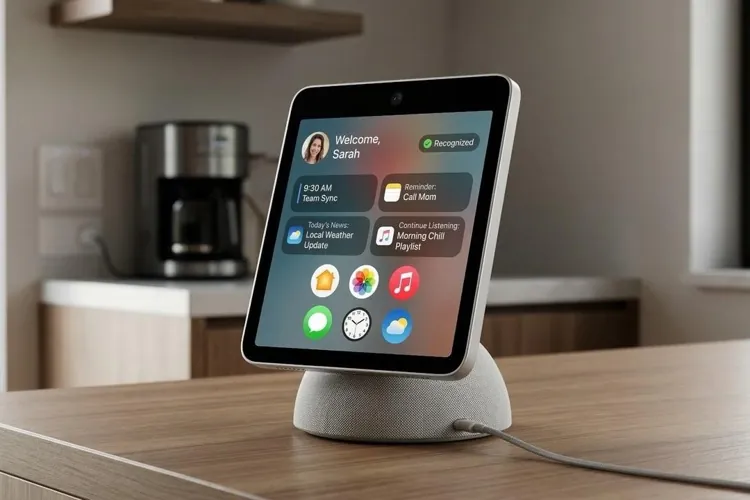

Apple unveiled HomeView, a new $299 smart home hub that uses artificial intelligence to control household devices, manage schedules and personalize information for family members.
The company also introduced a $149 HomePod mini 2 and a $299 Apple TV 4K, both designed to make greater use of Apple's upgraded Siri AI assistant.
A new lineup of smart locks, security cameras, doorbells and thermostats will give Apple a stronger position in the growing smart home market, challenging products from Amazon and Google.
Apple is making its most ambitious move yet into the connected home market, introducing a series of products designed to make artificial intelligence a central part of everyday household activities.
At its October 13 "Welcome Home" event in New York City, the company unveiled a new smart home display, an upgraded smart speaker, a more powerful streaming television device and a collection of home security and automation products.
The announcements represent a significant expansion beyond Apple's traditional emphasis on smartphones, computers and wearable devices. They also put the company into more direct competition with Amazon's Alexa and Ring products and Google's Nest ecosystem.
Smart home display
The centerpiece of the announcements is HomeView, Apple's first dedicated smart home display.
The device features a seven-inch screen and comes in two versions: a tabletop model that incorporates a speaker and a wall-mounted version designed to serve as a central control panel.
Both versions cost $299 and are now available.
HomeView allows household members to control connected lights, thermostats, locks and security cameras. It also supports FaceTime video calls, music, entertainment and household calendars.
One of its more distinctive features is facial recognition. Apple says the device can recognize as many as six household members and automatically display personalized information for each person.
With Apple's upgraded Siri AI assistant, users can make conversational requests and, when the device is paired with a compatible iPhone or iPad, access personal information from applications such as Messages, Calendar and Reminders.
For example, a family member could ask about an upcoming appointment or check who is at the front door without picking up a smartphone.
The company is emphasizing privacy as a selling point, although consumers will need to consider the implications of placing cameras and microphones in shared household spaces.
Two products get a new look
Apple also refreshed two existing products.
The HomePod mini 2, priced at $149, features a new S10 processor, improved audio capabilities and five color choices. It can play music, respond to voice commands and control compatible smart home equipment.
The speaker will go on sale October 30.
However, one of its biggest promised improvements will not be available immediately. Apple says the more advanced Siri AI capabilities will arrive through a future software update, with no specific release date announced.
The fourth-generation Apple TV 4K, meanwhile, will cost $299 and become available November 13.
Powered by Apple's A19 processor, the device is designed to provide faster navigation and improved graphics performance. It also includes microphones that allow users to speak to Siri without holding a remote.
Consumers will be able to ask conversational questions about television programs and movies, including requests for recommendations.
Help finding the remote
Apple has also improved the remote's location-tracking features, making it easier to find a misplaced controller.
For households interested in home theater audio, the new Apple TV can work with four compatible HomePod speakers to create a surround sound system.
Perhaps the most significant long-term announcement was Apple's introduction of the Home Collection, a group of connected household devices developed with LG Electronics and Schneider Electric.
The products include smart door locks, video doorbells, indoor and outdoor security cameras, thermostats and temperature sensors.
The first Home Collection products are scheduled to arrive in December, with additional availability extending into early 2027.
What it means for consumers
For consumers, Apple says its expanded product lineup offers the possibility of managing more household functions through a single system.
Instead of using separate applications for door locks, security cameras, thermostats and entertainment devices, homeowners could control much of their connected equipment through Siri or the HomeView display.
However, convenience comes at a price.
A household purchasing a HomeView, a HomePod mini 2, a new Apple TV and a $349 smart lock would spend nearly $1,100 before adding cameras, thermostats or other accessories.
There are also important compatibility questions.
Consumers considering the new products should check whether their existing smart home equipment will work with Apple's system. Support for the Matter smart home standard may make some devices easier to integrate, but not every feature will necessarily be available across different brands.
Buyers should also distinguish between AI features available immediately and those promised through future software updates.