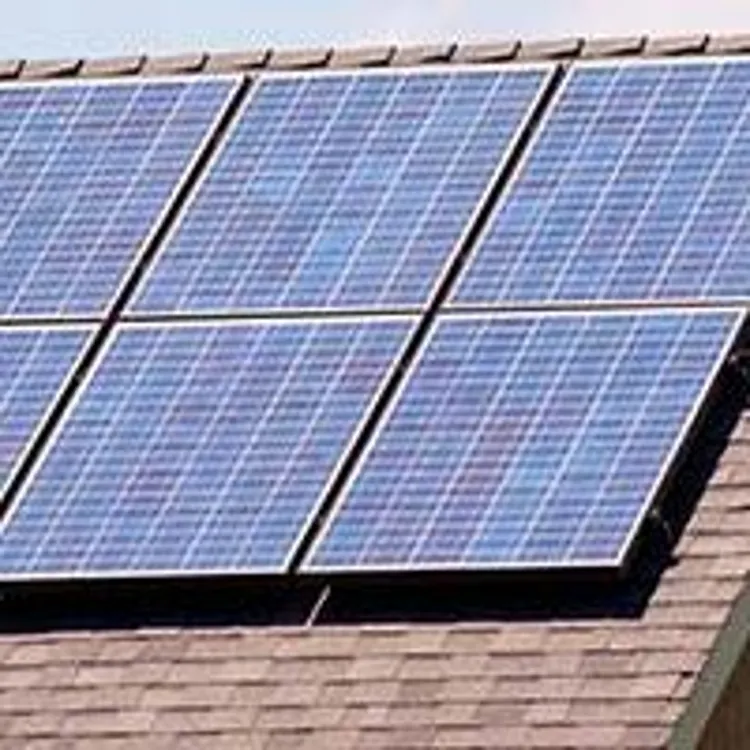


Residential solar panel incentives in California
Here are some of the top incentives available in California that can help lower the cost of installing solar. California solar incentives vary in savings, ranging from a $3-per-watt incentive to a 7.5% reduction in building and permit fees to rebates starting at $500.
No-cost rooftop solar installations for homeowners
Some lower-income homeowners in disadvantaged communities are eligible for no-cost rooftop solar installations in California. The Disadvantaged Communities - Single-family Solar Homes (DAC-SASH) program provides a $3-per-watt incentive on residential systems 1 kilowatt or larger for qualifying residents. It is scheduled to run through 2030.
To qualify, you must:
Own and live in a single-family home located in a designated disadvantaged community
Receive electric service from a participating utility company
Meet the income eligibility requirements for the California Alternate Rates for Energy (CARE) or Family Electric Rate Assistance (FERA) programs
You can apply online through GRID Alternatives after checking your eligibility.
Solar on Multifamily Affordable Housing (SOMAH)
The Solar on Multifamily Affordable Housing program helps property owners pay for solar energy systems on affordable apartment buildings. Qualifying properties must be deed-restricted, affordable housing with five or more rental units, and serve low-income or disadvantaged communities. This program helps reduce tenants’ utility bills and is available through 2032.
Property tax exclusion
Typically, an addition to your home increases the assessed value of your property, which in turn increases your property taxes. Thankfully, California’s property tax exclusion guarantees that your assessment — and tax bill — won’t go up because you added an active solar energy system to your home. This benefit is available for systems installed before January 1, 2027.
Local rebates
Many local power companies throughout California have solar rebates available:
Alameda Municipal Power offers a $500 rebate for customers who install solar and have households with an annual income under $106,000.
Rancho Mirage Energy Authority offers a rebate between $500 and $1,500 for customers who install solar battery systems.
Sacramento Municipal Utility District offers up to $10,000 in financial incentives per household for installing solar battery storage.
San Diego Community Power offers customers a rebate of $250 to $350 per kilowatt-hour of installed solar battery storage.
San Diego County has an expedited permitting process that incentivizes sustainable building practices. Projects that comply with resource conservation measures qualify for reduced building and permit fees by 7.5% and expedited plan checks.

Let’s run the numbers based on your location, current electric bill and home size.
Estimates use EIA electricity rates, ConsumerAffairs cost-per-watt (2026) plus a fixed base install cost, NREL PVWatts production factor and NREL Rooftop Solar Technical Potential (2016) roof-capacity assumptions. Systems are sized to offset up to 100% of your usage, limited by roof space; costs show a ±15% range and exclude incentives. Not a substitute for professional quotes.
Residential solar energy storage incentives
California’s Self-Generation Incentive Program (SGIP) offered rebates to help lower the cost of solar storage. This program also had additional equity and resiliency rebates for communities in high fire-threat areas, low-income communities and medically vulnerable people.
A solar storage battery typically costs $7,000 to $18,000.
However, most SGIP programs in California expired at the end of 2025. Some programs are operating on a limited basis or accepting wait-list applications.
Installing solar energy storage can still make financial sense. California has adopted a net billing model, where sending excess power to the grid earns less than the retail rate. This makes solar storage especially valuable because you can store power generated during the day and use it during higher-cost periods. Batteries can also offer backup power during outages.
| SGIP program | 2026 status |
|---|---|
| General Market | Closed to new applications |
| Equity | Closed to new applications |
| Equity Resiliency | Closed to new applications |
| Residential Solar and Storage Equity (RSSE) | Waitlist only |
California tax incentives: what’s real vs. rumored
California still offers tax incentives through property tax exclusion. Essentially, installing a solar energy system in your home will not cause your property taxes to increase.
With frequently changing incentives and programs, it can be hard to keep track of what solar tax incentives are available. Simply put, California does not offer an income tax credit for solar panels, and the federal solar investment tax credit expired at the end of 2025.
What to know about net billing in California
If you have solar panels in California, you can earn credits on your energy bill for the excess energy your panels generate. This process is called net billing. Essentially, you pay for the electricity you use from the grid (import charges) and earn back money for energy your panels send to the grid (export credits). This helps lower your monthly energy bill.
It’s important to note that with net billing, you pay full retail price for the energy you consume, but earn export credits at a lower price. There is also an annual “true-up” settlement period. If you exported more energy than you imported, you’ll be compensated at a lower rate through net surplus compensation.
Export credits aren't fixed rates
Under California's Solar Billing Plan, utility companies calculate export compensation using hourly values that vary by the season, time of day and grid conditions. Most daytime exports earn substantially less than the retail electricity rate, while some late-summer evening exports can be worth significantly more.
How to maximize value under net billing
Export credit values can also fluctuate based on demand. Exporting energy during peak hours earns a higher rate. To maximize your value, you can use a solar battery to store excess power and send it back to the grid during peak hours.
Some larger utility companies, including PG&E and SCE, also offer bonus credits to some customers for selling energy back to the grid. Your system’s connection date to the grid determines which incentive tier you’re eligible to receive. Smaller municipal utility companies also offer incentives, though their rates and rules vary.
Under NEM 3.0, homeowners earn export credits based on the grid's value of electricity rather than the retail electricity rate. Storing excess solar power in a battery and using it during the evening can significantly increase your savings.
Understanding utility territory for California solar incentives
The solar incentives you have access to in California largely depend on your utility provider.
Investor-owned utilities, such as PG&E, SCE and SDG&E, participate in state-administered incentive programs like net billing. They operate under statewide rules and regulations. On the other hand, municipal providers can set their own rates and payment structures.
Additionally, municipal providers such as Alameda Municipal Power and Sacramento Municipal Utility District offer solar rebates that aren’t available to customers of investor-owned utilities.
The type of utility company you have is typically determined by where you live. You can find your provider by checking your energy bill or your city’s website.
Business and nonprofit solar incentives
Many federal and state incentives for residential solar energy systems have recently been phased out. Thankfully, there are still several major solar incentives available to businesses and nonprofits that make going solar in California worth it. These include:
- The Federal Clean Electricity Investment Tax Credit: This credit covers up to 30% of commercial solar costs for projects started by July 4, 2026.
- Elective Pay for tax-exempt entities: Tax-exempt organizations, like nonprofits, can claim their solar tax credit as a cash payment from the IRS.
- The Modified Accelerated Cost Recovery System (MACRS): This system allows businesses that install solar panels to deduct the system’s cost in five years. Basically, this reduces the business’s taxable income and lowers its tax bill.
- Active Solar Energy System Property Tax Exclusion: Like residential solar, commercial solar projects will not increase the assessed value of a property. This prevents property tax increases.
How much are solar panels in California?
Solar panel costs in California typically range from $12,600 to $25,200, before considering any incentives. On the high end, Matthias in Westlake Village said they spent $52,000 on a system.
Average solar panel costs by system size in California
| 5 kW | 6 kW | 7 kW | 8 kW | 9 kW | 10 kW | |
|---|---|---|---|---|---|---|
| Statewide | $12,600 | $15,120 | $17,640 | $20,160 | $22,680 | $25,200 |
| Los Angeles | $12,500 | $15,000 | $17,500 | $20,000 | $22,500 | $25,000 |
| San Diego | $12,800 | $15,360 | $17,920 | $20,480 | $23,040 | $25,600 |
| Sacramento | $12,950 | $15,540 | $18,130 | $20,720 | $23,310 | $25,900 |
| San Francisco | $12,900 | $15,480 | $18,060 | $20,640 | $23,220 | $25,800 |
How can I pay for solar panels?
Paying upfront is the most obvious way to pay for solar panels, but many don’t have that kind of money saved up. If you’re one of those people, you can finance solar panels, lease or enter a PPA (power purchase agreement).
Solar loan terms are typically 8 to 20 years.
A solar loan works like any other type of home improvement loan — there’s an application and approval process, and you pay it back over time (with interest) each month. In an ideal financing scenario, your system generates enough extra power to offset your loan payment.
In California, property-assessed clean energy (PACE) financing lets you borrow money to pay for solar panels and then pay it back through your property tax bill over 15 to 25 years. It’s a way to make energy improvements without a high upfront cost, but it increases your tax bill until the loan is paid off.
Find solar companies in California
Read our guide to the top solar companies in California to compare more options.
| Company | Customer rating | Max panel efficiency | Warranty | Payment options | Year founded | |
|---|---|---|---|---|---|---|
 OC Solar | Learn More | 5.0 | 22.6% | 25 years | Cash, loan and lease | 2016 |
 Ameco Solar & Roofing | Learn More | 4.8 | 22.6% | 40 years | Cash, loan and lease | 1974 |
 Sunlux | Get Started | 4.7 | 19.7% | 25 years | Cash, loan and lease | 2015 |
 Soleeva | Learn More | 4.1 | Varies | 25 years | Cash, loan and lease | 2010 |
 LA Solar Group | Learn More | 3.4 | Varies | 25 years | Cash, loan and lease | 2010 |
FAQ
How much can I save with solar panels?
Over 25 years, California homeowners with solar panels avoid $120,735 in utility costs on average. Knowing your average energy consumption helps determine the size and capacity of the solar system you need. Once you know this, you can figure out potential savings and how long it should take for your solar installation to pay for itself.
Is my HOA allowed to restrict solar panels?
No, your HOA is not allowed to restrict solar panels. California law prohibits HOAs from restricting solar panels.
Do I have to pay sales tax on solar equipment?
California has a sales and use tax exemption for solar equipment, but it only applies to industrial and agricultural projects.
Is the federal solar tax credit still available in California in 2026?
No, the federal solar tax credit is not available in California in 2026. The federal solar ITC expired at the end of 2025.
How much can California solar incentives save me on installation?
California solar incentives can reduce your installation costs by several thousand dollars, depending on your income, utility provider and system size. The DAC-SASH program alone offers $3 per watt for qualifying low-income households, while the property tax exclusion prevents your assessment from increasing after installation.
Article sources
ConsumerAffairs writers primarily rely on government data, industry experts and original research from other reputable publications to inform their work. Specific sources for this article include:
- DSIRE, “California Programs.” Accessed Aug. 5, 2026.
- CPUC, “Solar in Disadvantaged Communities.” Accessed Aug. 5, 2026.
- CPUC, “Solar on Multifamily Affordable Housing (SOMAH).” Accessed Aug. 5, 2026.
- California State Board of Equalization, “Active Solar Energy System Exclusion.” Accessed Aug. 5, 2026.
- San Diego County, “The Green Building Program.” Accessed Aug. 5, 2026.
- CPUC, “Participating in Self-Generation Incentive Program (SGIP).” Accessed Aug. 5, 2026.