

Many big-box retailers like Home Depot and Best Buy offer online-only deals that aren’t shown in-store, making it easy to overpay if you don’t check.
Big-ticket items are often priced lower online or stored in warehouses, meaning the best deals aren’t always on the sales floor and employees don’t even know about them.
Smart shoppers check the app/online before buying, compare prices in-store, and use online pricing for pickup or price matching.
For years, shoppers were trained to trust what they saw on the shelf.
If a refrigerator was labeled $1,299 in-store, that was the price. If a TV had a tag, that was the deal.
But that’s no longer how retail works.
Today, many of the best deals are happening inside store apps and online listings. And if you’re not checking before you shop, you could be paying significantly more than you need to.
The real-world example most shoppers miss
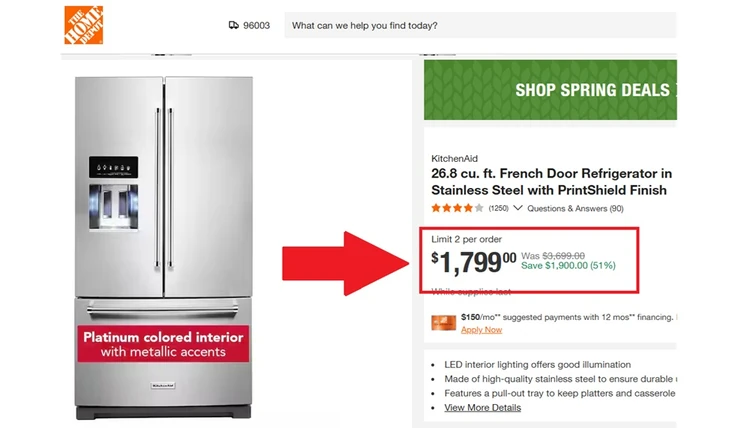
Let’s start with something simple, and expensive: major appliances.
I was recently talking with my mom about how she needed to buy a new refrigerator for a rental house. She told me, “Did you know the Home Depot website has deals on refrigerators that you can’t find if you walk into the store?” Being the bargain hunter that I am, I was immediately intrigued.
She explained that she had gone into the Home Depot and didn’t notice any good deals on refrigerators. Later, on a whim, she decided to check the Home Depot website and found a 26.8 KitchenAid French Door fridge for just $1,799, regularly $3,699. As you can see by the screenshot above, that’s a whopping 51% off.
So she wrote down the model number and headed back to the Home Depot, thinking the deal might be too good to be true and they probably wouldn’t have it available.
An employee put the model number into the computer and said, “Yep, we have a couple available at that price in our warehouse, where do you want it delivered?”
If she hadn’t done the extra research online, she never would have known the deal existed. There are often no signs in-store pointing out deals like this. No obvious indication that a better deal exists beyond what sits on the sales floor.
And when you’re talking about big-ticket items like refrigerators, TVs, dishwashers, or ovens, the savings can easily reach into the thousands, like it did for my mom.
This isn’t just a Home Depot thing
This pricing gap is happening across multiple major retailers and big-box stores, and in many different product categories as well.
At Lowe’s, similar situations pop up regularly. Tools, outdoor equipment, and appliances may carry in-store pricing that doesn’t reflect online promotions, bundle discounts, or limited-time app deals.
For example:
- A power tool set might be listed at full price on the shelf, while another similar set might be cheaper but only found on their website.
- The app may include a bundled accessory or discount that you can’t find in-store.
At Best Buy, the gap can be even more dynamic.
Electronics pricing changes fast, and Best Buy frequently runs:
- App-exclusive deals
- Flash sales
- Member pricing
- Online-only discounts
A TV you see in-store might look like a solid deal, but checking the app could reveal:
- A lower online price
- A bundle with accessories
- Or a limited-time discount not shown in-store
Other stores where this often works include Target, Sam’s Club, IKEA, Walmart, and even Costco.
The takeaway is that what you see in-store, versus what’s on the app/website, is not always in sync — and it turns out they’re not meant to be.
Why many retailers are doing this
Many retailers are intentionally moving deals into their digital platforms for a few key reasons:
1. They want you using their app
Apps allow retailers to:
- Send notifications
- Track your shopping behavior
- Promote personalized deals
And they know that once you download the app and start using it, you’re much more likely to return to the store.
2. They can change pricing faster
Updating in-store price tags takes up a lot of time and labor. While updating pricing on a website, or app, can be done in seconds.
That means retailers can:
- Run short-term promotions
- Adjust prices based on inventory
- Test different pricing strategies
3. They can target specific shoppers
Not every deal is meant for everyone.
Some discounts are:
- Location-based
- Time-sensitive
- Or tied to digital engagement
4. It reduces reliance on in-store staff
Instead of training employees to explain every deal, retailers let the app do the work.
That puts the responsibility on you, the shopper, to seek out the deals online before you head to the actual store.
Why most people never notice
Even though these deals are widely available, most shoppers completely miss them.
That comes down to habit, as most people:
- Walk into a store with a general idea of what they want
- Look at the price tag
- Make a decision based on what’s in front of them
Many shoppers rarely:
- Open the store’s app
- Cross-check pricing
- Compare online listings
They are also assuming that: “If it were cheaper, they’d tell me.”
But that’s no longer how retail works, especially at many big-box stores where not all inventory is on the sales floor, but in a regional warehouse somewhere.
In fact, the system now rewards shoppers who take an extra step to look online and quietly penalizes those who don’t.
What smart shoppers do differently
The difference between paying full price and getting the best deal often comes down to a simple habit shift.
Here’s how experienced shoppers approach it:
1. They check the app before leaving home.
Before heading to stores like Home Depot, Lowe’s, or Best Buy, they search the item they plan to buy.
Specifically, they’re looking for:
- Lower online pricing
- Active promotions and deals that don’t exist in-store
- Bundle offers
This takes less than a minute in most case, but it sets a baseline. Now they know what the item should cost.
2. They use the app inside the store.
Once they’re in-store, they don’t rely solely on shelf price tags.
Instead, they:
- Scan barcodes
- Search product names
- Compare listings in real time
This often reveals:
- Hidden discounts
- Pricing discrepancies
- Availability at nearby locations
3. They look for “online only” deals.
This is where some of the biggest savings are hidden.
Many retailers label deals as:
- “Online only”
- “App exclusive”
But here’s the trick most people miss: You can usually buy the item in the app and choose in-store pickup — while standing in the store.
Same product. Lower price. No extra effort.
4. They ask for price matches.
If they find a lower price in the store’s app, they don’t simply ignore it.
Instead, they:
- Show the lower price at checkout.
- Ask if it can be matched on the spot.
In many cases, retailers will absolutely honor their own online pricing.